
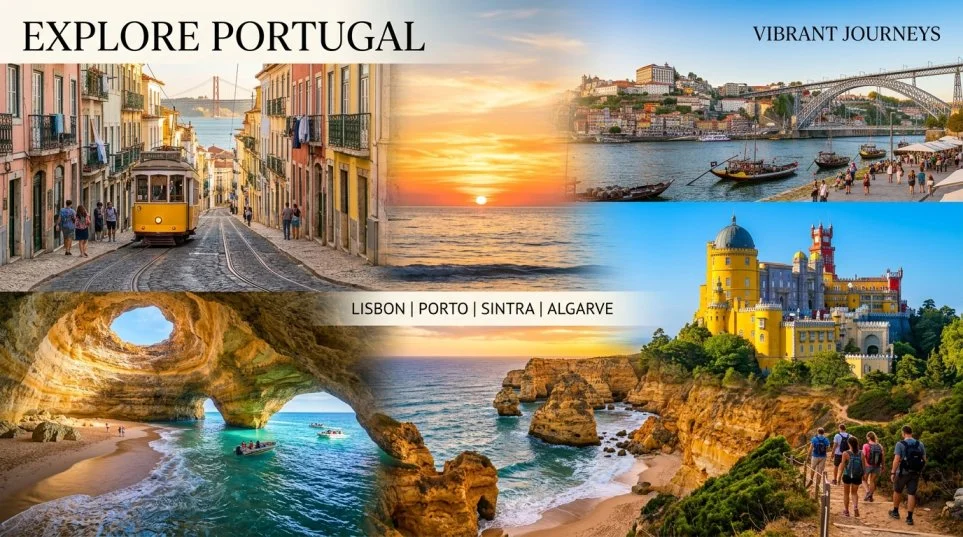
There is a particular kind of late afternoon light you only find in Portugal. It hits the whitewashed walls of Lisbon at a low angle and turns everything — the old trams, the terracotta rooftops, the Tagus River below — into something that looks almost too beautiful to be real. I found myself standing on the Miradouro da Graça on my first evening in the city, thinking: I had no idea it was going to be like this.
If you are planning your first trip to Portugal and trying to figure out where to go, how long to stay, and what you might be missing — this guide is for you. Portugal is small enough to cover a surprising amount of ground in one trip, but deep enough that every place you visit rewards serious time. The country packs Atlantic coastlines, medieval hill villages, wine valleys, volcanic islands, and two of Europe’s most liveable cities into a space smaller than the UK.
Below, I have mapped out the 15 best places to visit in Portugal — from the famous to the genuinely overlooked. I have also included a practical Portugal itinerary, honest Portugal travel tips, and answers to the most common questions first-time visitors ask. Let’s go.
Northern Portugal: Cities With Stories in Every Stone

1. Porto — The City That Earns Its Reputation
Porto is one of those cities travel writers have been raving about for a decade, and it still somehow exceeds expectations when you actually arrive. Built on a series of steep hills above the Douro River, the city has a raw, lived-in energy that feels nothing like the polished tourist destinations further south. Laundry dries between washing lines over cobblestone lanes. Locals argue over football in café doorways. The smell of fresh bread and roasting coffee spills out of bakeries that have been open since before your grandparents were born.
The Ribeira district — the old riverside quarter, a UNESCO World Heritage Site — is the natural starting point for any Porto travel guide. From there, walk across the upper deck of the Luís I Bridge into Vila Nova de Gaia, the riverside suburb where all the famous port wine lodges are located. Taylor’s, Graham’s, and Sandeman all offer cellar tours followed by tastings that are, frankly, worth the trip to Portugal on their own.
Top Lisbon tourist attractions aside, Porto competes seriously for the crown of Portugal’s most rewarding city. Don’t rush it.
Do not miss:
- São Bento Station — the interior is tiled with 20,000 hand-painted azulejo panels depicting Portuguese history
- Livraria Lello — a 1906 Art Nouveau bookshop with a famous central staircase
- Bonfim and Cedofeita neighbourhoods — street art, independent coffee shops, boutique vintage stores
- A port wine tasting at sunset in Vila Nova de Gaia
2. Guimarães — Birthplace of a Nation

An hour’s drive east of Porto, Guimarães is where Portugal began — literally. This is the birthplace of Afonso Henriques, the first King of Portugal, and the city where the nation was declared independent in 1143. Its medieval centre is UNESCO-listed and extraordinarily well preserved, which makes it feel less like a tourist attraction and more like an accidental time capsule.
Walk the short route between the hilltop castle, the Palace of the Dukes of Braganza, and the lively medieval square of Largo da Oliveira. Drink something local at one of the square’s outdoor cafés and watch the pigeons and the tourists do their separate, overlapping dances. This is one of those historic places in Portugal that genuinely earns the adjective.
3. Braga — Sacred Architecture and a Young Soul
Portugal’s third-largest city has the highest concentration of churches and religious monuments in the country — and yet Braga’s large university gives it an energy that feels anything but dusty. The old town is elegant and walkable, with grand baroque facades lining pedestrian shopping streets.
The unmissable experience here is Bom Jesus do Monte, a baroque pilgrimage sanctuary perched on a forested hill above the city. The monumental stairway zigzagging up through cypress trees is one of the most theatrically dramatic structures in all of Portugal. Walk up, take the funicular down — or do both on foot if your knees allow.
Lisbon and Central Portugal: The Heart of the Country

4. Lisbon — Europe’s Most Underrated Capital (For Now)
Lisbon tourist attractions draw millions of visitors a year, and yet the city somehow maintains an authenticity and sense of neighbourhood life that places like Barcelona and Amsterdam lost years ago. Perhaps it is the scale — this is a genuinely walkable capital, built on seven hills, where each neighbourhood has its own distinct personality and pace.
Belém is where most first-timers start, and with good reason: the Mosteiro dos Jerónimos is one of the most extraordinary buildings in Europe — a 16th-century monastery in the flamboyant Manueline style, dripping with maritime carvings that reference Portugal’s age of exploration. The nearby Torre de Belém, standing at the edge of the Tagus, is the iconic image on every Portugal vacation destinations mood board. Both can be done in a morning.
But the Lisbon that stays with you is found in the Alfama — the old Moorish quarter that tumbles down from the São Jorge Castle to the waterfront. Here the streets are barely wide enough for two people walking side by side. Every alleyway leads to a viewpoint, a tiled staircase, or the sound of fado drifting from somewhere just out of sight. On Friday and Saturday evenings, the neighbourhood fills with the most haunting music you will hear anywhere in Europe.
Lisbon also rewards wandering beyond the obvious. The Mouraria neighbourhood, directly below the castle, is one of the most culturally layered places in the city — it was the Moorish quarter under Islamic rule and later the birthplace of fado. The LX Factory complex, a converted 19th-century industrial campus open on Sundays, hosts Lisbon’s most interesting market, with independent bookshops, food stalls, vintage clothing, and live music running simultaneously.
5. Sintra — Where Fairy Tales Become Architecture

Forty minutes on a direct train from Lisbon’s Rossio station and you arrive in a landscape that seems to belong to a different country entirely. Sintra’s granite hills are swathed in ancient forest, and scattered through those trees are some of the most outlandish palaces in Europe.
The Palácio da Pena is the undisputed showpiece — a 19th-century Romantic fantasy in yellow and pink that sits above the clouds on particularly misty mornings. The ruined Moorish Castle nearby dates to the 8th century and offers the best views across the Sintra hills. And the Quinta da Regaleira, with its underground initiation wells and neo-Gothic chapel buried in the trees, is the kind of place that demands at least two hours and an open mind.
One piece of practical advice: Sintra on a summer weekend is enormously crowded. Visiting midweek in spring or autumn is not just more comfortable — it is an entirely different experience. The paths are quiet, the light is better, and the palaces feel like genuine discoveries rather than items on a checklist.
6. Évora — The Ancient Capital of the Alentejo
Drive two hours east of Lisbon and you emerge from the rolling cork oak forests of the Alentejo onto a hilltop where one of Europe’s most remarkably preserved Roman and medieval cities sits inside intact walls. Évora is a UNESCO World Heritage Site that wears the designation lightly — it remains a functioning town of 50,000 people, not a preserved museum piece.
The Roman Temple of Évora, built in the 1st century AD and still standing in the city centre, is one of the finest examples of Roman architecture on the Iberian Peninsula. A ten-minute walk brings you to the Cathedral, the largest medieval cathedral in Portugal, and then to the street that houses the Igreja de São Francisco — which contains the unforgettable Capelo dos Ossos, the Chapel of Bones, decorated entirely with the bones and skulls of approximately 5,000 monks. The inscription above the entrance reads: We bones that are here await yours. This is not a place you forget easily.
7. Óbidos — A Medieval Walled Town, Unspoiled
Roughly an hour north of Lisbon, Óbidos is one of those places that makes you briefly consider abandoning your itinerary and staying indefinitely. The entire town is enclosed within medieval walls, and inside them, the streets are lined with whitewashed houses draped in bougainvillea, geraniums, and jasmine. It is astonishingly pretty.
Drink ginja — the local cherry liqueur — served in a small chocolate cup at one of the kiosks near the main gate. Walk the full circuit of the walls for views across the patchwork countryside below. Then do something many day-trippers miss: stay until evening. Once the buses leave and the town empties, Óbidos becomes one of the most peaceful and atmospheric places in all of Portugal.
The Algarve: Sun, Cliffs, and the Best Beaches in Europe

Ask anyone who has visited about Algarve beaches Portugal and they will describe the same thing: towering ochre limestone cliffs carved into arches, sea stacks, and sea caves by millennia of Atlantic battering, with sand as fine and pale as anything in the Caribbean. The Algarve is the reason Portugal became a popular holiday destination in the first place, and it still delivers spectacularly.
8. Lagos — The Town That Launched a Thousand Return Trips
Lagos sits at the western end of the Algarve and is, in the opinion of most people who have covered this coast seriously, the best base for exploring it. The town itself has an intact medieval centre enclosed by Moorish walls, a working fishing harbour, and a concentration of genuinely good restaurants that would be impressive in a much larger city.
The beaches immediately surrounding Lagos are extraordinary. Praia Dona Ana, reached by a steep wooden staircase descending through the cliffs, is a small, sheltered cove framed by golden limestone pillars. Praia do Camilo is similarly jaw-dropping. And the clifftop walk from the town to Ponta da Piedade — where the rocks have been carved by the sea into a labyrinth of arches, grottos, and sea stacks — is one of the finest coastal walks in Europe.
*Do this: Hire a sea kayak in the morning and paddle through the arch caves at Ponta da Piedade. Guides take you through passages you cannot access from above, and the light inside the grottos at low tide is extraordinary. Book early — spaces fill by 9am in summer.
9. Tavira — The Eastern Algarve’s Best Kept Secret

While most visitors focus on the western Algarve between Lagos and Albufeira, the eastern stretch near the Spanish border is quieter, more authentic, and arguably more beautiful. Tavira is its undisputed gem — a small, elegant town of churches, Roman bridges, and terracotta rooftops built beside the Gilão River.
The beaches at Tavira are among the best in Portugal. They sit on the Ilha de Tavira, a barrier island reached by a short ferry, and are protected as part of the Ria Formosa Natural Park. Wide, uncrowded, backed by dunes rather than cliff-face developments, they feel like a different Algarve entirely from the crowded resorts to the west.
Tavira is one of those hidden gems in Portugal that the travel industry keeps threatening to discover at scale. Visit now, while it remains what it is.
10. Sagres — The End of the World, Literally
Drive to the far southwestern corner of the Algarve and you arrive at Cabo de São Vicente — the southwestern-most point of mainland Europe. The lighthouse at the tip of the headland marks the spot where the continent finally gives up and surrenders to the Atlantic. The cliffs here drop 75 metres to the sea below, and the wind is relentless and exhilarating.
The nearby town of Sagres is small, unhurried, and very popular with surfers who come for the consistent Atlantic swells at Praia do Tonel and Praia do Beliche. The Fortaleza de Sagres — a clifftop fortress from which Henry the Navigator is said to have planned the Portuguese voyages of discovery — is one of the most atmospherically positioned historic places in Portugal. Stand on its walls in the late afternoon and it is genuinely impossible not to feel the weight of everything that was launched from here five centuries ago.
Islands, Interior, and the Places Most Visitors Miss

11. Azores (São Miguel) — Portugal’s Volcanic Surprise
The Azores archipelago sits in the middle of the Atlantic Ocean, 1,500 kilometres west of Lisbon, and São Miguel is the largest and most spectacular of its nine islands. This is a place of extraordinary natural drama: twin volcanic crater lakes whose colours shift from emerald to deep blue depending on the weather and the light; hot springs that bubble up through the earth in the village of Furnas, where residents still cook slow-cooked stew (cozido das Furnas) underground using geothermal heat; and whale watching opportunities that are among the best in the world.
If your Portugal itinerary allows for ten days or more, adding three or four nights in the Azores is, by any measure, the best possible addition. Flights from Lisbon to Ponta Delgada take under two hours. Nothing else on this list will look quite like São Miguel.
12. Madeira — The Island Europe Forgot to Tell You About
Madeira is another autonomous Portuguese island that deserves a dedicated visit rather than a footnote. The island’s laurel forest — a UNESCO-listed ancient ecosystem that predates the Ice Age — covers much of the mountainous interior and is best explored on foot via the famous levadas: a network of ancient irrigation channels cut into the hillsides, now used as walking trails that traverse tunnels, vertical cliff faces, and dense forest with extraordinary views at every turn.
Funchal, the island’s capital, has one of the finest covered markets in the Portuguese world (Mercado dos Lavradores), excellent local wine bars serving the island’s distinctive Madeira wine, and a cable car that climbs above the city to the hilltop village of Monte. Madeira is a Portugal holiday destination that regularly converts first-time visitors into people who return every year for the rest of their lives.
13. Douro Valley — The World’s Most Beautiful Wine Landscape

The Douro Valley is the world’s oldest demarcated wine region, established in 1756. Drive or take the scenic train east from Porto and the landscape transforms gradually and then suddenly into something astonishing — steep hillsides terraced with centuries-old vines, dropping to the silver ribbon of the Douro far below. In September, during harvest, the whole valley smells of fermenting grapes.
The best way to experience the Douro is slowly. Book a night or two at a quinta (wine estate) with river views. Take a traditional rabelo boat along the river at sunrise. Eat long lunches of roasted kid and dried cod dishes at quinta restaurants. Drink the local table wine, not just the port. This is Portugal sightseeing spots at its most timeless and most rewarding.
14. Monsaraz — A Dark Sky Village Above a Hidden Lake
In the southern Alentejo, on a granite ridge above the vast Alqueva reservoir — Europe’s largest artificial lake — sits Monsaraz, one of the most dramatically positioned villages in Portugal. The medieval walls enclose a settlement of just a few streets, whitewashed houses, a castle, a church, and maybe 150 permanent residents. It is almost absurdly picturesque.
But the reason to come at night is extraordinary. The Alqueva Dark Sky Reserve is one of the first officially certified stargazing destinations in the world. On a clear night, standing inside the castle walls of Monsaraz, the Milky Way is so bright and dense overhead that it casts a faint shadow. If you have ever wanted to see the sky the way your great-grandparents saw it before electricity, this is your chance.
15. Cascais and the Estoril Coast — Lisbon’s Perfect Escape
Forty minutes west of Lisbon by direct train, Cascais is the kind of small coastal town that makes you understand immediately why the Portuguese royal family used to summer here. The old fishing quarter still operates as it always has, with morning catches landed at the dockside and sold at a small outdoor market. The bay is ringed with beaches. The pedestrianised old town has excellent restaurants, independent shops, and a relaxed rhythm that contrasts beautifully with Lisbon’s urban bustle.
The surrounding coastline is outstanding. The Boca do Inferno (Mouth of Hell) is a dramatic sea cave carved into the cliffs ten minutes’ walk from town. The Guincho beach, five kilometres north, is a wild, wind-blasted Atlantic beach backed by dunes, popular with windsurfers and anyone who wants to feel genuinely remote while being 45 minutes from a capital city.
Suggested Portugal Itinerary: 10 Days for First-Time Visitors

Here is a practical starting framework. Adjust according to your interests — if you are more drawn to history than beaches, swap Algarve days for more Alentejo time; if surf and coast are your priority, anchor more nights in the Algarve.
- Days 1–3: Lisbon — Belém, Alfama, Mouraria, Miradouros, LX Factory Sunday market
- Day 4: Sintra day trip from Lisbon (or Évora if you prefer history to palaces)
- Days 5–6: Porto — Ribeira, Gaia wine lodges, São Bento, Cedofeita
- Day 7: Douro Valley day trip from Porto (or overnight at a quinta)
- Days 8–9: Algarve — fly or drive to Lagos, day trip to Sagres
- Day 10: Cascais coastal morning, evening flight from Lisbon
Portugal Travel Tips That Will Actually Save You Time
- Book the Jerónimos Monastery and Pena Palace online in advance — not because tickets sell out (they usually do not) but because the skip-the-queue benefit in July and August is genuinely significant.
- Learn four words of Portuguese: obrigado/obrigada (thank you, m/f), por favor (please), com licença (excuse me). The effort is noticed and appreciated everywhere outside Lisbon and Porto.
- Order the prato do dia at lunch. The midday set lunch — typically a main course, side dish, bread, and drink for €9–€13 — is almost always better food than the dinner menu, cooked fresh that morning.
- Hire a car for the Alentejo, Douro Valley, and inland Algarve. The train network connects the main cities brilliantly, but rural Portugal is inaccessible without wheels.
- Go to a proper fado house in Lisbon, not a tourist restaurant with a fado show. Tasca do Chico in Bica and A Baiuca in Alfama are small, authentic, and require bookings weeks in advance — worth every effort.
- The Viva Viagem card works across Lisbon’s metro, trams, and buses — load it with credit rather than buying individual tickets and save time and money simultaneously.
Frequently Asked Questions About Places to Visit in Portugal
Q. What are the best places to visit in Portugal for first-time visitors?
The essential starting trio is Lisbon, Porto, and the Algarve. These three cover the country’s greatest city culture, its most famous wine history, and its most spectacular coastline. Add a day trip from Lisbon to Sintra and from Porto to the Douro Valley, and you have a first visit that genuinely does Portugal justice. Évora is worth adding for anyone with a day to spare and an interest in ancient history.
Q. How many days do you need to see Portugal properly?
Seven to ten days covers the highlights comfortably without rushing. Two weeks allows you to add the Alentejo, slow down in the Douro Valley, and potentially include a short Azores or Madeira extension. If you only have five days, choose between the north (Porto and surroundings) or the south (Lisbon and Algarve) and do one region well rather than both quickly.
Q. When is the best time to visit Portugal?
Spring (March to May) and early autumn (September to October) are the optimal times: warm and sunny without the July and August heat and crowds. Summer is the most expensive and most congested period, particularly in the Algarve, though the weather is reliably excellent. Lisbon and Porto are pleasant year-round, and even winter brings mild temperatures and far smaller queues at the main attractions. The Algarve in November and December is a genuinely underrated destination for warm-weather Europeans escaping northern cold.
Q. Is Portugal expensive to visit?
Portugal remains one of Western Europe’s most affordable destinations. A good mid-range hotel in Lisbon or Porto costs €90–€150 per night; a set lunch with wine at a local tasca runs €12–€18 per person. Taxis and Ubers are inexpensive by European standards. The Algarve is pricier in high season, particularly for accommodation, but food and activities remain reasonable. Budget travellers can eat and sleep well throughout the country — far more easily than in Spain, France, or Italy at comparable quality.
Q. What are the hidden gems in Portugal worth adding to an itinerary?
Tavira in the eastern Algarve, Monsaraz in the southern Alentejo, Óbidos in Estremadura, and Guimarães in the north are all genuinely spectacular and significantly less visited than the headline destinations. For those drawn to wild nature, the Peneda-Gerês National Park in northern Portugal — Portugal’s only national park, a landscape of ancient granite, waterfalls, and roaming horses — remains almost entirely off the mainstream tourist circuit and is extraordinary.
Why Portugal Stays With You
Most countries have a list of places to visit. Portugal has something rarer: a mood. There is a quality to the light here, and a particular temperament to the people, and a music that emerges from the very architecture of the old cities, that somehow gets under your skin in a way that most destinations do not.
The 15 places to visit in Portugal covered in this guide are not simply ticked boxes on a tourist trail. Each one has its own specific reason to be there — the fado of Alfama, the port wine of Gaia, the cliffs at Ponta da Piedade, the silent bones of Évora, the volcanic lakes of São Miguel. Taken together, they form a picture of a country that has been around long enough to know exactly what it is, and is completely unbothered about proving it to you.
Use this Portugal travel guide as your starting structure. Then let the country do the rest.
Ready to Book Your Portugal Trip?
Save this guide, build your Portugal itinerary from the framework above, and start with one honest question: do you want to begin in Lisbon or Porto? Everything else will follow naturally from that choice. Both cities will earn your trust within the first evening. Both will give you reasons to come back.
Bom viagem — good travels.

