
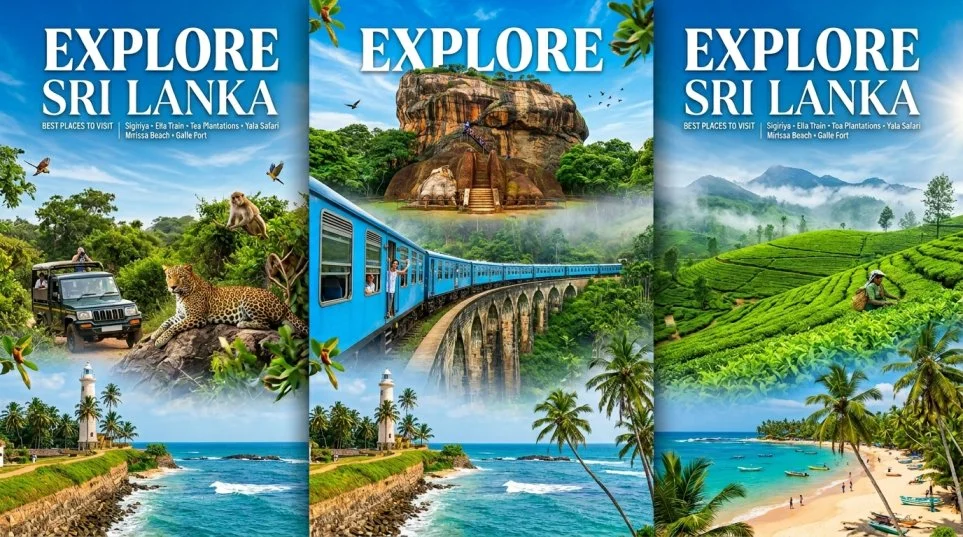
The Island That Surprised Me
I’ll be honest — I almost skipped Sri Lanka.
I had Southeast Asia on the mind, budget spreadsheets on the screen, and a travel agent friend telling me Sri Lanka was “too small to bother with.” I ignored that advice, booked a three-week trip on a whim, and came home having witnessed everything from wild elephants crossing ancient reservoir roads to the kind of sunrise over a mist-wrapped tea plantation that genuinely makes you stop talking mid-sentence.
Sri Lanka — the teardrop-shaped island dangling off the southern tip of India — is not too small. It’s just perfectly concentrated. Within a single day’s drive, you can move from a UNESCO-listed ancient city to a coral-fringed beach to a cool highland town where you’ll need a jacket in August. Not many countries in the world offer that.
This guide covers the 15 best places to visit in Sri Lanka, organized so you can plan a logical travel itinerary whether you have 10 days or a full month. Along the way, I’ll share what makes each destination genuinely worth your time, who it suits best, and a few things most travel blogs won’t tell you.
| Quick Answer: The best places to visit in Sri Lanka include Sigiriya, Kandy, Galle, Mirissa, Ella, Yala National Park, Polonnaruwa, and the cultural triangle — each offering a unique mix of history, nature, and authentic local experience. |
1. The Cultural Triangle: Sri Lanka’s Ancient Soul

If you’re a first-time visitor to Sri Lanka, the Cultural Triangle should anchor your itinerary. This inland region, roughly forming a triangle between Kandy, Anuradhapura, and Trincomalee, contains some of the most extraordinary ancient ruins in all of Asia — and most travellers zip past them too quickly.
| 01. Sigiriya — The Lion Rock Fortress Rising 200 metres above the surrounding jungle, Sigiriya is the kind of place you expect to see in a fantasy novel. Built in the 5th century by King Kasyapa, this massive rock fortress was his palatial escape — and his paranoid masterpiece. The famous frescoes of celestial maidens painted into a sheltered alcove about halfway up are remarkably well-preserved, full of colour and personality after 1,500 years. The climb is worth every step of the slightly vertiginous upper section. Best for: History lovers, photographer. Best time: Dec–Apr (dry season). |
| 02. Polonnaruwa — The Forgotten Medieval Capital Polonnaruwa doesn’t get the attention it deserves. As Sri Lanka’s second ancient capital (flourishing between the 11th and 13th centuries), it contains a compact but superb collection of ruins: a royal palace, a circular relic house, enormous Buddha statues carved into living rock at the Gal Vihara, and a perfectly proportioned lotus pond that still floods in the monsoon. Rent a bicycle at the entrance — the whole site is best explored slowly on two wheels. Best for: Archaeology, cycling, peaceful ruins. Best time: May–Sep, Nov–Feb. |
| 03. Anuradhapura — Sacred City of Ancient Kings Sri Lanka’s oldest recorded kingdom, Anuradhapura, has been a place of Buddhist pilgrimage for over two thousand years. The Sri Maha Bodhi — a sacred fig tree grown from a cutting of the original Bodhi Tree under which the Buddha attained enlightenment — is said to be the oldest documented tree in human history, planted in 288 BC. Standing near it as pilgrims in white lay offerings of lotus flowers is a quietly moving experience. The dagobas (domed white shrines) here are some of the tallest ancient structures in the world. Best for: Pilgrimage, ancient architecture. Best time: Year-round. |
2. The Central Highlands: Tea, Trains, and Cool Air

The central hill country of Sri Lanka is a world apart from the coast. The air smells of eucalyptus and rain; the hillsides are carpeted in emerald-green tea bushes; and the train ride through it all is one of the most celebrated rail journeys in Asia. This is the Sri Lanka that tends to appear on Instagram — and the reality is even better.
| 04. Ella — The Backpacker’s Beloved Hill Town Ella is a small, easygoing town perched at around 1,000 metres elevation, surrounded by waterfalls, hiking trails, and tea estates. The famous Nine Arches Bridge — a British-era stone viaduct that appears to float above the jungle when a colonial-era train trundles across it — is just a 20-minute walk from town. Sunrise hike up Little Adam’s Peak is a must. The town itself has excellent cafés, decent restaurants, and the kind of slow-travel energy that makes people extend their stays by several days. Best for: Hiking, nature photography, slow travel. Best time: Jan–Mar, Jul–Sep. |
| 05. Nuwara Eliya — The ‘Little England’ of Sri Lanka Called ‘Little England’ by the British who built it as a colonial hill retreat, Nuwara Eliya sits at 1,868 metres above sea level and gets genuinely cold at night — enough that you’ll want that second blanket. The surrounding landscape is all manicured tea estates, mist, and pink-and-white colonial bungalows. Visit a working tea factory (Pedro Tea Estate is excellent) to see the full process from leaf to cup, then stay for afternoon tea on the estate veranda. Gregorys Lake and Horton Plains National Park (home of the dramatic ‘World’s End’ escarpment) are nearby. Best for: Tea tourism, cool weather, colonial architecture. Best time: Jan–Apr. |
| 06. Kandy — Heart of Sinhalese Culture Kandy is the cultural capital of Sri Lanka and the last royal capital of the Kandyan kings. The famous Temple of the Sacred Tooth Relic — which houses a tooth of the Buddha himself and was for centuries the source of political legitimacy in Sri Lanka — draws thousands of pilgrims and visitors daily. The Perahera festival held every August is arguably the most spectacular cultural procession in South Asia, featuring elaborately decorated elephants and traditional Kandyan dancers. Don’t miss the Royal Botanical Gardens at Peradeniya, just outside town, which is one of the finest tropical gardens in Asia. Best for: Culture, religion, festivals. Best time: Year-round. |
| Insider Travel Tip Book the Kandy-to-Ella train weeks in advance. The 6-hour journey through the highlands is rightly famous, and seats in the observation car sell out fast. If you can’t pre-book, standing by an open door works perfectly and feels more adventurous anyway. |
3. Sri Lanka Beaches: The Southern & Eastern Coast

Sri Lanka has over 1,600 kilometres of coastline and a dizzying variety of beaches — some busy and resort-heavy, some wild and empty enough that you’ll share them only with fishing boats and shore birds. The trick is knowing which coast to visit when, since monsoon seasons affect the southwest and northeast at different times of year.
| 07. Mirissa — Whale Watching Capital of Asia. Best for: undefined. |
Mirissa is a small fishing village turned beach destination on the southern coast, and it does two things exceptionally well: it provides the best beach-bar vibes in Sri Lanka, and from November to April, it offers some of the world’s most accessible whale watching. Blue whales — the largest animals ever known to have lived on Earth — feed in the waters just off the coast. I went out on a boat at 6:30am on a grey December morning and watched a blue whale surface three times within 50 metres of us. It’s an experience that recalibrates your sense of scale. The beach itself is a classic crescent of golden sand with good surf breaks at the western end.
| 08. Unawatuna — Snorkelling and Sunset Crowds Unawatuna, near Galle on the south coast, is one of Sri Lanka’s most visited beaches — and you’ll understand why immediately. The bay is naturally protected from currents, making it calm and safe for swimming, and the shallow reef just offshore is perfect for beginner snorkelling. Sunset here is reliably photogenic. It does get crowded during peak season, so arrive early or walk ten minutes east to the quieter Jungle Beach. Best for: Swimming, snorkelling, sunsets. Best time: Nov–Apr. |
| 09. Arugam Bay — Sri Lanka’s Surf Capital On the eastern coast — which gets its best weather May to October, opposite the south — Arugam Bay is a world-class surf destination with a delightfully unhurried pace. The main point break is one of the best in Asia for intermediate and advanced surfers. But even non-surfers find it irresistible: fresh seafood, tuk-tuk rides to lagoons full of crocodiles and birds, and nearby Kumana National Park for wildlife. It feels genuinely off the beaten path even as it quietly grows. Best for: Surfing, wildlife, eastern coast escape. Best time: May–Oct. |
| 10. Trincomalee — The Undiscovered North-East Trincomalee is criminally undervisited. It has one of the world’s finest natural deep-water harbours, a striking Hindu temple (Koneswaram) perched on a clifftop with dramatic Indian Ocean views, and some of the most beautiful beaches in Asia at Nilaveli and Uppuveli — both barely developed. The snorkelling and diving off Pigeon Island is outstanding, with blacktip reef sharks common. Visit between April and September. Best for: Diving, snorkelling, empty beaches. Best time: Apr–Sep. |
4. Wildlife Sri Lanka: Safaris and Sanctuaries

For a relatively small island, Sri Lanka’s biodiversity is extraordinary. It has one of the highest concentrations of wild leopards anywhere in the world, healthy elephant populations, five species of sea turtles nesting on its beaches, endemic birds found nowhere else on Earth, and several Blue Whale feeding grounds off both coasts.
| 11. Yala National Park — Leopards and Elephants in the Wild Yala is Sri Lanka’s most famous national park and has one of the world’s highest densities of wild leopards — which means if you go on a game drive, your chances of a sighting are genuinely excellent. Block 1 is the most accessible section; arrive at 6am when the gates open. In addition to leopards, Yala has large herds of elephants, sloth bears, crocodiles, and hundreds of bird species. The landscape shifts between dry scrub forest, open grassland, and coastal lagoon, which makes every hour of a game drive visually interesting. Best for: Wildlife safaris, leopard sightings, birdwatching. Best time: Feb–Jul. |
| 12. Udawalawe National Park — Sri Lanka’s Elephant Haven If Yala is about leopards, Udawalawe is about elephants — and it doesn’t disappoint. With over 600 resident elephants in a relatively open grassland landscape, sightings are almost guaranteed. Game drives here are relaxed and unhurried compared to Yala, and the park has a working Elephant Transit Home where orphaned calves are rehabilitated before being released into the wild. Watching the feeding at 9am is genuinely moving. Udawalawe is also one of the best places in Sri Lanka to spot endemic and migratory birds. Best for: Elephant sightings, family safaris, birdwatching. Best time: Year-round. |
5. Galle and the Colonial South Coast

| 13. Galle Fort — Living UNESCO Heritage on the South Coast Galle Fort is one of Sri Lanka’s greatest pleasures — a 36-hectare walled town built by the Dutch in 1663 over an earlier Portuguese fortification, and so extraordinarily well-preserved that it was declared a UNESCO World Heritage Site in 1988. Today, its narrow cobblestone streets house boutique guesthouses, excellent restaurants, independent bookshops, spice merchants, and a cricket ground where matches are played on the grass with the Indian Ocean as a backdrop (possibly the most scenic cricket ground on Earth). Walk the ramparts at sunset for golden-hour views. Best for: Architecture, history, food, boutique shopping. Best time: Nov–Apr. |
6. Jaffna: The Resilient North

| 14. Jaffna — A Culture Apart in the Far North Northern Sri Lanka has a distinct Tamil cultural identity, and Jaffna — the largest city in the north — is unlike anywhere else in the country. The food is different (more tamarind-heavy, more seafood, extraordinary curries), the temples are different (dramatic Dravidian architecture with towering colourful gopurams), and the vibe is different — quieter, more self-contained, with a history of isolation that is slowly lifting. The Nallur Kandaswamy Kovil is one of the most important Hindu shrines in Sri Lanka. The Jaffna Peninsula and its islands, accessible by causeway, have a stark beauty all their own. Best for: Unique culture, food, Tamil heritage. Best time: Jan–Sep. |
7. Adam’s Peak: The Sacred Pilgrimage

| 15. Adam’s Peak (Sri Pada) — A Climb Above the Clouds Adam’s Peak is a 2,243-metre mountain in the central highlands, sacred to Buddhists, Hindus, Muslims, and Christians simultaneously — a remarkable feat of shared reverence. The climb of roughly 5,500 steps takes 3 to 4 hours and is traditionally done at night so you summit for sunrise. Standing above the clouds as dawn breaks and watching the mountain cast a perfect triangular shadow across the landscape below is one of the most memorable travel experiences Sri Lanka offers. The pilgrimage season runs December to May, when the steps are lit and tea stalls line the route. Best for: Pilgrimage, adventure, spiritual experience. Best time: Dec–May. |
Essential Sri Lanka Travel Tips
Before you pack your bags, here are a few practical notes from personal experience that could save you time, money, and minor frustration:
- Best time to visit the south and west coast: November to April. For the east coast (Arugam Bay, Trincomalee), reverse that — May to October.
- Getting around: Trains are affordable and atmospheric but slow. For flexibility, hire a tuk-tuk driver for full days (negotiate a day rate) or use a private car with driver for longer journeys. Buses are cheap but crowded.
- Visas: Most nationalities need an Electronic Travel Authorisation (ETA), which you apply for online before arrival. It’s straightforward and currently costs around USD 35.
- Currency: The Sri Lankan Rupee (LKR). ATMs are widely available in cities but scarce in rural areas — carry cash when heading to national parks or remote beaches.
- Temple dress code: Carry a light sarong or scarf. Most temples require covered shoulders and knees, and you’ll remove shoes frequently. A dedicated pair of easy-slip-off sandals makes this less annoying.
- Food: Don’t limit yourself to tourist restaurants. Sri Lankan street food — kottu roti, hoppers, pol sambol, and fresh wood-fired roti — is outstanding and inexpensive. Ask guesthouse owners where they eat.
- Safety: Sri Lanka is generally very safe for solo travellers including solo women. Exercise the usual common sense in busy areas and on beaches at night.
| ✦ ⏱ Suggested 10-Day Itinerary Day 1–2: Colombo → Day 3–4: Sigiriya / Polonnaruwa → Day 5: Kandy → Day 6: Train to Ella → Day 7: Ella hiking → Day 8: Nuwara Eliya tea estates → Day 9: Drive to Galle Fort → Day 10: Mirissa beach / whale watching (seasonal) |

Frequently Asked Questions
Q. What is the best time to visit Sri Lanka?
The best time to visit most of Sri Lanka — particularly the south coast, cultural triangle, and hill country — is from December to March, when skies are clear, roads are dry, and wildlife sightings in national parks are at their best. If you’re targeting the east coast (Arugam Bay, Trincomalee), aim for April through September instead. There is no universally “bad” time to visit Sri Lanka, since the island is large enough that when one coast is in monsoon, the other is typically dry.
Q. How many days do I need to see the best of Sri Lanka?
Ten to fourteen days is the sweet spot for a first visit — enough to cover the cultural triangle, hill country, and one coastal region without feeling rushed. Three weeks allows you to add the east coast, more wildlife, or the far north. Seven days is possible but means making real choices: either the cultural sites or the coast, not both.
Q. Is Sri Lanka expensive to travel?
Sri Lanka is a mid-budget destination. Budget travellers can get by on USD 35–50 per day including accommodation, food, and local transport. Mid-range travellers spending USD 80–150 per day will have very comfortable experiences: good boutique guesthouses, game drives, guided tours, and excellent meals. Accommodation prices have risen since 2022, but food and transport remain excellent value.
Q. Which is better for first-time visitors: Yala or Udawalawe National Park?
Both are excellent, and the right choice depends on what you prioritise. Yala offers more diverse wildlife and the best leopard-sighting opportunities in Sri Lanka, but it’s busier and more expensive. Udawalawe virtually guarantees elephant sightings in a more relaxed atmosphere and is better suited to families with young children or travellers on a tighter budget. If you have time for only one, and elephants are your priority, choose Udawalawe.
Q. Do I need to book accommodation far in advance?
For peak season (December to March), especially in popular spots like Ella, Galle Fort, and around Sigiriya, booking at least 4–6 weeks ahead is strongly advised. The best guesthouses and boutique hotels sell out. For shoulder and off-season travel, you can be more spontaneous, though a day or two’s advance notice is still wise for specific properties.
Go Before Everyone Else Does
Sri Lanka is at an interesting crossroads. It’s well-established enough as a destination that infrastructure is solid and guesthouses are excellent, but still raw enough that you can regularly find yourself the only foreign visitor at a 2,000-year-old temple at sunset, or watching a wild leopard with no other jeeps in sight.
The 15 destinations in this guide are a starting framework, not a rigid checklist. The real magic of Sri Lanka tends to happen between them — on a train that stops for no apparent reason in the middle of a tea estate, in a roadside café where a guesthouse owner explains the history of a nearby village, or on a beach at dawn with nothing but fishing boats and a sky full of frigate birds.
The island surprised me once. Based on the messages I still get from people who took that original advice — ‘Sri Lanka is not too small’ — it tends to surprise everyone.
| Ready to start planning? Begin with the cultural triangle (Sigiriya, Polonnaruwa, Kandy), take the famous train through the highlands to Ella, and work your way down to the southern coast. That single route captures more of Sri Lanka’s extraordinary variety than any other itinerary of similar length. |
Plan Your Sri Lanka Journey Today
Save this guide · Share it with your travel partner · Drop a question in the comments below

