
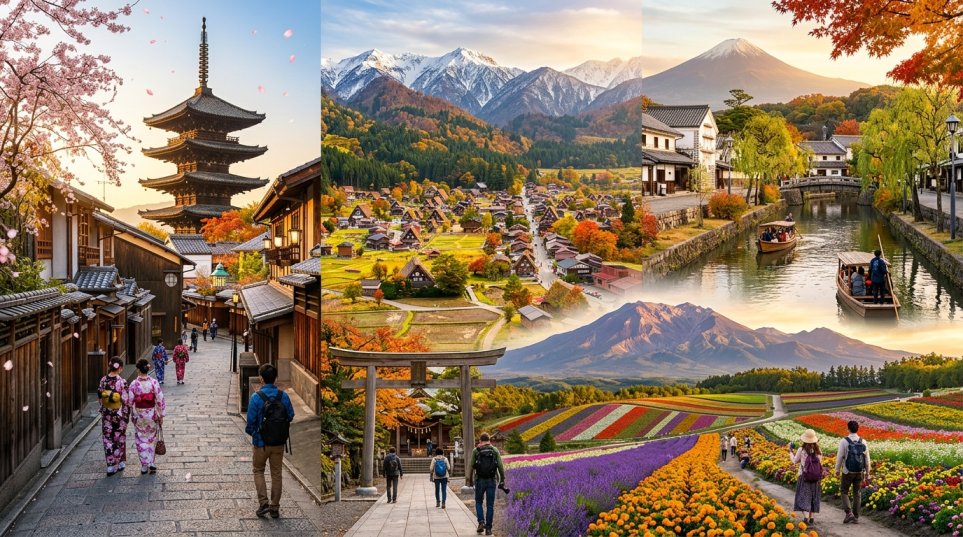
There’s a specific kind of regret that hits Japan travelers on their last day — not regret about what they did, but about what they didn’t see. They stayed in Tokyo too long. They never caught that slow train south. They never stood at the edge of a crater lake in Hokkaido at dawn.
I know this because I was that traveler once. My first trip to Japan lasted twelve days, and I spent nine of them in Tokyo. It was wonderful. And I left knowing I’d barely scratched the surface of a country that has been quietly perfecting itself for thousands of years.
Japan rewards the curious traveler who goes beyond the obvious. Not because Tokyo isn’t worth your time — it absolutely is — but because every region of this country carries its own distinct character, food culture, dialect, and aesthetic. Once you understand that, you realize one city will never be enough.
This guide covers the best places to visit in Japan beyond Tokyo: places with real stories, distinct personalities, and experiences you simply cannot replicate anywhere else on earth.
1. Kyoto — The Soul of Traditional Japan

Every Japan travel guide includes Kyoto. Most of them still undersell it.
What those guides don’t capture is the specific texture of Kyoto in the early morning — the hour before tour buses arrive and the selfie sticks come out. Walk through the Philosopher’s Path at 6:30 AM in late March, when cherry blossoms drop into the canal like slow pink confetti, and you’ll understand why people spend years trying to put Kyoto into words and mostly fail.
What Makes Kyoto Different
Kyoto was Japan’s imperial capital for eleven centuries. That’s not just history — it’s infrastructure. The city holds over 1,600 Buddhist temples and 400 Shinto shrines. But more than the numbers, what sets Kyoto apart is that its traditional culture is still living. Maiko (apprentice geisha) still train in Gion. Tea ceremony masters still teach in wooden machiya townhouses. Local artisans still produce Nishijin silk weaving and Kyo-yuzen dyeing by hand.
Go Beyond the Famous Spots
Kinkaku-ji and Fushimi Inari are on every itinerary for good reason. But Daitoku-ji — a vast temple complex in northern Kyoto with twenty-four sub-temples — is visited by a fraction of the tourists who crowd the famous sites. Some sub-temples only open for a few weeks a year. Spend a morning there and the quiet is startling.
Also worth your time: Nishiki Market (best before 10 AM), the bamboo-lined streets of Sagano in Arashiyama (go on a weekday), and the Fushimi sake district — where several breweries dating back four centuries still produce Kyoto’s famous soft-water sake.
2. Osaka — Loud, Generous, and Completely Itself

Ask locals what separates Osaka from every other Japanese city and they’ll tell you the same thing: people here talk to strangers. In a country where public reserve is the default, Osaka’s warmth and directness is almost disorienting at first. Within twenty-four hours, you love it.
Osaka is also, without question, one of the finest eating cities on the planet. The concept of kuidaore — roughly translated as “eating yourself bankrupt” — was invented here, and the city wears it as a badge of honor.
Where to Eat Like a Local
Dotonbori is famous for a reason, but it’s also extremely touristy. For better food at lower prices, head to Shinsekai for kushikatsu (breaded and deep-fried skewers — dipping the sauce twice is a local taboo taken surprisingly seriously), or to Hozenji Yokocho, a narrow lantern-lit alley of small restaurants where the locals actually go rather than the tourist trail.
The Day Trips Most Visitors Skip
Osaka is only 45 minutes from Nara by train — home to Todai-ji, one of the world’s largest wooden buildings, and hundreds of semi-wild deer who roam the park grounds freely. The deer have learned to bow their heads to receive food crackers. This is real. It never stops being delightful.
3. Kanazawa — The City That Time Treated Kindly

Kanazawa is where Japan’s history survived. Unlike most major Japanese cities, it was never bombed during World War II — which means its historic districts came through intact, and walking through them today still feels genuinely old rather than reconstructed.
Most travelers fly into Tokyo or Osaka and never make it to Kanazawa. That’s a mistake. The city is easily reachable from Tokyo via the Hokuriku Shinkansen in about two and a half hours, and it rewards every hour of the journey.
Three Things Kanazawa Does Better Than Anywhere Else
Kenroku-en Garden is one of Japan’s three “great gardens” — a distinction awarded during the Edo period — and unlike the other two, it rarely feels overwhelming with visitors. I spent a full morning there in October and found stretches of the path where I was completely alone, watching koi drift under stone lanterns while maple leaves detached slowly from their branches overhead.
The Higashi Chaya district is the best-preserved geisha entertainment district in Japan outside Kyoto. The wooden latticed facades, the narrow lanes, the small teahouses — it looks exactly as it did two hundred years ago. Walk it in the evening when the lanterns are lit.
Kanazawa’s food scene is built around the Omicho Market, a covered market that has been operating for nearly three centuries. The seafood here — snow crab, yellowtail, sea urchin from the Sea of Japan — is exceptional and, by Tokyo standards, remarkably affordable.
4. Hiroshima and Miyajima — Two Places, One Unforgettable Journey

No destination in Japan carries more emotional weight than Hiroshima. And no destination has defied that weight more completely. The Hiroshima of today is a forward-looking, vibrant city with excellent food, a river culture centered on cycling and riverside picnics, and residents who speak about their history with an openness and thoughtfulness that consistently moves visitors.
The Peace Memorial — Go Prepared
The Hiroshima Peace Memorial Museum is essential. It is also genuinely difficult. Set aside two to three hours, resist the instinct to rush through, and read the individual stories rather than treating it as a broad historical overview. The museum handles an almost impossible subject with extraordinary care, and it deserves your full attention.
Miyajima: Stay the Night
A ten-minute ferry from the city brings you to Miyajima Island, home to the Itsukushima Shrine and its iconic torii gate — one of Japan’s most recognized images. Most visitors arrive mid-morning and leave by late afternoon. That’s a missed opportunity.
Stay overnight at a small ryokan on the island, and you’ll have the gate to yourself at dawn when the tide is low and you can walk out across the wet sand toward it. That image — the orange gate, the misty mountains behind it, absolute silence — is one you don’t forget.
5. Takayama — Where the Japanese Alps Hold Time Still

There’s a moment that happens in Takayama that doesn’t happen in many other places: you turn a corner in the Sanmachi Suji historic district and realize that nothing you can see from where you’re standing looks modern. The buildings are dark timber and white plaster. The streets are narrow and stone-paved. Sake breweries advertise their presence with cedar ball sculptures (sugidama) hung above their entrances, slowly browning from green to gold through the winter months.
Takayama sits in a mountain valley in Gifu Prefecture, which historically made it difficult to reach — and that isolation is exactly why its old town survived so completely. The local government has been careful about development, and it shows.
Shirakawa-go: The Village UNESCO Couldn’t Ignore
A forty-minute bus ride from Takayama brings you to Shirakawa-go, a UNESCO World Heritage village of massive thatched-roof farmhouses called gassho-zukuri (literally “praying hands” — a reference to the steep roof angles designed to shed Gifu’s heavy snowfall). In winter, when snow blankets the rooftops and smoke rises from the farmhouses, the village looks like someone painted the idealized image of old Japan. It wasn’t designed — it simply survived.
6. Hokkaido — Japan That Surprises You

Most of what people imagine about Japan — the density, the precision, the temple-and-tea-ceremony aesthetic — doesn’t apply to Hokkaido. Japan’s northernmost island is a place of open space, volcanic landscapes, dairy farms, lavender fields, and brown bears. It’s the Japan that surprises you.
Why Hokkaido Deserves Its Own Trip
In summer (July–August), the Furano and Biei region becomes one of the most visually stunning landscapes in Asia — rolling hills patterned with lavender, sunflowers, wheat, and pumpkins in overlapping bands of color. Rent a bicycle and spend a full day moving slowly through it. There’s no reason to hurry.
In winter, Hokkaido becomes Japan’s skiing capital. Niseko receives some of the deepest powder snowfall on earth, drawing enthusiasts from Australia, Europe, and North America. Sapporo’s Snow Festival (early February) fills the city’s parks with enormous ice sculptures — some of them the size of buildings.
For something wilder: Shiretoko Peninsula in eastern Hokkaido is a UNESCO-listed wilderness where brown bears fish in rivers, drift ice grinds along the coast in winter, and the road simply ends. Getting there requires effort. It is worth every minute.
7. Naoshima — Art, Sea, and Silence

Naoshima Island in the Seto Inland Sea is one of the strangest and most rewarding places in Japan. Over the past three decades, a deliberate project has transformed what was a quiet fishing island into one of the world’s most significant contemporary art destinations — without displacing the community that was already there.
The Chichu Art Museum, designed by architect Tadao Ando and built almost entirely underground, houses a permanent collection that includes Claude Monet’s Water Lilies in a space specifically designed to display them in natural light. Standing in that room, looking up through the concrete skylight at a shifting Japanese sky while Monet’s reflections pool below you, is one of those travel experiences that quietly reorganizes something in your head.
Naoshima requires a ferry and some advance planning, which is part of why it feels so different from anywhere else. The visitors who make it there tend to be people who travel intentionally. The conversations you have on that island tend to be good ones.
8. Nikko — Baroque Grandeur in the Forest

Two hours north of Tokyo by train, Nikko is the most accessible destination on this list and also one of the most visually extraordinary. The Tosho-gu Shrine — a UNESCO World Heritage complex built in the early 1600s to enshrine the founder of the Tokugawa shogunate — is a deliberate exercise in excess: lacquer in red, black, and gold; intricate carvings covering every surface; a scale that feels almost theatrical against the surrounding cedar forest.
Nikko in autumn (mid-October through November) is something else entirely. The surrounding mountains turn in waves of red, orange, and gold, and the shrine complex glows within that color in a way that photographers travel from across the world to capture.
Practical Notes for Your Japan Itinerary Beyond Tokyo
Rail pass strategy: A 14-day JR Pass covers shinkansen travel between Tokyo, Kyoto, Osaka, Hiroshima, and back — and pays for itself within the first three long-distance journeys. For Hokkaido exclusively, a dedicated Hokkaido JR Pass usually offers better value.
Timing: Book accommodation 3–4 months ahead for cherry blossom season (late March–early April) and autumn foliage (November). Both are genuinely worth the extra planning, but they fill fast — especially in Kyoto and Nikko.
Stay in a ryokan at least once: A traditional inn with futon bedding, a yukata (light cotton kimono), and a multi-course kaiseki dinner changes how you experience Japan. Budget ryokans start around ¥8,000–¥12,000 per person including dinner and breakfast — remarkable value for what you receive.
Cash still matters: Japan is more cashless than it used to be, but many smaller restaurants, rural temples, and market vendors are cash-only. 7-Eleven ATMs accept most foreign cards reliably throughout the country.
Connectivity: Rent a pocket Wi-Fi at the airport on arrival or pick up a data SIM. Google Maps works excellently across Japan, including for navigating complex train systems.
Frequently Asked Questions
Q. What is the best place to visit in Japan outside Tokyo for first-time visitors?
Kyoto and Osaka together make the strongest first experience outside Tokyo. They’re connected by a 15-minute shinkansen ride, they offer genuinely complementary experiences — Kyoto for temples, traditional culture, and quiet beauty; Osaka for food, nightlife, and warm, direct locals — and both cities have excellent English signage and tourist infrastructure.
Q. What are the most underrated hidden gems in Japan?
Kanazawa tops most seasoned travelers’ lists. Beyond that: Matsumoto in Nagano (a castle town with one of Japan’s finest original castles and a laid-back arts scene), Beppu in Kyushu (a geothermal city where steam rises from streets and riverbanks, with some of Japan’s most theatrical hot spring pools), and Tottori (Japan’s least-visited prefecture, famous for dramatic Sea of Japan sand dunes) are consistently overlooked and rewarding.
Q. How many days do I need for a Japan itinerary beyond Tokyo?
Plan for at least 10–14 days to move meaningfully beyond the capital. A practical structure: 3–4 days in Kyoto and Nara, 2 days in Osaka, 2 days in Hiroshima and Miyajima, 2 days in Kanazawa, 1–2 days in Takayama. Hokkaido deserves a separate dedicated trip of at least 5–7 days.
Q. Is Japan affordable to travel outside of Tokyo?
Generally yes — regional Japan tends to be slightly less expensive than Tokyo, particularly for accommodation and food. Street food and local restaurant meals in Osaka and Kanazawa are exceptional value. A solid mid-range daily budget for regional Japan (accommodation, food, transport, and entry fees) runs approximately ¥12,000–¥18,000 per person, or roughly $80–$120 USD.
Q. What scenic places in Japan are best for nature lovers?
Hokkaido for sheer scale and wilderness. Yakushima Island in Kagoshima Prefecture for ancient cedar forests that feel genuinely prehistoric — this island partially inspired the landscapes in Studio Ghibli’s Princess Mononoke. The Nakasendo trail between Nagoya and Tokyo for forested mountain walking between preserved Edo-period post towns. And the Izu Peninsula south of Tokyo for dramatic ocean cliffs, hot spring towns, and relative ease of access from the capital.
Ending
Japan is a country that gets better the more time you give it. The first trip shows you the surface — the famous skylines, the cherry blossoms, the Zen gardens. The second trip takes you deeper. The third trip takes you somewhere small and quiet that nobody back home has heard of, and that’s usually the trip people talk about for the rest of their lives.
The best places to visit in Japan beyond Tokyo aren’t better than Tokyo. They’re different in the way that matters — they show you a country that has been thinking carefully about beauty, craft, food, and hospitality for a very long time, and hasn’t stopped yet.
Start planning. Japan is waiting.
Planning a trip to Japan? Tell us in the comments — what kind of traveler are you? History, food, nature, or contemporary art? We’ll point you exactly where to go.

