
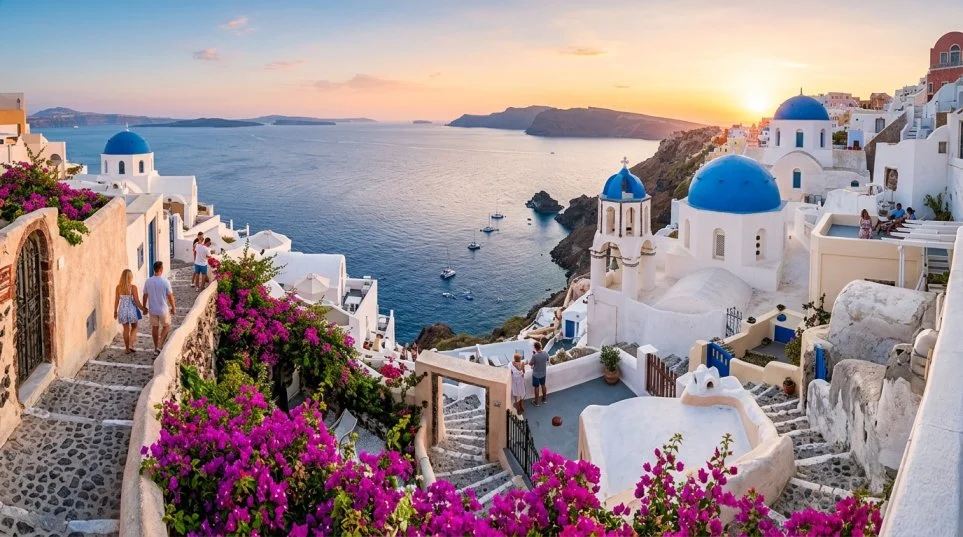
Let’s Be Honest — Santorini Looks Different Depending on When You Land
The first thing that hits you is the light. Not the famous blue domes or the infinity pools you have already seen plastered across travel magazines — just the raw, clean quality of the Aegean sunlight bouncing off whitewashed stone. I was not prepared for it on my first trip, and I doubt most visitors are.
But here is the thing nobody puts in the glossy itinerary posts: that same island can feel completely different depending on which month you step off the plane. Santorini in August and Santorini in November share the same geography, the same volcanic cliffs, the same jaw-dropping caldera views — and almost nothing else.
So the real question is not just when is the best time to visit Santorini Greece, but: best for whom? Best for what kind of experience? That is exactly what this guide is going to sort out for you, month by month, with no fluff and no vague platitudes about ‘mild Mediterranean weather.’
| QUICK ANSWER —The Shortest Version of This Guide Best overall window: May, or September through mid-October. Good weather, the island fully open, crowds you can actually tolerate. Tightest budget: January through February — seriously cheap, seriously quiet, and genuinely beautiful if you are not chasing a beach holiday. Honeymooners: late May or early October. Warmth, atmosphere, and none of the August madness. |
Santorini Weather by Month — The Full Picture

Santorini sits in the southern Aegean and runs on a textbook Mediterranean climate: long, dry summers and short, occasionally stormy winters. But that summary glosses over the very real differences between, say, a windy March afternoon on the caldera rim and a sweltering August afternoon on the same spot with 400 other tourists. Let’s go season by season.
Spring in Santorini — March, April & May
March — Quiet, Cool, Surprisingly Worthwhile
March is the start of Santorini’s slow awakening. Daytime temperatures hover around 14 to 16 degrees Celsius — that is roughly 57 to 61 Fahrenheit, which means a light jacket is not optional. You will encounter some rain and overcast days, particularly in early March. A handful of hotels are still shuttered and some restaurants have not flipped the sign back to ‘open’ yet.
What you get in exchange for those minor inconveniences: the caldera trail to yourself, village squares where cats outnumber tourists, and a sense that you are seeing an authentic version of the place. March is not the romantic Santorini of postcards, but it has a raw, honest quality that some travelers find more compelling than the manicured summer version.
April — The Sweet Awakening
This is when things start genuinely clicking. April delivers 17 to 20 degrees, longer sunny stretches, and the island slowly filling back up — but gently, not aggressively. The volcanic hillsides burst into wildflowers at this time of year, which almost nobody photographs because almost nobody is there to see them. The Fira-to-Oia hiking trail, which runs along the caldera rim for about nine kilometres, is completely walkable without dodging crowds. You might share it with a dozen other hikers on a weekday morning.
I did that trail on a Tuesday in mid-April. Passed a family of three, two couples, and one very determined elderly Greek gentleman with hiking poles. That was it. Four hours of volcanic cliffs, wild herbs underfoot, and the whole Aegean spread out below. In July, that same path is a slow-moving queue.
May — The Month That Gets It Right
Ask any experienced Greece traveller and a disproportionate number will say May without hesitation. Temperatures settle into a genuinely pleasant 20 to 25 degrees. The sea has warmed enough for the braver swimmers among us. Hotels are fully operational, restaurants are open, boat trips to the caldera’s volcanic islands are running — but the summer tourist wave has not yet crashed onto the island.
Pricing is meaningfully lower than June onwards. You can walk through Oia at 10am without it feeling like a queue for a theme park attraction. Sunset is still breathtaking but you can actually find a position at the viewpoint without arriving forty-five minutes early and waiting with your elbows out. May is, in a word, balanced.
Summer in Santorini — June, July & August

This is peak season, and it earns the name honestly. June through August brings sustained heat — 27 to 32 degrees on average, sometimes creeping beyond that in late July. The sea is warm and clear. Sunsets over the caldera in summer are genuinely spectacular, the kind of thing that is hard to photograph because no camera quite gets the colour. Beach clubs are in full swing. The island’s cocktail bars, rooftop restaurants, and infinity pools are operating at their finest.
Here is the part the travel brochures smooth over: Santorini in peak season is extremely crowded. Oia, which sits on the northern tip of the island and is home to the famous windmills and sunset viewpoint, can feel genuinely suffocating by mid-afternoon in August. The narrow pedestrian streets were simply not designed for thousands of people shuffling through them simultaneously. Getting a table at a decent caldera-view restaurant without a reservation made weeks in advance borders on impossible. Car rentals and quad bikes sell out. The famous ‘sunset at Oia’ experience involves standing shoulder to shoulder with several hundred other people, all holding phones aloft.
None of that means you should not go. Plenty of people absolutely love the energy of peak-season Santorini. Just go in knowing what you are booking yourself into, and plan accordingly — reservation for everything, accommodation booked months ahead, and a strategy for finding the quieter corners of the island early in the mornings.
Autumn in Santorini — September & October
September — The Crowd Clears, The Warmth Stays
September is quietly becoming one of the most sought-after months to visit Santorini among travellers who have done their homework. The summer heat mellows to a lovely 23 to 26 degrees. The sea holds its summer warmth beautifully — late September is arguably the best swimming month on the island, because the water is at its warmest while the air has cooled off. Schools go back in northern Europe and North America, which drives a very noticeable drop in tourist numbers from the second week of September onwards.
Everything is still fully open. Restaurants, wine tours, boat trips, the archaeological site at Akrotiri — all running at full capacity. But there is a loosening, a letting-out-of-breath quality to September that peak summer simply does not have.
October — Romantic, Unhurried, and Underrated
October is, in this writer’s considered opinion, the single best month to visit Santorini if your priority is atmosphere over beach weather. Temperatures sit between 20 and 24 degrees — comfortable for exploring without being oppressive. The Aegean is still warm enough for a swim well into mid-October. The tourist numbers have dropped substantially, and the island regains a sense of itself that summer temporarily drowns out.
Pyrgos, the medieval hilltop village that most summer tourists never visit because they’re locked in the Fira-Oia corridor, is worth half a day of anyone’s time in October. The local tavernas there are cooking for people who actually live on the island, not for a rotating cast of visitors. The wine is good. The quiet is better.
Winter in Santorini — November Through February

Let me say something that will surprise a few people: Santorini in January is genuinely beautiful. Not beautiful the way it is in August — not the sun-and-sea-and-sunset beautiful that fills Instagram feeds. A different kind. The caldera light in winter has a quality that summer sun burns away. The villages feel like real places again, because the people in them are the people who actually live there.
Temperatures range from 10 to 16 degrees. There will be rain. There will be wind off the Aegean that cuts right through a light jacket. Many hotels, restaurants and shops close from mid-November through to late February or early March. If you are planning a winter visit, you need to do your research in advance to make sure your accommodation options and preferred restaurants are actually open.
What winter gives you in return: extraordinary solitude, dramatically reduced prices (a caldera-view room that costs 400 euros a night in August might cost 90 euros in January), and an honest encounter with a place that is usually too crowded to reveal its quieter character. It is not right for everyone. But for a certain type of traveller, it is exactly right.
Monthly Quick-Reference Table
| Month / Window | Avg. Temp | Crowds | Budget Level | Made For… |
| January – February | 10 – 15 °C | Barely any | Lowest of the year | Solo explorers, budget trips |
| March – April | 15 – 20 °C | Low | Affordable | Hikers, landscape photographers |
| May ★ Best Overall | 20 – 25 °C | Moderate | Mid-range | First-timers, couples, families |
| June – August | 27 – 32 °C | Packed | Most expensive | Beach lovers, party crowd |
| September – October ★ | 22 – 27 °C | Thinning | Mid-range | Honeymooners, food lovers |
| November – December | 13 – 18 °C | Quiet | Budget-friendly | Slow travelers, winter romantics |
When to Go Based on What You Are Actually After

Santorini for Honeymoons and Couples — Best Time
The answer nearly every experienced traveller gives is May or the September-to-October window, and the reasoning holds up. In both periods you get genuine warmth, the island fully operational, and — critically — enough of a crowd reduction that the place feels intimate rather than theatrical.
There is something about Santorini in early October, in particular, that rewards couples. The light at golden hour in October sits lower in the sky than it does in midsummer, and it hits the caldera walls at an angle that turns everything amber and rose. If you are the sort of person who cares about that kind of thing, plan your trip around it.
| SANTORINI HONEYMOON: The Honest Recommendation Book late May or early October. You will get warm weather, a sea still suitable for swimming, restaurants fully open, and hotel pricing that is noticeably more reasonable than August. A cave suite in Imerovigli or Firostefani rather than Oia gives you the same caldera drama with fewer people on your doorstep. |
For Budget Travellers — Cheapest Time to Visit Santorini
The cheapest time to visit Santorini without question is January and February. The savings are not marginal — they are dramatic. A caldera-view room that commands 350 to 500 euros per night in peak summer can drop to 80 to 120 euros in January. Flights from most European cities are a fraction of summer prices. Ground transport and activities follow the same pattern.
The trade-off is honest: fewer restaurants open, shorter daylight hours, occasional rough weather. If a quiet solo trip, a writing retreat, or a photography expedition with no crowds appeals to you, January and February deliver extraordinary value. If you want beach weather but still want to save money, March or November sit at a middle ground — prices lower than summer, most things still open or re-opening.
For Beach and Swimming
The sea around Santorini reaches its warmest in August — roughly 25 degrees Celsius — and stays comfortably swimmable through September. The volcanic beaches here (black sand at Perissa and Kamari, red sand at the smaller Red Beach near Akrotiri) are unlike any beach most visitors have encountered before. In July and August those beaches are packed. Early June or late September is the sweet spot — warm enough water, manageable numbers.
For Photography and the Visual Side of the Island
Professional travel photographers tend to cluster in April, May, and October for good reason. The golden-hour light in these months is dramatically different from the harsh, overhead summer sun that bleaches the famous blue-and-white palette into something flatter. Longer shadows, warmer angles, and the absence of crowds means you can actually compose a photograph of Oia’s famous church domes without someone else’s arm or phone appearing in your frame.
If you want the dramatic ‘Santorini sunset’ image and you are going in summer, set your alarm for sunrise instead. The Oia streets at 5:30am in July are almost empty. The caldera glows pink and gold in the early light. It is one of the best-kept not-quite-secrets about visiting the island during high season.
Practical Planning: What to Know Before You Go

Booking Lead Times by Season
- Summer (June–August): Book caldera-view accommodation 6 to 9 months ahead. Seriously. The best properties sell out that early. Restaurants in Oia require advance reservations, often weeks out. Car hire is limited — arrange it before you arrive or use the island’s bus network and taxis.
- Shoulder seasons (May, September–October): Two to three months ahead is usually enough for good properties. You will have far more flexibility with dining. Most activities can be arranged a day or two in advance.
- Winter (November–February): Before booking, confirm that your hotel and any restaurants or experiences you are planning are actually open during your dates. Some properties close entirely; check their website or call directly.
Getting There
Santorini’s airport (IATA: JTR) receives direct flights from many European cities in season. Outside of May to October, your best bet is usually a connection through Athens (ATH), which has year-round service. The ferry from Piraeus is worth considering if you are not in a rush — the high-speed catamaran takes about four to five hours and the slower overnight ferry is a classic Aegean experience in its own right.
What to Pack for Each Season
- March–April: Comfortable walking shoes that can handle uneven stone paths, a proper rain layer, sunscreen for sunny spells, and light layers you can add or remove as the day changes temperature.
- May–June: Sunscreen (higher SPF than you think you need), a hat, light cotton clothing, sandals, and one smart outfit for dinner. A light jacket for evenings in May.
- July–August: The lightest clothing you own, reef-safe sunscreen, sturdy sandals that can handle steep stone stairs, a reusable water bottle. Evenings rarely need more than a shawl.
- September–October: Very similar to summer but add a light jacket or cardigan for evenings. Water shoes are useful on volcanic beaches where the black sand bakes in the afternoon.
- November–February: A proper waterproof jacket, warm layers, and walking boots. The Aegean wind in January is genuinely cold.
Questions People Actually Ask
What is the single best month to visit Santorini?
May, by a reasonable margin. The weather is warm and stable (20 to 25 degrees), the island is fully operational, the sea is beginning to warm up, and you get none of the pressure-cooker feeling of midsummer. If May is not possible, aim for September or the first two weeks of October.
Is Santorini worth going to in winter?
Yes — with honesty about what you are walking into. It is not a beach or pool-scene holiday. Some hotels and restaurants are closed. But the island has a completely different personality in winter, one that is harder to access in summer because it gets drowned out. The caldera is just as extraordinary. The prices are a fraction. If solitude and atmosphere matter more to you than heat and activity, winter Santorini is genuinely worth it.
When is Santorini least expensive?
January and February. Accommodation prices can be 60 to 70 percent lower than peak-season rates. Flights similarly. If you want budget combined with acceptable weather, March and November sit at a middle point.
How many days do you actually need there?
Four to five days is the honest answer for most visitors. That gives you time to explore the main villages properly (Fira, Oia, Imerovigli, Pyrgos), spend at least one full day on the beaches, take a boat trip to the volcanic islands in the caldera, and watch a sunset without feeling like you are rushing. Three days feels slightly compressed. A week starts to feel slow unless you are very intentional about it.
Is Santorini suitable for families with young children?
Yes, though timing matters. May and September are much easier than August for families — the heat is manageable for children, crowds are lower, and there is genuine flexibility in how you spend your days. The boat trips, volcanic beaches, and relatively compact geography of the island make it very doable with kids. Just note that many of the caldera villages have steep stairs and narrow paths that are challenging with pushchairs.
The Bottom Line
Santorini is not a place that overpromises and underdelivers. It is genuinely as beautiful as the photographs suggest — perhaps more so, because photographs cannot capture the quality of the light, or the particular smell of the island’s volcanic soil, or the way the caldera stretches out into the Aegean like something a painter imagined rather than geology created.
But the island you experience is shaped almost entirely by when you arrive. Go in August and you are signing up for a spectacle — loud, hot, crowded, expensive, and in its own way, thrilling. Go in May or October and you get something quieter and arguably deeper. Go in January and you get something most visitors never see at all.
The best time to visit Santorini is the time that matches what you are actually looking for. Work backwards from that. If it is your first trip, May is a near-perfect starting point. If you have been once and want a different version of the island, try October, or be adventurous and go in February. Either way — go.
| READY TO START PLANNING? Lock in your travel window based on the guidance above, then move on accommodation first — caldera-view properties at quality hotels sell out faster than anything else on the island. Flights from Athens (ATH) to Santorini (JTR) run year-round, and the ferry from Piraeus is worth considering for the experience alone. Wherever you land and whenever you go, the caldera will be there waiting. |

