
Nobody warned me about the noise.
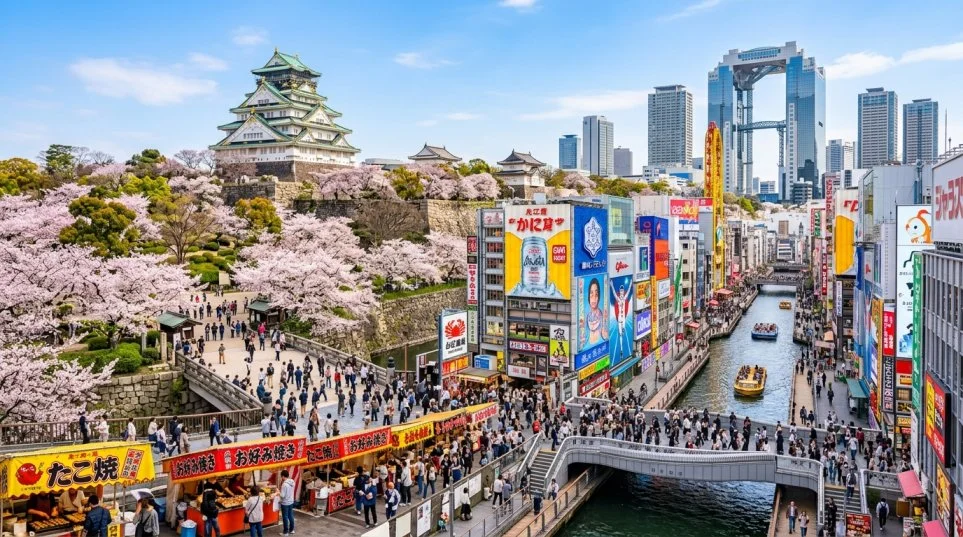
Not bad noise — just the kind that comes from a city that genuinely cannot sit still. A takoyaki vendor with a microphone, three competing karaoke bars, the hiss of a pressure cooker from somewhere I never identified. I was standing in Dotonbori at 9:30 on a Tuesday night, eating something fried and golden off a wooden skewer, watching a salary-man in a pressed suit take a selfie with the Glico sign, and I remember thinking: this city does not perform for visitors. It simply is — loudly, confidently, all the time.
Osaka has been called Japan’s kitchen, Japan’s comedy capital, and Japan’s most approachable city. All three things are accurate, and none of them fully captures it. What you get here is a place that has been feeding and entertaining people for four centuries and has developed strong opinions about how both should be done.
This guide covers the 25 best things to do in Osaka — from the bucket-list landmarks everyone shows up for, to the backstreet corners that most travel blogs haven’t found yet. Whether you have two days or ten, this is the Osaka travel guide worth bookmarking.
| Quick Trip Facts — Osaka at a Glance – Best months to visit: March–May (cherry blossoms) | October–November (autumn colour) Getting there: Kansai International Airport (KIX) or Shin-Osaka Shinkansen station Getting around: Osaka Metro is fast, clean, and covers almost everywhere you need Best value pass: Osaka Amazing Pass — unlimited subway + free entry to 40+ sights Currency: Japanese Yen (JPY). IC cards (Suica/ICOCA) work on all transport Useful Osaka phrase: Maido! (informal hello, sounds warm, locals appreciate the effort) |

1. Osaka Castle — The Story Behind the Stone Walls
There’s a peculiar moment that happens to almost everyone who visits Osaka Castle for the first time. You walk through the outer gate, cross the stone bridge over the moat, and suddenly the tower appears above the tree line — gold leaf on the eaves, white plaster walls, curved roofs stacked five stories high — and you completely forget that it was rebuilt in 1931 and has a lift inside.
The castle grounds span 106 hectares, and the park that surrounds the tower is worth as much of your time as the building itself. Cherry blossom season turns the western moat into something almost unrealistically beautiful. I sat on the grass near Nishinomaru Garden on an April morning, sharing the space with about forty retired couples having picnic breakfasts, and it occurred to me that this is what Osaka actually looks like when it slows down for a moment.
Inside the tower: The eight-floor museum traces Toyotomi Hideyoshi’s story from peasant foot-soldier to ruler of Japan — genuinely fascinating if you read the panels rather than skip straight to the observation deck. The view from the top floor takes in the whole east side of the city.
- Hours: 9:00 AM – 5:00 PM daily (last entry 4:30 PM)
- Tower entry: ¥600 adults | Castle park is free, open all hours
- Nearest access: Osakajokoen Station (JR Loop Line) — 10-minute walk to tower
- Insider tip: Arrive before 9 AM on weekdays. By 10 AM the queue to enter the tower can stretch 45 minutes.
2. Dotonbori — Osaka’s Most Famous Street (And Why It Deserves the Hype)
Every city has a neighbourhood that somehow becomes the face of the entire place. For Osaka, it’s Dotonbori — specifically the 400-metre canal-side strip that glows in neon from dusk until 3 AM and smells, permanently and blessedly, of food.
The Glico Running Man billboard is the obvious photo spot, and yes, you should absolutely take the picture. But Dotonbori rewards people who slow down and stop treating it as a backdrop. The canal walk at the Tombori Riverwalk level, right beside the water, is quieter and gives you the reflections that make the nighttime shots work. The food stalls along the main arcade serve some of the most honest street food in the city — not tourist-inflated prices, just good takoyaki and fresh crab legs at sensible money.
What most visitors miss: Hozenji Yokocho, a moss-covered stone lantern alley directly behind the main Dotonbori strip. Two rows of tiny restaurants face each other across a lane barely wide enough for two people walking side by side. The moss on the stone Fudo Myoo statue has been growing thicker for decades because locals splash water on it before praying. It feels like a completely different era from the neon outside.

3. Universal Studios Japan — Worth Every Minute of the Queue
Universal Studios Japan in Sakurajima is one of those places that sounds like a marketing claim until you’re actually standing in it. The Wizarding World of Harry Potter — Hogsmeade, the castle, the working wands, the Butterbeer that costs more than a bowl of ramen and is worth every yen — is the most convincing fictional-world recreation I’ve walked through anywhere.
The Super Nintendo World zone operates on a different level of immersion entirely. The entire area is built at a 1:1 scale with the games, interactive wristbands track your coin punching and power-up collecting in real time, and Mario Kart: Koopa’s Challenge uses AR headsets to merge the physical ride with the game world. My nephew, who is eight, lost his mind. I, who am thirty-four, also partially lost my mind.
Planning note: USJ requires advance booking in peak seasons and school holidays. Express Passes for the major rides sell out weeks ahead. Standard queue times for Mario Kart and Harry Potter without an Express Pass routinely hit 90–120 minutes.
- Tickets: From ¥8,600 (adult 1-day) — book at usj.co.jp well in advance
- Express Pass: From ¥4,200 additional — worth it for Mario Kart and Forbidden Journey
- Getting there: JR Yumesaki Line direct to Universal City Station (5-minute walk)
- Tip: Park opens at 8 AM on most busy days — arrive 30 minutes before opening time
4. Kuromon Ichiba Market — Where Osaka Chefs Actually Shop
I have eaten in a lot of markets. Kuromon is the one I think about when someone asks me what good food market culture looks like. The 580-metre covered arcade has been trading since 1902 and contains over 150 stalls selling fresh seafood, premium beef, vegetables, pickles, knife-sharpened sashimi, and prepared foods that put most sit-down restaurants to shame.
The difference between Kuromon and a tourist market is this: professional cooks from Osaka’s restaurants come here every morning to buy their stock. That keeps the quality standard genuinely high and the prices honest, because the vendors know that if they drift, their wholesale clients leave. For visitors, it means you can eat a plate of fresh uni (sea urchin) at 8:30 in the morning that a sushi restaurant would charge you triple for at dinner.
What to eat here: Fresh oysters with ponzu, wagyu beef skewers grilled to order, tamagoyaki (rolled egg omelette) cut thick and still warm, fresh uni on rice, and — if you spot it — nodoguro (blackthroat seaperch), one of Japan’s most prized white fish.
- Hours: Approximately 8 AM – 6 PM; most stalls closed Sunday
- Location: Nipponbashi area, 5-minute walk from Namba Station south exit
- Budget: ¥1,500–¥3,000 covers a full morning of eating
5. Shinsekai & Tsutenkaku Tower — Old Osaka, Completely Unfiltered
The Neighbourhood That Didn’t Renovate Itself for Anyone
Shinsekai was designed in 1912 as a glamorous new entertainment district — the southern half modelled on Paris, the northern half on New York’s Coney Island. It thrived for two decades, then declined badly through the mid-20th century. What’s left is a neighbourhood that never got the budget to redevelop, and as a result it has accidentally preserved the most intact mid-century streetscape in Osaka: old pachinko halls, retro food stalls, hand-painted signage, and the particular energy of a place where people have been eating and gambling and watching boxing on TVs for seventy years.
Tsutenkaku Tower and the Kushikatsu Code
The 103-metre Tsutenkaku Tower presides over the neighbourhood like a proud old relative who still dresses up to come out. The observation deck has good views over southern Osaka and into the Namba skyline. But the real reason to be in Shinsekai is the kushikatsu restaurants clustered around the base of the tower.
Kushikatsu — deep-fried skewers of meat, fish, vegetables, cheese, quail eggs, and things you cannot identify but order anyway — is Shinsekai’s trademark dish. Every restaurant here posts the same warning in multiple languages: no double-dipping your skewer in the communal dipping sauce. Use the ladle to pour sauce onto your plate instead. It is explained in every guidebook and ignored by about 15% of first-time visitors, much to the visible displeasure of everyone else.
Recommended: Daruma (since 1929, multiple Shinsekai locations) for authentic kushikatsu. Budget ¥1,500–¥2,500 per person for a full sitting.

6. Namba and Shinsaibashi — Shopping, Eating, Repeating
If you need one neighbourhood to anchor your Osaka visit, Namba makes the most logical base. It sits at the intersection of the city’s main shopping corridors, entertainment venues, and food streets, and is connected by subway to everywhere else worth going.
Shinsaibashi-suji is Japan’s longest covered shopping arcade — 600 metres of retail from international brands at the Shinsaibashi end down to independent vintage shops and cheap accessories near Namba. The crowds are relentless on weekends, but weekday mornings are almost pleasant. The best find I’ve made in this arcade was a forty-year-old vinyl record shop where the owner speaks no English and doesn’t need to, because the records speak for themselves.
Amerika-mura (American Village) is a few blocks west and runs at a completely different frequency. Triangle Park at its centre is a gathering spot for young Osakans, and the surrounding streets are packed with independent streetwear labels, used clothing sellers, tattoo studios, and basement bars that open at 6 PM and have jazz playing too loud to hold a conversation. It’s the creative underbelly of a city that usually leads with food.
Don’t skip: Doguyasuji, a street dedicated entirely to professional kitchen equipment. Osaka’s restaurants and home cooks both shop here. Even if you’re not buying, watching a cook spend twenty minutes choosing between two carbon-steel knives is its own kind of entertainment.
7. Minoo Park and the Waterfall — Nature 30 Minutes from Central Osaka
Most Osaka itineraries treat the city as entirely urban, which means most visitors miss Minoo entirely. That’s a genuine shame, because the 2.7-kilometre trail from Minoo Station to the 33-metre Minoo Waterfall is one of the most satisfying half-day walks available within easy reach of any major Japanese city.
The trail follows a mountain stream through cedar and maple forest, past a handful of small temples and stone Jizo statues dressed in red bibs, and vendors selling momiji (maple leaf) tempura — a regional tradition dating back over a thousand years. The taste is more interesting than it is spectacular: a subtle sweetness under the batter, the kind of thing you eat as much for the story as the flavour.
Best seasons: November for autumn colour (the valley turns crimson in mid-November and draws serious photographers); early spring for wildflowers and new-growth green. The waterfall itself is year-round and worth the walk in any season.
- Getting there: Hankyu Minoo Line from Umeda, 30 minutes to Minoo Station (¥280 one way)
- Trail: 2.7 km one way, gently uphill — comfortable in regular shoes
- Allow: 3–4 hours including the walk, waterfall stop, and a slow walk back
8. Osaka Aquarium Kaiyukan — One of the Finest Aquariums on Earth
Kaiyukan Aquarium in Tempozan Harbour occupies a tier that very few aquariums anywhere in the world reach. The centrepiece is the Pacific Ocean tank — 5.4 million litres of water, 8 metres deep, home to whale sharks, manta rays, sunfish, and schools of smaller fish that move through the blue water like smoke. You descend through eight floors of habitat environments, each representing a different Pacific Rim ecosystem, and the whale shark tank appears multiple times as you spiral down.
I have been to aquariums on four continents. None of them have produced the same quality of sustained quiet that happens in that main tank room. People who came in speaking loudly gradually stop. Children stop running. Everyone stares upward for a while.
- Hours: 10:00 AM – 8:00 PM (last entry 7:00 PM)
- Tickets: ¥2,400 adults | ¥1,200 children (4–15)
- Getting there: Osaka Metro Chuo Line to Osaka-ko Station, 5-minute walk
- Combine with: Tempozan Giant Ferris Wheel and Santa Maria sightseeing cruise nearby

9. Tennoji Zoo, Tennoji Park, and Abeno Harukas — A Neighbourhood Worth a Full Day
Tennoji Zoo and the Park
Japan’s third-oldest zoo is not the main reason to come to Tennoji, but if you’re travelling with young children it makes an easy add-on to an afternoon in the area. What I find more interesting is Tennoji Park itself — 11 hectares of maintained gardens and lawns with a traditional Japanese garden inside that most visitors walk straight past. Entry to the Japanese garden is ¥150 and it provides a level of quiet that the surrounding neighbourhood does not offer.
Abeno Harukas — The 300-Metre View
The Abeno Harukas skyscraper (300 metres, Japan’s tallest building for over a decade) sits directly above Tennoji Station. The Harukas 300 observation deck occupies the 58th to 60th floors with a glass floor section, an outdoor terrace, and views stretching to Kobe on clear winter days. The building also contains a Kintetsu department store, a hotel, an art museum, and dining floors — making it easy to spend a half-day without stepping outside.
- Harukas 300 tickets: ¥2,000 adults
- Hours: 9:00 AM – 10:00 PM (last entry 9:30 PM)
- Tip: Visit on a clear winter afternoon — visibility can reach 60 km
10. Sumiyoshi Taisha Shrine — 1,800 Years Without the Crowds
Osaka’s most important Shinto shrine is everything the famous Kyoto shrines are not: uncrowded, unfussed about, and radically peaceful for a site that draws millions of worshippers annually. Sumiyoshi Taisha dates to the third century and serves as the head shrine for over 2,300 Sumiyoshi shrines across Japan — a significance that should warrant more tourist attention than it gets.
The four main shrine buildings are built in a style called Sumiyoshi-zukuri — straight non-curved rooflines, no decorative metalwork, a design that pre-dates Buddhist influence on Japanese architecture. It’s a fundamentally different visual language from the lacquered, curved-roof shrines that most visitors associate with Japan, and it’s genuinely striking.
The Taiko Bridge: The steep arched stone bridge at the entrance — so steep it’s almost vertical at the top — is technically climbable in both directions. Do it carefully. The view from the peak of the arch, over the pond to the shrine buildings, is the best photograph you’ll take here.
- Access: Hankai Tramway from Tennoji (15 minutes) — Japan’s only surviving private tram line
- Entry: Free; open dawn to dusk
- Best time: Early morning for photography; New Year (Jan 1–3) for Hatsumode crowds that are spectacular

11. Osaka Street Food Experiences — The Real Reason Everyone Comes Back
The Four Foods Osaka Actually Invented
Osaka’s food culture has a depth that a few market visits and a takoyaki ball don’t fully convey. The city is credited with developing or popularising four dishes that are now eaten across Japan. Each one has a proper version and a tourist version. Here’s how to find the proper version.
Takoyaki — Batter poured into cast-iron sphere moulds, a piece of octopus dropped in, cooked and turned with metal picks until the outside is crispy and the inside is still liquid. The best in Osaka are at Aizuya in Dotonbori, which claims the original recipe, and Wanaka in Umeda. The inferior versions — overly dense, pre-made, not turned properly — are everywhere. The exterior crunch and interior near-molten filling are non-negotiable.
Okonomiyaki — A savoury pancake layered with shredded cabbage, your choice of protein, batter, egg, and topped with okonomiyaki sauce, Kewpie mayo, aonori, and bonito flakes that wave in the heat. Osaka-style (Namba-yaki) is layered, not mixed. Chibo on Dotonbori does the flagship version. Mizuno on Dotonbori has been going since 1945 and the queue at dinner tells you everything you need to know.
Kushikatsu — Already covered under Shinsekai, but worth repeating here: the combination of deep-fry batter, varied ingredients, and that communal sauce you must never double-dip is pure Osaka logic. Simple, social, impossible to stop at just five skewers.
Negiyaki — The lesser-known cousin of okonomiyaki: a thinner batter loaded with spring onion and pork or beef, lighter and grassier in flavour. Seek it out at Yukari near Hommachi. Because most visitors don’t know to order it, the portions at the counter are often bigger and the service more relaxed.
The Osaka Food Strategy: Morning vs Evening
Morning means Kuromon Market — the vendors are setting up, the stock is freshest, the prices are at their most honest. Evening means Dotonbori and Hozenji Yokocho — the atmosphere is at maximum, the standing bars are open, and the izakayas that seat twelve people are filling up with salary-men who have been looking forward to this moment since 2 PM. Do both.
12. Osaka Nightlife — Three Versions of a Good Evening
Osaka after dark runs on a different logic than Tokyo. The city is smaller and the nights are shorter (last train is typically midnight-1 AM), but the culture of drinking standing up at a counter, eating a third dinner at 11 PM, and continuing a conversation that started at work until the early hours is deeply embedded. Here are three different ways to spend an Osaka evening.
Version 1 — Izakaya hopping in Namba. Pick a small izakaya on one of the side streets between Namba and Hozenji Yokocho, sit at the counter, order the house tofu, the grilled chicken, and whatever sake the owner recommends. Move to a second place in an hour. Repeat until the last train. This is how Osakans actually spend Thursday evenings.
Version 2 — Amerika-mura bar scene. Younger, louder, often with live music. The basement bars around Triangle Park play jazz, electronic, and hip-hop depending on the night. Cover charges are usually ¥500–¥1,000 and include one drink. The vibe is genuinely warm rather than exclusive.
Version 3 — Whisky bar, Umeda area. Osaka has several excellent standalone whisky bars in the Umeda district that stock Japanese single malts at prices that seem reasonable only because Tokyo prices have recalibrated your expectations. Bar K in West Umeda and Bar Nayuta on Midosuji are worth finding.
13. Best Osaka Day Trips — Three Directions Worth Waking Up Early For

Nara — 45 Minutes, Completely Different World
Nara is the single easiest and most rewarding day trip from Osaka. Take the Kintetsu Nara Line (45 minutes, ¥680) and walk ten minutes from the station to Nara Park, where over 1,200 free-roaming sika deer coexist with some of Japan’s oldest temples. The deer have been considered sacred messengers of the gods for over 1,200 years and have developed, over that same period, absolutely no fear of humans and a powerful interest in any food you might be carrying.
Todai-ji Temple houses Japan’s largest bronze Buddha statue — 15 metres tall, sitting serenely in a hall that is itself the world’s largest wooden structure. The scale of the whole complex takes a few minutes to properly absorb.
Kyoto — 75 Minutes by Limited Express
Kyoto is 75 minutes from Osaka by limited express (¥570 on the Kintetsu or Hankyu lines — skip the Shinkansen, it’s 15 minutes faster but significantly more expensive for a day trip). I’d focus a Kyoto day on Fushimi Inari in the morning — take the 2.5-hour hike up through the full torii gate tunnel rather than just photographing the lower section that everyone shoots — and Arashiyama Bamboo Grove plus Tenryu-ji garden in the afternoon.
Himeji — 90 Minutes, Japan’s Finest Castle
If Osaka Castle represents Japan’s rebuilt castle heritage, Himeji represents what was never lost. The castle is original, largely intact, and one of the genuine architectural masterpieces of pre-modern Japan. The 90-minute express from Osaka (¥2,310) is the most direct way to understand what Japan’s feudal fortifications actually looked like before the wars that destroyed most of them.
14. Osaka Hidden Gems — The Places That Reward Slow Travelling
Nakazakicho
A 10-minute walk from Umeda Station takes you from one of Osaka’s most commercial districts into a neighbourhood that seems to belong to a different decade. Nakazakicho is a preserved cluster of Showa-era wooden townhouses (machiya) that have been converted, with minimal intervention, into independent cafes, second-hand bookshops, art galleries, vintage clothing stores, and a handful of small ceramics studios. The streets are narrow and slightly tilted. The cafes have individual characters. Nothing is branded. It’s the version of Osaka that locals send their creative friends to, and it moves at about a third of the speed of everything else.
Osaka Museum of Housing and Living
Inside the Tenjinbashisuji complex near the Osaka Temmangu Shrine, this museum recreates full-scale Edo-period Osaka street scenes — complete merchant townhouses, food stalls with detailed replica stock, narrow alleys, period sounds piped through speakers overhead. You walk through a life-size replica of a merchant district as it looked in the 1820s. It is peculiar and absorbing in equal measure.
Tsuruhashi — The Korean Quarter
Osaka has Japan’s largest Korean community, centred on the Tsuruhashi neighbourhood surrounding Tsuruhashi Station. The covered market district here — dense, loud, smelling powerfully of grilling meat and kimchi — has been operating since the postwar period and is completely unlike anything else in the city. Korean yakiniku restaurants here are excellent and considerably less expensive than the equivalent in central Osaka. Come hungry.
Spa World — 24-Hour Onsen Complex
Spa World is the kind of facility that sounds odd on paper and makes complete sense the moment you walk in. Nine floors of themed hot spring baths, saunas, and wellness spaces, open around the clock. The bathing areas rotate monthly by gender between two zones: European (Roman bath, Finnish sauna, Aegean pool) and Asian (Japanese, Turkish, Iranian, Persian themes). Entry is ¥1,000–¥1,200 depending on time of day. It’s an only-in-Osaka experience.
15. Practical Osaka Itinerary — How to Spend Your Time Wisely
If you have 2 days:
Day 1 — Start at Osaka Castle grounds (morning), walk south through Namba to Dotonbori for lunch and afternoon wandering, end in Shinsekai for kushikatsu dinner. Day 2 — Kuromon Market for breakfast, taxi or metro to Kaiyukan Aquarium for mid-morning, Tempozan Ferris Wheel for late afternoon, end the night at a Hozenji Yokocho izakaya.
If you have 4 days:
Add a full USJ day (Day 3, book well in advance) and a Nara day trip (Day 4, start early for the morning deer park before the crowds arrive). Nakazakicho fits into any afternoon that doesn’t have a fixed plan.
If you have a week:
Add Minoo Park waterfall hike, a day trip to Kyoto or Himeji, an evening in Tsuruhashi, and at least one full afternoon of doing nothing useful in Amerika-mura. Osaka rewards the people who stop planning and start wandering.
Frequently Asked Questions — Things to Do in Osaka
| Q How many days should I spend in Osaka? A Three to four days is the practical minimum for first-time visitors who want to cover the main attractions, eat properly, and do at least one day trip. Food-focused travellers can fill five or six days without difficulty — the city’s eating culture is deep enough to sustain that kind of attention. Two days is possible but leaves you feeling like you only scratched the surface. |
| Q What is Osaka most famous for? A Food, above everything else. Osaka’s kuidaore culture — the idea of eating until you’re ruined, financially and physically — shapes almost every interaction the city has with visitors. Beyond food, Osaka is famous for Dotonbori entertainment district, Osaka Castle, Universal Studios Japan, the warmth and direct humour of its locals, and being the most approachable major city in Japan for first-time international visitors. |
| Q Is Osaka safe for solo travellers and families? A Osaka is exceptionally safe by any international standard. Solo travellers, women travelling alone, and families with young children all navigate the city comfortably. The public transport system is clean, reliable, and well-signed in English. The only practical safety consideration is the same as any densely crowded area: keep an eye on your belongings in the busiest sections of Dotonbori and Namba on weekend evenings. |
| Q What is the best area to stay in Osaka? A Namba or Shinsaibashi for first-time visitors who want maximum access to food, nightlife, and sightseeing. Umeda for business travellers or those taking multiple Shinkansen trips. Tennoji for a quieter base that still has excellent transport connections. Nakazakicho or Honmachi for travellers who want a more residential, less touristic neighbourhood feel. |
| Q Do I need to speak Japanese to get around Osaka? A You do not need Japanese to navigate Osaka as a visitor. The metro system has full English signage. Major restaurants in tourist areas have picture menus or English menus. Hotel staff in mid-range and above properties generally speak workable English. That said, learning five or six basic phrases — hello, thank you, excuse me, how much, one more please — produces a noticeable warmth in interactions with locals and is worth the twenty minutes it takes. |
Why Osaka Gets Under Your Skin
I’ve tried to figure out why Osaka is the Japanese city I find myself recommending most, and I think it comes down to this: it doesn’t hold anything back.
Kyoto is beautiful in a way that asks you to be quiet and reverent. Tokyo is brilliant in a way that demands that you keep up. Osaka is good in a way that just wants you to sit down, eat something, and stay a while. It’s the city in Japan that feels most like it’s having fun with you rather than performing for you.
The 25 things on this list would take a dedicated two-week trip to cover completely. You won’t do all of them in one visit. That’s fine. Osaka is genuinely one of those cities where running out of time is part of the experience — it means you have a reason to come back.
Start with the food. Stay longer than you planned. Eat something fried at midnight with no particular justification. That’s the correct way to do Osaka.
| Save This Guide — Share it Before Your Trip Planning your Osaka itinerary? Bookmark this page or share it with your travel partner. |

