
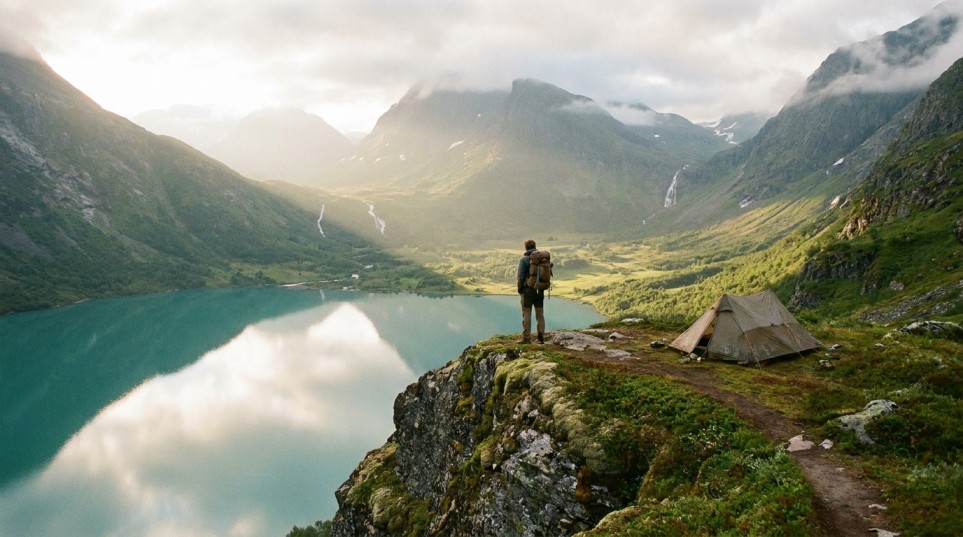
“I Just Need to Get Away” — And Why That Feeling Is Worth Acting On
You know that Sunday evening feeling — the one that creeps in around 7 PM when the weekend is almost gone and Monday is already breathing down your neck? You are sitting somewhere familiar, surrounded by familiar things, and something inside you quietly whispers: I need out. Not permanently. Just long enough to remember who I am when nobody is asking anything of me.
That feeling is not weakness. It is not selfishness. It is actually wisdom — the part of you that understands rest before exhaustion does.
Solo travel, particularly to genuinely peaceful destinations, has become one of the most searched and most personally transformative choices people are making today. Not group tours. Not all-inclusive resorts with scheduled activities every 45 minutes. Solo — just you, a bag, a window seat, and a destination that has no idea who you are yet.
But here is what most travel lists get wrong: they recommend beautiful places without considering whether those places are actually quiet. Beauty and peace are not the same thing. Santorini is stunning. It is also packed from June through September with people photographing every square inch of it.
This list is different. Every destination below was chosen for the specific, lived quality of its stillness — the kind that settles into your shoulders, loosens something in your chest, and leaves you more yourself than you arrived.
Whether you are a first-timer who has never traveled alone, a seasoned solo explorer looking for new ground, or someone who simply needs a stress-free travel destination that genuinely delivers — read on. Something here will find you.
1. Hallstatt, Austria — A Village So Quiet It Feels Like a Secret

Let me paint you a picture.
It is 6:15 in the morning. You are the only person walking the stone-paved lane that runs along the edge of Hallstätter See — a lake so still it looks painted. The Austrian Alps rise behind the village rooftops. There is no traffic, no crowd noise, no background hum of a city waking up. Just cold air, soft light, and the faint sound of water.
Hallstatt has existed in this valley for over 7,000 years. It did not become a postcard — it simply continued being itself, and eventually the world noticed. The trick is visiting it at the right time: early morning, late evening, or midweek in autumn, when the day-trippers have gone and the village returns to its natural rhythm.
Why solo travelers choose Hallstatt:
- Walking its narrow lanes alone feels genuinely private — there is no pressure to perform happiness here.
- The surrounding trails give you access to Alpine forest silence within minutes of leaving your accommodation.
- Boat rides on the lake are available; floating alone across glassy water is the kind of simple experience that stays with you for years.
- It is compact enough to know intimately in two or three days.
Honest Tip: Book accommodation inside the village, not in nearby Obertraun. The difference between waking up in Hallstatt versus commuting into it is enormous for a solo experience.
2. Kyoto, Japan — The City That Mastered the Art of Intentional Calm

There is a Japanese concept called ma — it roughly translates to the space between things, the productive pause, the value of emptiness. Kyoto seems to have been built around this idea.
Tokyo is extraordinary. But for solo travelers seeking peaceful vacation places with genuine interior quiet, Kyoto is in a different category entirely. The city moves at a cadence that does not pull you along — it invites you to set your own pace, and then accommodates whatever that pace turns out to be.
The neighborhoods that define the solo Kyoto experience — Fushimi, Arashiyama, Higashiyama — are best experienced before 8 AM, before the organized tour groups arrive. Walking the stone-paved Philosopher’s Path alone in early spring, cherry blossoms drifting like slow pink snow, is one of those experiences that does not photograph well but lives in your memory with unusual clarity.
What makes Kyoto one of the safest places for solo travelers:
- Japan consistently ranks among the world’s lowest in crime against tourists.
- The transit system (bus and subway) is logical, well-labeled in English, and genuinely reliable.
- Solo dining is entirely normalized — restaurants often have counter seating specifically designed for one.
- The culture values discretion and personal space; nobody will make you feel conspicuous for being alone.
Personal Observation: Many travelers describe Kyoto as the first place they felt the difference between being alone and being lonely. Those are two very different experiences — and Kyoto teaches the distinction effortlessly.
3. Faroe Islands, Denmark — Where the World Ends Beautifully

There is no other place on Earth that looks quite like the Faroe Islands.
Eighteen islands of volcanic rock and impossible green, suspended in the North Atlantic between Norway and Iceland, home to about 53,000 people and what feels like several million sheep. Waterfalls pour directly off cliff edges into the ocean below. Villages of grass-roofed houses cluster in valleys that look more like concept art than geography.
The Faroes are one of the most genuinely quiet destinations for solo travelers on the planet — not because they are underdeveloped, but because they are simply not crowded. The entire archipelago receives fewer annual visitors than a single popular European city does on a weekend. That means hiking trails entirely to yourself, viewpoints unobstructed by other cameras, and the profound solo travel experience of standing somewhere extraordinary with no one else around.
Practical Notes for Solo Travelers:
- English is spoken almost universally — communication is effortless
- Renting a car is the recommended approach; it gives you the freedom to stop wherever the landscape demands it
- Crime is so rare that it barely registers as a concern
- The weather is famously unpredictable — pack for all four seasons in every bag
The one thing nobody tells you: The Faroes will make you feel simultaneously very small and very capable. Both feelings are useful.
4. Chiang Mai, Thailand — Asia’s Unhurried Capital for Solo Explorers

Chiang Mai does something that very few popular tourist cities manage to do: it absorbs visitors without becoming defined by them.
The Old City — enclosed by its original moat and crumbling red-brick walls — has a self-contained quality that makes it feel like a neighborhood rather than a destination. Morning alms-giving ceremonies happen on the same streets as coffee shops full of digital nomads working peacefully on laptops. Food markets operate alongside centuries-old temples. The ancient and the present exist here without friction.
For solo travelers, especially those making their first independent trip to Southeast Asia, Chiang Mai functions almost as a soft landing. It is affordable, navigable, genuinely warm in its welcome, and structured enough to feel safe without being so sanitized that it loses its soul.
What a week in Chiang Mai can look like for a solo traveler:
- Monday: Sunrise at Doi Suthep temple before anyone else arrives
- Tuesday: A cooking class where you spend five hours learning and eating alone — but somehow end up with a table full of accidental friends
- Wednesday: Renting a bicycle and following the moat road at whatever pace your mood decides
- Thursday: A meditation session at Wat Suan Dok — open to visitors, no experience required
- Friday: Getting utterly lost in the Saturday Walking Street night market
- Saturday: Doing absolutely nothing except sitting in a good café with a book
That is a week well spent.
5. The Azores, Portugal — Europe’s Most Underrated Peaceful Vacation Place

If someone told you there was an archipelago in the middle of the Atlantic Ocean with dramatic volcanic craters, natural thermal hot springs, whale-watching year-round, and almost no crowds — and that it was part of Europe, reachable on a budget flight — you might assume they were inventing a place.
The Azores are real, and they are spectacular.
São Miguel, the largest island, packs an almost irrational amount of natural beauty into a small space. The twin crater lakes of Sete Cidades — one green, one blue, separated by a narrow bridge — look like they belong in a fantasy novel. The thermal pools at Caldeira Velha let you soak in naturally heated water surrounded by tropical forest.
What distinguishes the Azores as one of the best countries (technically autonomous regions) for solo travel is the combination of safety, affordability, and genuine tranquility. Tourism exists here, but it has not yet overwritten the local character. Bakeries are still for locals. Cafés still close at irregular hours when the owner feels like it. Life here moves on its own terms — and that slowness is contagious.
Azores Solo Travel Essentials:
- Direct flights from Lisbon (1.5 hours) and several European hubs.
- Inter-island ferries and short flights make island-hopping easy.
- Accommodation ranges from budget guesthouses to boutique volcanic stone hotels.
- Hiking difficulty varies — trails exist for every fitness level.
6. Bhutan — The Kingdom That Decided Happiness Was a Policy

Bhutan is the only country in the world that measures its success partly by the happiness of its citizens. That is not a marketing slogan — it is a constitutional principle.
The result is a country that looks, feels, and operates differently from anywhere else. Development here has been deliberate and selective. A minimum of 60% of the land is legally required to remain forested. Plastic bags have been banned for decades. Television and internet arrived only in 1999. Tourism is managed through a sustainable development fee that limits visitor numbers while funding environmental protection.
For the solo traveler who finds peace through depth rather than breadth — who would rather know one place profoundly than skim ten superficially — Bhutan delivers an experience that is simply not available elsewhere.
A few things that will stay with you from Bhutan:
- The sight of Tiger’s Nest Monastery appearing through morning cloud, clinging to a 3,000-foot cliff face
- The sound of prayer wheels turning in mountain wind
- A conversation with a guide who genuinely wants to know what you think about happiness
- The strange, clarifying feeling of being somewhere that has protected itself from the 21st century’s more exhausting elements
Important Note: Independent travel is not permitted; all visitors must book through a licensed Bhutanese tour operator. For solo travelers, this often results in a deeply personal experience — your guide becomes less a service provider and more a philosophical companion.
7. Iceland — Where the Scale of Nature Resets Human Perspective

Iceland works on solo travelers the way very few places do — not gently, but decisively.
There is something about standing next to a geyser erupting every eight minutes, or watching a glacier calve into a lagoon the color of Arctic glass, or driving the Ring Road for an hour without passing another vehicle — something that physically relocates your sense of proportion. Your problems do not disappear. They just become appropriately sized.
Iceland is one of the safest destinations for solo travelers on Earth. Violent crime is almost nonexistent. Women traveling alone consistently report feeling entirely comfortable here. The infrastructure for self-drive touring is excellent, with well-maintained roads, reliable petrol stations, and clear trail marking in national parks.
Solo Iceland: Two Ways to Experience It
For the reflective traveler: Rent a small campervan. Drive the Ring Road over 10–14 days. Wake up wherever the view demands it. This is the most free you will feel on any solo trip you have ever taken.
For the comfortable traveler: Base yourself in Reykjavik and take day tours to the Golden Circle, South Coast, and Snæfellsnes Peninsula. Return to a warm guesthouse each evening. Have long, interesting conversations with other travelers at dinner.
Both are valid. Both are extraordinary.
8. Ubud, Bali — Indonesia’s Quiet Interior and a Nature Destination Unlike Any Other

Bali is two very different islands depending on where you go.
The southern coast — Seminyak, Kuta, Canggu — is loud, beautiful, and relentlessly social. It is wonderful for many things. Deep personal peace is not typically among them.
Ubud is the other Bali — the inland, uphill, green-and-fragrant version that operates at a frequency closer to a forest than a city. Rice terraces descend in perfectly terraced steps behind guesthouses. The air carries woodsmoke and frangipani. Roosters establish the morning schedule whether you approve or not.
Solo travelers come to Ubud and, with a frequency that is almost statistical, end up staying longer than planned. There is a quality to the light here in the late afternoon — golden, slow, filtered through palm canopy — that makes leaving feel like a poor decision.
What Ubud Does for Solo Travelers:
- Yoga and meditation retreat options range from structured 7-day immersions to drop-in single classes.
- The Sacred Monkey Forest is a 30-minute walk from the center — bring your curiosity and protect your sunglasses.
- Rice terrace walks through Tegallalang are best done early morning for photography and late afternoon for atmosphere.
- The night is quiet: crickets, distant gamelan music, and the reliable sound of rain on a tile roof.
9. Sligo, Ireland — The Atlantic Edge Where Poets Go to Think

Not enough people know about Sligo.
This is largely intentional on the part of people who have been to Sligo and would prefer it stayed exactly as it is.
Located on Ireland’s northwest coast, part of the celebrated Wild Atlantic Way, Sligo is the county that produced W.B. Yeats and arguably shaped him more than anything else. The landscape here is not gentle Irish rolling green — it is dramatic, weather-worn, and slightly melancholy in the way that great literature tends to be. Flat-topped Benbulben Mountain watches over everything from an altitude that suggests judgment. The beaches at Strandhill are wild and empty and magnificent.
Solo travelers who appreciate literary history, Celtic mythology, and the particular pleasure of sitting in a pub where traditional music simply happens — not performed for tourists, but played because Tuesday evening calls for it — will find Sligo speaks to them at a register other destinations cannot access.
Honest Assessment: Sligo will not dazzle you. It will do something better — it will settle you. You will leave feeling like something that was subtly wrong has been quietly corrected.
10. Patagonia, Chile & Argentina — The World’s Edge for Travelers Who Find Peace in Motion

Some solo travelers find stillness in silence. Others find it through movement — through the specific, exhausted clarity that comes after a long day of walking through enormous wilderness with no one to talk to but yourself.
Patagonia is for the second kind.
Shared between Chile and Argentina at South America’s southern extreme, Patagonia contains some of the most awe-inspiring and least populated terrain on Earth. Torres del Paine National Park in Chile — with its famous granite towers rising 8,000 feet from the steppe — offers multi-day trekking routes that solo hikers consistently describe as among the most significant experiences of their lives.
This is not passive relaxation. This is the peace that comes from honest effort — from walking until your legs ache and your mind empties and the only thoughts left are the ones worth keeping.
Who Should Go:
- Solo travelers who are physically active and comfortable with variable weather.
- Anyone seeking a genuine digital detox (connectivity ranges from limited to nonexistent in the backcountry).
- Travelers who want to return home having genuinely pushed themselves somewhere unfamiliar.
- People who believe the best stories start with the words “I went alone”.
FAQ-Real Answers for Solo Travelers Considering a Peaceful Trip
Q: What is the single most peaceful destination for a first-time solo traveler?
Kyoto, Japan. It combines exceptionally low crime with excellent transport infrastructure, English-accessible signage, normalized solo dining culture, and a city rhythm that naturally accommodates quiet exploration. First-timers can focus entirely on the experience without managing background anxiety about safety or logistics.
Q: Are peaceful destinations actually safe for solo female travelers?
The majority of the destinations on this list are extremely safe for solo women. Japan, Iceland, Ireland, the Faroe Islands, Austria, and the Azores consistently receive the highest safety ratings for female solo travelers from independent surveys and community reports. Bhutan, Bali, and Thailand also have strong records, with the standard advice applying: stay aware, trust your instincts, and have accommodation confirmed before arrival.
Q: How much budget should I plan for a solo peaceful travel trip?
It depends entirely on the destination and your style:
- Budget-friendly (under $60/day): Chiang Mai, Ubud, Azores with guesthouses
- Mid-range ($60–$150/day): Kyoto, Sligo, Hallstatt, Patagonia
- Higher investment ($150+/day): Iceland (costs are genuinely high), Bhutan (mandatory sustainable tourism fee)
Solo travel does carry a single-supplement cost at many accommodations — hostels, guesthouses, and apartment rentals tend to offer the best value for one person.
Q: How long does it take to actually feel the benefits of solo peaceful travel?
Most experienced solo travelers report that the genuine shift — the mental decompression — happens between days three and five. The first two days typically involve logistical adjustment and the strange sensation of having no one to coordinate with. By day four, most solo travelers describe a notable drop in mental noise, a return of curiosity, and a quality of presence in the moment that daily life rarely permits.
Plan for at least seven days if you want to carry the benefits home with you.
Q: What is the one thing every solo traveler should pack that most people forget?
A physical journal. Not a notes app — a notebook with a pen. There is something about the act of writing longhand in a quiet destination that anchors the experience in a way photographs cannot. Solo travel generates an unusual volume of thought; having somewhere to put it changes the quality of the whole trip.
The Quiet Is Out There — It Has Been Waiting For You

Here is what peaceful solo travel ultimately teaches you, if you let it:
The world is far less threatening than the noise inside your head suggests. Most places are safe. Most people are kind. Most problems are solvable. And you — traveling alone, navigating an unfamiliar city or a mountain trail or a menu written in a language you do not speak — are far more capable than you have been giving yourself credit for.
The ten destinations in this guide are not just beautiful places. They are the kinds of environments that give solo travelers permission to slow down, look inward, and return to themselves.
Hallstatt will give you mornings you cannot explain. Bhutan will rearrange your priorities. Patagonia will expand your sense of what you are capable of. Kyoto will teach you that silence, handled well, is a form of luxury.
You do not need a grand reason to go. You do not need to have everything figured out. You do not need a travel companion to make an experience valid.
All you need is a destination, a date, and the decision.
The peace is already out there. Go find your version of it.
Found a destination that called to you? Drop it in the comments — and if you have already been somewhere quietly wonderful alone, share it. Solo travel is one of the few experiences that grows richer when it is shared.
Quick Reference: At-a-Glance Destination Summary
| Destination | Best For | Budget Level | Best Season |
|---|---|---|---|
| Hallstatt, Austria | Storybook solitude | Mid-range | Spring & Autumn |
| Kyoto, Japan | Cultural stillness | Mid-range | March–May, Oct–Nov |
| Faroe Islands | Raw wild nature | Mid-range | May–September |
| Chiang Mai, Thailand | Relaxed city base | Budget | November–February |
| Azores, Portugal | Volcanic landscapes | Budget–Mid | April–June |
| Bhutan | Deep cultural immersion | Higher | March–May, Sep–Nov |
| Iceland | Epic natural scale | Higher | Year-round |
| Ubud, Bali | Spiritual reset | Budget | May–September |
| Sligo, Ireland | Literary coastlines | Mid-range | May–August |
| Patagonia, S. America | Wilderness challenge | Mid-range | November–March |

