
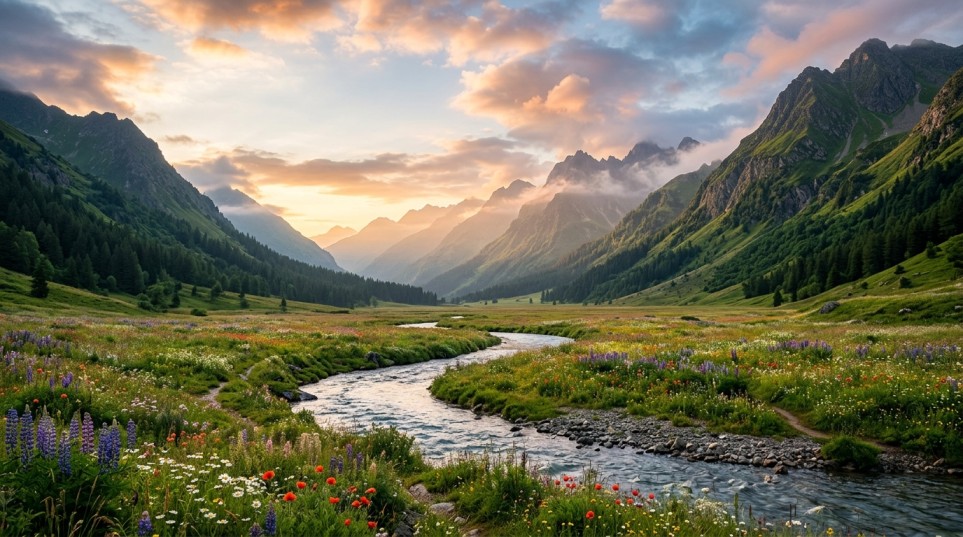
My grandmother had a word for that specific kind of place.
She called it “shunyata” — a Sanskrit-borrowed term she used loosely to mean “beautiful emptiness.” A forest path that vanishes into mist. A river bend where the current slows just enough to reflect the trees perfectly. A cliff edge where the wind arrives before the view does.
She passed away before smartphones. Before Instagram turned every hidden waterfall into a waiting line. Before “hidden gem” became a marketing phrase used to describe places that sell branded water bottles at the entrance.
I think about her often when I travel. And I travel specifically to find the places she would have loved — places that haven’t been processed yet, packaged yet, or performed at yet.
This guide is the result of three years of that kind of searching.
These aren’t the prettiest destinations on Earth. They’re not even necessarily the most dramatic. But they are genuinely unknown, genuinely untouched, and genuinely worth every complicated kilometer it takes to reach them.
If you’re a nature lover who’s been quietly disappointed by how crowded the “hidden” places have become — read on. This one’s for you.
What Makes a Place Truly Untouched? (And Why It Matters More Than You Think)

Let me be honest about something upfront.
“Untouched” is a complicated word. Almost nowhere on Earth has zero human footprint. Indigenous communities have shaped forests for millennia. Herders have traced the same mountain passes for centuries. Rivers have been fished, valleys have been farmed, and even the wildest-seeming landscapes carry human histories in their soil.
What I mean by untouched — and what most serious nature lovers mean — is this: places where the ecosystem still sets the terms. Where the animals haven’t learned to avoid humans. Where the vegetation isn’t shaped by visitor management. Where the trail doesn’t have a gift shop at the end of it.
Those places still exist.
They’re just not the ones that appear on the first page of search results.
9 Best Unknown Destinations for Nature Lovers
1. Lencóis Maranhenses, Brazil — Where the Desert Fills With Water and Nobody Explains It Better Than Standing There

I’ll be upfront: this place breaks the brain a little.
Imagine two hundred thousand hectares of pure white sand dunes — classic Sahara-style, rolling and windswept and silent. Now imagine those dunes filling with thousands of freshwater lagoons between January and September. The water is so clear it looks edited. The dunes between the lagoons glow in the afternoon light like something between a desert and a dream sequence.
The science is straightforward enough: heavy seasonal rains collect in the low valleys between dunes, and because the sand is too compact for water to drain through, the lagoons form and persist for months. But standing at the top of a dune looking down at an impossibly blue lagoon surrounded by white sand — the science feels inadequate.
Lencóis Maranhenses National Park exists. It’s technically “known.” But it sits in Maranhão state — Brazil’s northeast, which gets a sliver of the tourism that floods Rio and Amazonas. Most of the park’s interior is reached only by four-wheel-drive vehicles and local guides who know which sand valleys flood shallowest and which routes shift year to year as the dunes migrate.
The experience nobody tells you about: Swimming in a warm lagoon at sunset while a completely empty horizon of white dunes glows pink around you. Not a soul in any direction.
Best months: June through August — lagoons are fullest, temperatures are bearable. Getting there: Fly to São Luís, then a bus or private transfer to Barreirinhas. The park itself requires a local guide — don’t skip this. The landscape genuinely changes year to year.
2. The Wakhan Corridor, Tajikistan — A Valley That History Walked Through and Tourism Forgot

There’s a narrow strip of land in eastern Tajikistan that exists because 19th-century British and Russian imperial mapmakers needed a buffer zone between their empires. The result — accidental, political, and strange — is the Wakhan Corridor: a valley flanked by the Hindu Kush on one side and the Pamir range on the other, running for roughly 220 kilometers with almost no paved road and almost no visitors.
The Wakhi people live here. Silk Road traders passed through here. Marco Polo reportedly traveled this route in the 13th century and described landscapes so extreme they seemed invented.
They’re not invented.
The Pamir peaks above the valley top 7,000 meters. The river running through it — the Panj, which forms the border with Afghanistan — carries ice-cold water from glaciers that have been receding slowly but are still enormous. Yak caravans still move through the valley in summer. Villages of stone houses, with flat rooftops stacked with winter firewood, sit at elevations where the air is thin enough to feel different in your lungs.
This is the kind of offbeat nature travel spot where the landscape and the human story are completely inseparable. You cannot understand one without the other.
The experience nobody tells you about: Camping below a Pamir glacier while a family of Wakhi herders sets up their summer camp two hundred meters upwind. Their dogs check you out. Their children wave and then return to their work. Nobody is performing anything for anyone.
Best months: June through September. The corridor is effectively inaccessible in winter. Note: Requires a GBAO permit in addition to a standard Tajikistan visa. Apply early. Worth every bureaucratic step.
3. Ennedi Plateau, Chad — Saharan Rock Art and Canyons That Make No Sense

Most people’s mental image of Chad involves conflict or crisis — understandably, given recent history. But the northeastern corner of the country contains a landscape so extraordinary it was declared a UNESCO World Heritage Site in 2016, and it still receives almost no international visitors.
The Ennedi Plateau is a sandstone massif in the middle of the Sahara. Wind and water over millions of years have sculpted it into arches, towers, canyons, and passages that look like architecture rather than geology. The most famous formation — Aloba Arch — is among the largest natural arches on Earth.
Inside the sheltered canyon walls: rock paintings and engravings left by communities who lived here when the Sahara was green, 5,000 to 10,000 years ago. Hippos, crocodiles, giraffes, and cattle rendered in ochre and charcoal on sandstone walls — a record of a world that has been desert for millennia.
There are crocodiles here still, living in isolated pools in the canyon depths, descendants of populations that have been landlocked for thousands of years. They’re smaller than their river-dwelling relatives. They’re also genuinely prehistoric in the way their existence is.
The experience nobody tells you about: Standing in a canyon that has stone walls forty meters high on both sides, rock art to your left, a crocodile pool to your right, and absolute Saharan silence above. Time feels different here. Thinner.
Best months: November through February — temperatures are manageable, and the light on the sandstone in morning and evening is remarkable. Getting there: Fly to N’Djamena, then to Faya or Abeché. Expeditions require a specialist operator. This is not DIY territory, but specialist operators who know the region are excellent.
4. Tara River Canyon, Montenegro — Europe’s Amazon, Mostly Unexplored

The Tara River Canyon is the second deepest river canyon in the world after the Grand Canyon. That’s not a niche claim — it’s a geographical fact that most people simply don’t know because Montenegro gets overshadowed by its neighbors.
What most visitors who do come experience: the famous Đurđevića Tara Bridge and a rafting trip through the easier upper sections of the canyon.
What almost nobody experiences: the deeper sections of the canyon, accessible only by hiking trails that descend through ancient black pine forests — some of the last old-growth conifers in Europe — into a gorge so deep and so narrow that sunlight reaches the river for only a few hours each day.
The river at the bottom is glacial blue-green. The canyon walls tower up to 1,300 meters on either side. The forest is dense enough and old enough that the understory feels permanent — like it has been exactly this way for centuries, because in many places, it has.
The experience nobody tells you about: Reaching the river at the canyon bottom after two hours of descent and finding the sound completely different. The canyon amplifies the water until it fills the whole space. You don’t just hear the river — you feel it.
Best months: May, June, and September for hiking. July and August for rafting (and crowds, relatively speaking). Honest note: The descent trails require proper footwear and a reasonable fitness level. They’re not technical, but they’re serious.
5. Rann of Kutch, India — The Salt Desert That Blooms Overnight

Gujarat’s Rann of Kutch is known in India. But it is almost entirely unknown outside it — which means it remains one of the most startling landscapes most international travelers will never find.
The Great Rann is one of the world’s largest salt flats: a vast, white, nearly featureless plain for most of the year. And then the monsoon arrives.
Between August and October, portions of the Rann flood with shallow water — rarely more than ankle or knee deep — turning the flat salt desert into a mirror that reflects the sky with such precision that the horizon disappears. You can walk out into what feels like the middle of a cloud. Above you, sky. Below your feet, a perfect reflection of sky. No visible edge in any direction.
But the Rann’s greatest secret is wildlife. The Indian Wild Ass Sanctuary in the Little Rann protects the last significant population of khur — the Indian wild ass — along with wolves, desert foxes, and flamingo breeding colonies in the seasonal wetlands.
This is one of the best scenic places for nature lovers in India that isn’t in a single international travel guide targeting foreign visitors.
The experience nobody tells you about: Standing in the flooded Rann at dawn when the flamingos lift from the shallow water in a single, coordinated wave — thousands of birds turning the pink horizon into motion.
Best months: November through February for salt flat access. August through October for the flooded mirror effect (access requires local guidance). Getting there: Fly to Bhuj. Hire a local guide for the interior — the landscape is disorienting in the best possible way and genuinely easy to get turned around in.
6. Croajingolong National Park, Australia — The Coast Victoria Kept to Itself

Australia’s most famous coastline — the Great Ocean Road — is extraordinary and genuinely worth the visit. It is also extremely well-visited.
Croajingolong, tucked into the far eastern corner of Victoria near the New South Wales border, receives a fraction of the attention. It protects 87,500 hectares of coastal wilderness — eucalyptus forests, granite headlands, estuary systems, and beaches that can be walked for an entire day without seeing another person.
The diversity is the thing. In the space of an hour’s walk you can move through wet rainforest, cross open heathland covered in wildflowers, descend to a beach where little penguins nest in sand dune burrows, and watch osprey fishing in the river mouth below a headland of ancient granite.
Croajingolong is a UNESCO Biosphere Reserve. It is also, somehow, not famous. Australians in Melbourne know about it vaguely. International visitors essentially never go.
The experience nobody tells you about: The Thurra River mouth at low tide, when the estuary is completely still and the reflection of the surrounding forest creates a landscape that feels painted rather than real.
Best months: September through November (spring) for wildflowers and wildlife. March through May for quieter conditions and warm water.
7. Bwindi Impenetrable Forest, Uganda — Beyond the Gorillas (Yes, There’s a Beyond)

Bwindi IS known — for mountain gorillas, which are extraordinary and absolutely worth the permit cost. But here’s the thing almost nobody talks about:
Bwindi Impenetrable Forest is one of Africa’s most biodiverse ecosystems, and gorilla trekking covers a tiny fraction of it. The forest protects over 350 bird species — making it one of the most important birding sites in Africa. It contains primate species beyond gorillas: chimpanzees, l’Hoest’s monkeys, black-and-white colobus. It has plants found nowhere else on Earth.
And outside the gorilla trekking sections, the forest is almost entirely visited by local researchers and the occasional serious birder.
Walking the community trails in the buffer zone, through forest so dense the canopy closes thirty meters above your head and the floor is perpetual green twilight, is one of the most atmospheric nature experiences in East Africa — and it costs a fraction of a gorilla permit.
The experience nobody tells you about: The forest at 5am, before the gorilla trekking groups depart, when the birds are at their loudest and the mist is still sitting in the gaps between trees. African hill forest in that light, in that sound, is genuinely arresting.
Best months: June through August and December through February — drier periods for trails. Honest note: Gorilla permits sell out months in advance. The bird walks and community trails don’t. Plan accordingly.
8. Aysén Region, Chilean Patagonia — South of Where the Maps Get Detailed

Everyone knows Torres del Paine. Fewer people know that Chilean Patagonia extends for another thousand kilometers south of Torres del Paine into a region called Aysén — a landscape of fjords, ancient forests, glaciers, and river systems so remote that much of it has never been surveyed on foot.
The Carretera Austral — Chile’s southern highway — runs through Aysén, and while it has become more traveled in recent years, the destinations off the Carretera remain almost entirely unexplored by international visitors.
The Río Cochrane. The Cerro Castillo trail (increasingly known, but still a fraction of Torres del Paine’s traffic). The Valle Exploradores, where a single dirt track leads to the edge of the Northern Patagonian Ice Field — the third-largest freshwater reserve on Earth — and the sound of calving glaciers carries across a lagoon that has no name on any tourist map.
The experience nobody tells you about: Arriving at the edge of the ice field after a two-day approach and realizing that what you thought was cloud on the horizon is actually the ice itself — white, continuous, and extending further than you can track.
Best months: November through March for Patagonian summer. Book accommodation on the Carretera early — it’s basic but limited.
9. Mulu Caves and the Kelabit Highlands, Malaysian Borneo — The Jungle Interior Nobody Reaches

Sarawak in Malaysian Borneo is not unknown. But it’s also not fully known — and the distinction matters.
The Mulu Caves — Gunung Mulu National Park — are technically on the tourist map: a UNESCO site famous for Deer Cave, one of the world’s largest cave passages, where millions of wrinkle-lipped free-tailed bats pour from the entrance at dusk in columns that writhe and fold against the sky for twenty minutes every evening.
But adjacent to Mulu, and requiring a small prop plane to reach, is the Kelabit Highlands: a plateau at 1,000 meters, covered in intact primary rainforest, home to the Kelabit people, and accessible only by air or a multi-day jungle trail. The birding is world-class. The forest is primary — old-growth tropical rainforest that has never been logged. The villages are genuine communities, not tourism performances.
The experience nobody tells you about: Waking up in a longhouse guesthouse in Bario to the sound of the forest starting — hornbills calling from the canopy, and a mist sitting low over the highland plateau that makes the treeline look painted on.
Best months: March through October — drier period. The Highlands can receive rain year-round, but the main wet season reduces trail access significantly.
How to Evaluate Any “Hidden” Destination Before You Go
A practical framework, because not everything marketed as hidden actually is:
The Google Image Test. Search the destination name. If the first three pages are all professional photography with recognizable angles repeated across multiple accounts, it’s not hidden — it’s been discovered and branded. Real hidden nature destinations have sparse, inconsistent, low-resolution imagery from the few travelers who’ve documented them.
The Infrastructure Question. Ask: is there a visitor center? A branded entrance gate? A set visiting window? Dedicated parking? These aren’t negatives — they’re just signals that a place has been absorbed into managed tourism. Peaceful nature escapes tend to have minimal formal infrastructure.
The Local Ratio. When you’re there, what percentage of people you see are locals versus international tourists? A place where locals significantly outnumber visitors is still a place where the experience belongs to the landscape rather than to the tourism industry.
The Seasonal Logic. Does the destination have a strict “peak season” heavily promoted in travel marketing? Genuinely unknown destinations don’t have marketing. They have weather patterns. Understand the weather and let that guide your timing.
Traveling Responsibly in Secret Natural Destinations

This matters more than almost any other part of this guide.
The fragility principle. Unknown destinations are often unknown because they’re ecologically fragile or logistically difficult. Their protection is often accidental — a function of remoteness rather than active conservation. When you visit, you become part of the story of whether they stay that way.
Never be the person who posts GPS coordinates. Share the feeling, the region, the experience. Not the exact location of the nesting site, the unmarked cave, the unmarked trail junction. You don’t owe the algorithm a complete map.
Hire local expertise every time it’s available. Not as a tourism convenience but as an economic argument for conservation. When local families make income from natural areas, those areas get protected. When they don’t, they get logged, farmed, or developed.
Learn the local concept of the land. Many of the most beautiful hidden places in the world are significant to indigenous or local communities in ways that have nothing to do with their visual appeal. Understanding that context before you arrive changes how you experience the place — and how you behave in it.
Take nothing. Leave nothing. Disturb nothing. This sounds like a poster in a ranger station. It is. It also genuinely works.
Frequently Asked Questions About Unknown Nature Destinations
Q: How do I actually find destinations this remote? Where do I even start?
Three underused sources: (1) Reports from scientific expeditions and field researchers — they describe landscapes without commercial motive. (2) Overlanding forums and long-distance cycling communities — these travelers move slowly through places and notice what faster travelers miss. (3) Regional tourism boards of countries that are not major tourism destinations — they often promote genuinely unknown places because they have nothing else to compete with.
Q: Is it ethical to visit genuinely untouched places, given the risk of disturbing them?
This is a real question and it deserves a real answer. Thoughtful, low-impact visitation is almost always preferable to zero visitation from a conservation standpoint — because tourism revenue provides economic arguments for protection. The problem isn’t visiting; it’s visiting without care. Research the place, follow the principles of Leave No Trace, hire locally, and go with genuine respect for what you’re entering.
Q: What’s a realistic budget for remote nature travel?
It varies enormously by destination. Some of the most remote places — highland Kyrgyzstan, inland Estonia, interior Croatia — cost very little once you’re there, because infrastructure is basic and local costs are low. Others — Mulu, Ennedi, the Wakhan — require specialist logistics that carry real costs. The general rule: getting there costs more. Being there often costs less.
Q: How do I handle medical emergencies in genuinely remote locations?
Travel insurance with emergency evacuation coverage is non-negotiable for remote travel. Carry a basic wilderness first aid kit and know how to use it. Take a wilderness first aid course if you’re planning serious remote travel — a one-day course covers the scenarios you’re most likely to face. And always tell someone at home your itinerary, check-in schedule, and what to do if they don’t hear from you.
Q: Can families with children visit these kinds of destinations?
Some yes, some absolutely not. Lencóis Maranhenses, the Rann of Kutch (in season), Croajingolong, and Bwindi (non-gorilla sections) are all accessible to families with children who are comfortable with basic outdoor conditions. The Wakhan Corridor, Ennedi Plateau, and Deosai Plateau require physical capability and logistical tolerance that makes them adult-only in practice.
The Map Is Not the Territory — Go Find the Territory
There’s a particular kind of disappointment that comes from arriving somewhere you’ve seen a thousand photographs of and finding that the photographs told the whole story. That the place is beautiful, yes. But it’s a beauty you’ve already consumed. There’s nothing left to discover because discovery has already been done, packaged, and distributed.
The destinations in this guide are the opposite of that.
They’re places where the photograph — if you take one — will look like nothing in particular compared to standing there. Where the experience exceeds the documentation. Where you come back changed in some small but real way, because you stood somewhere that hasn’t yet been explained to you in advance.
My grandmother would have loved all of them.
She would have stood at the edge of a Lencóis lagoon, or on the salt flat of the Rann at dawn, or at the mouth of a Patagonian ice field, and she would have used her word.
Shunyata. Beautiful emptiness.
Go find yours.
If this guide helped you see the world a little differently — share it with someone who needs to wander somewhere real. Not the link. The idea.
The world is wider than any list. These are just nine doors.

