
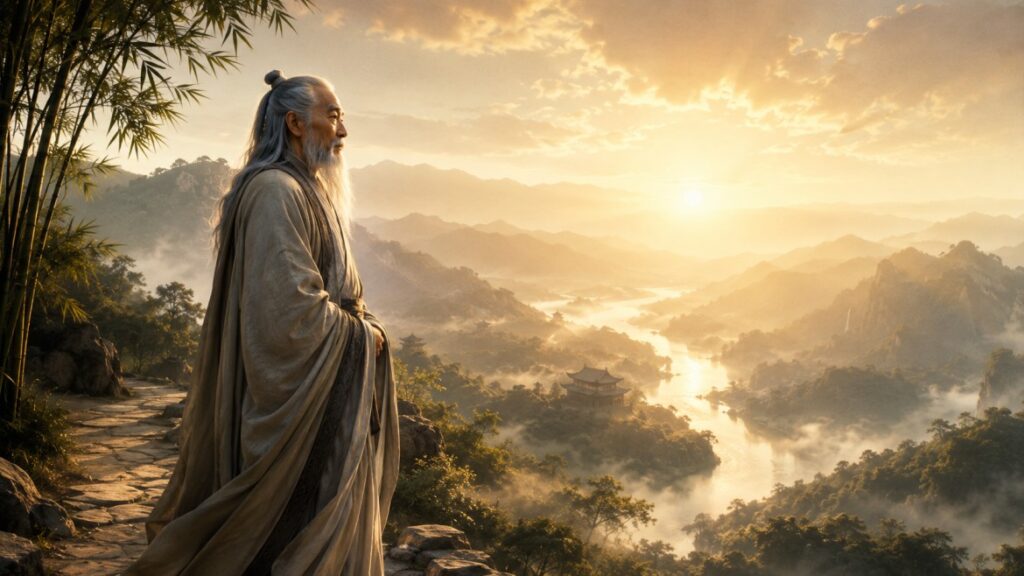
There is a particular kind of silence that only arrives when you are far from home.
Not the silence of an empty room. Not the silence of a muted phone. Something richer — the silence of being a stranger somewhere, of having no appointments, no reputation, no version of yourself that anyone around you knows or expects. You are just a person on a road, and the road does not care who you were last week.
I first felt that silence properly in a mountain village in northern India. I had taken three wrong buses to get there. I had no data signal. My shoes were wet. And I remember sitting on a low stone wall as the late afternoon light poured gold across the valley, thinking — this is it. This is the thing I have been trying to find.
I did not have the language for what I felt that evening. But Lao Tzu did. He wrote it down roughly 2,500 years ago, and somehow, impossibly, his words still fit.
This article is a collection of the most grounding travel quotes of the day by Lao Tzu — not presented as motivational decoration, but unpacked with real context, personal reflection, and honest thought. Because these are not just pretty lines. They are instructions. And if you travel — or if you are navigating any long, uncertain road in life — they are worth sitting with slowly.
Who Was Lao Tzu, and Why Should Travelers Listen to Him?
Before we get into the quotes themselves, let us spend a moment with the man — or at least, the legend.
Lao Tzu was a keeper of the imperial archives in Zhou dynasty China, probably somewhere around the 6th century BCE. He was a quiet man by all accounts. A watcher, not a talker. He spent decades observing — rivers, seasons, people in power making poor decisions, ordinary people making wiser ones — and he drew conclusions that still hold up today.
At some point late in his life, so the story goes, he grew tired of the corruption around him and decided to leave. A border official stopped him at the western gate and, recognizing a sage, asked him to write down his wisdom before disappearing. Lao Tzu sat down and produced the Tao Te Ching — roughly 5,000 Chinese characters, 81 short chapters, one of the most translated books in human history.
Then he walked into the mountains and was never seen again.
His final act was a journey. His life’s work was about the Way — the Tao — which is, at its root, a word for a path. A road. A direction of movement through the world.
There is no philosopher in history more naturally suited to the traveler’s soul than Lao Tzu. He never wrote a packing list. But he understood the inner terrain of travel better than almost anyone who followed him.

The Travel Quotes of the Day by Lao Tzu That Actually Mean Something
“A Journey of a Thousand Miles Begins with a Single Step.”
Let us start with the obvious one — the quote you have almost certainly seen before, possibly on a poster, possibly on someone’s forearm as a tattoo. Stay with me here, because I think most people read this quote at about 20% of its actual depth.
What Lao Tzu is not saying: “Big journeys seem scary but they are worth it, so be brave!”
What he is actually saying is something far more radical: the thousand miles are irrelevant to the question of whether you begin. You do not need to think about a thousand miles. You need to think about one step. The enormity of the journey is a trick your mind plays on you. The step in front of you is real.
This is one of the most practically useful Lao Tzu journey quotes for anyone who has ever delayed a trip — or a life decision — because the whole thing felt too large.
The person who has been putting off solo travel for three years is not really afraid of the airport or the foreign country. They are afraid of the thousand miles. Lao Tzu says: stop looking at the thousand miles. Where is the first step? Your passport. A flight search. One email to your boss requesting leave. One step.
I have used this principle to book some of the most important journeys of my life. Not by working up the courage to go. By working up the courage to do one small thing, and then letting the next thing follow naturally.
The quote is not motivational. It is methodological.
“To the Mind That Is Still, the Whole Universe Surrenders.”
Here is a calming travel quote that deserves to be read slowly, ideally while not doing anything else.
Modern travel culture has a productivity problem. We treat trips like projects. We have spreadsheets of attractions. We “do” a city in 48 hours. We stand in front of things that took centuries to build and give them 90 seconds before moving on to the next item on the list. We come home with 600 photographs and a bone-deep tiredness, wondering why we do not feel refreshed.
Lao Tzu diagnosed this problem millennia before the first guided tour existed.
The universe — and by universe he means the full depth of any experience, any place, any moment — does not reveal itself to a busy, grasping mind. It reveals itself to a still one. Not a passive one. Not a switched-off one. Still. Present. Receptive. Unhurried.
I had a moment in Kyoto that illustrated this perfectly. I had been rushing between temples all morning — checked off the famous ones, photographed the famous gates. By early afternoon I was tired, and I stopped in a small, unremarkable garden that was not in any guidebook. I sat on a wooden bench for maybe 40 minutes. No phone. No notebook. Just watching a pond.
By the time I stood up, I felt like I had actually been somewhere. All the famous temples that morning had been noise. That ordinary garden, approached with stillness, had been a universe.
That is what this mindful travel quote is pointing at. The places are not the point. Your relationship to them is.

“Nature Does Not Hurry, Yet Everything Is Accomplished.”
If you have been following the slow travel movement — or if you simply feel exhausted by the pace of modern life — this is your quote. These eight words are among the most quietly liberating things Lao Tzu ever said, and they are entirely relevant to how we travel.
Think about what actually lasts. Think about what actually moves you in the places you visit. Is it the famous landmark you queued for? Or is it the meal that went on for three hours because you kept ordering more, and the restaurant owner sat down with you at 10 PM and told you about his grandfather? Is it the checked-off sight? Or the unhurried afternoon that somehow contained everything?
Nature — and Lao Tzu observed nature constantly — does not optimize. The river does not take the most efficient route to the sea. It takes the easiest one, following gravity, curving around obstacles, pooling in valleys. And eventually, patiently, it carves a canyon.
This is one of those peaceful travel sayings that challenges the entire premise of how most of us vacation.
You do not need to see everything. You need to see some things properly. A single city understood deeply is worth more than a six-country sprint photographed from the surface. A single conversation with an unhurried stranger in a small town can rewrite something inside you that a hundred famous attractions cannot touch.
Go slower. The best things are accomplished that way.
“Knowing Others Is Intelligence. Knowing Yourself Is True Wisdom.”
Here is the question that every serious traveler eventually has to face, usually somewhere between the second and third year of regular travel: Why am I actually doing this?
The first honest answer is usually: because I love discovering other places and other people. And that is real — that is the intelligence Lao Tzu talks about. Learning how different cultures structure their days, their meals, their relationships, their silences — this is a genuine form of knowing. Travel gives you more data about humanity than almost any other experience. It stretches your sense of what is possible, what is normal, what is arbitrary.
But the deeper answer — the one that tends to arrive on a long overnight train or a solo beach at dawn — is different. Travel does not just show you other people. It strips away the social costumes you wear at home and shows you yourself. Away from your routines, your role, your reputation, the version of you that other people have built over years of knowing you — who are you actually?
This is the essence of travel quotes for inner peace from Lao Tzu’s tradition: peace does not come from seeing enough of the world. It comes from knowing enough of yourself to move through the world without being at war with it.
The truly peaceful traveler is not someone who has visited 40 countries. It is someone who has learned, through movement and exposure and discomfort and wonder, to be at ease with who they are.
“When You Realize There Is Nothing Lacking, the Whole World Belongs to You.”
This one stops people mid-scroll and I understand why.
We live in a travel culture that is built almost entirely on the premise of lacking. You have not been to Iceland. You have not seen the Northern Lights. You have not experienced that beach, that festival, that restaurant. Your travel bucket list is, by design, never complete. There is always more. The algorithms know this and feed it to you constantly.
Lao Tzu looked at this tendency — the endless craving for the next thing — and quietly suggested that it is the primary source of human suffering. Not because wanting things is wrong. But because the belief that you are incomplete without them is a lie.
The traveler who arrives in a new city feeling that the city needs to deliver something to them will always be mildly disappointed. The traveler who arrives feeling whole — curious, present, already enough — will find treasure in a side street, a market, a chance encounter, a sky.
This is not a passive idea. It is not about lowering expectations. It is about recognizing that the richness of an experience is not in the experience itself — it is in the quality of attention you bring to it. And you cannot bring good attention to anything if you are secretly desperate for it to fill a hole.
When you travel from abundance rather than lack, everything you encounter becomes a gift rather than a transaction.

“The Flame That Burns Twice as Bright Burns Half as Long.”
This is one of the inspirational journey quotes attributed to Lao Tzu that speaks directly to the well-traveled but chronically burnt-out wanderer.
There is a type of traveler — and I have been this person at certain points — who travels furiously. Back-to-back trips. No rest between adventures. A slightly panicked quality to the pace, as if stopping might mean missing something irreplaceable.
The flame that burns twice as bright burns half as long.
Sustainable travel — sustainable movement through life — requires rhythm. Periods of intense experience followed by periods of genuine rest. Not rest as in lying in a resort doing nothing, but rest as in returning to stillness, processing what you have taken in, allowing the experiences to settle into wisdom rather than noise.
Some of the deepest travel insights I have had did not arrive on the road. They arrived three weeks later, at home, in a quiet morning with a coffee, when something that happened on the trip suddenly made complete sense.
The journey does not end when you unpack. And the next journey is better when you have genuinely absorbed the last one.
“Silence Is a Source of Great Strength.”
Of all the soul-calming quotes in Lao Tzu’s writing, this may be the most underrated — and the most countercultural.
We fill travel with sound. Podcasts on the flight. Music on the walk. Group conversations at every meal. Background noise in hotel rooms because silence feels uncomfortable. We have become so habituated to constant input that genuine quiet feels like something has gone wrong.
But Lao Tzu spent his life studying what silence does to a person who stays with it long enough. And his conclusion was not that silence is peaceful (though it is). His conclusion was that silence is powerful. It is generative. Things grow in silence that cannot grow in noise.
The best travelers I have ever met — the ones who carry something genuinely settled about them, who seem to have found something most people are still looking for — tend to be people who have made a practice of silence on the road. An hour of sitting in a place without documenting it. A meal eaten slowly without conversation. A morning walk without headphones through a neighborhood that has nothing famous in it.
These are not wasted moments. They are where the real travel happens.
How Ancient Wisdom Travel Quotes Apply to Everyday Life
Something important needs to be said here: you do not have to be on a physical journey for any of this to matter.
Lao Tzu was not writing travel guides. He was writing about the movement of life itself — through seasons, through loss, through transformation, through the long and uncertain road between being born and becoming wise. The journeys he cared most about were interior ones.
The motivational travel thoughts above apply with equal force to:
The career transition that feels like standing at a border without a map. Take the single step. Trust the natural pace of things.
The relationship that has entered unfamiliar territory. Bring stillness to it. Stop trying to see everything at once.
The grief that feels like a journey with no destination. Nature does not hurry, yet everything is accomplished. Even this.
The creative project that sits unstarted because the whole of it is too large to hold. A journey of a thousand miles begins with a single step.
Lao Tzu’s wisdom travels well because it was never really about geography. It was always about the Way — the road that every human being walks, whether they leave home or not.

A Short Practice-Traveling with Lao Tzu’s Eyes
Here is something concrete to take with you, whether you are boarding a plane next week or simply navigating the ordinary terrain of your Tuesday:
Morning ritual: Before the day begins, read one Lao Tzu quote. Not to analyze it. Just to let it sit in you while you drink your coffee. Let it be a lens for the day rather than a task to complete.
On arrival: When you reach a new place — a new city, a new job, a new relationship — spend the first hour as a student rather than a judge. Observe before you conclude. The place will show you what it is if you are patient enough to watch.
In discomfort: When travel goes wrong — and it always does, at some point — ask what is being offered rather than what has been taken. A delayed train, a wrong turn, an unexpected closure. Lao Tzu would call these the places where the real journey begins.
At the end of the day: Five minutes of genuine silence. No review of photographs, no journaling, no planning. Just sitting with what happened. This is where the experience becomes wisdom.
FAQ-Travel Quotes of the Day by Lao Tzu
Q. Which Lao Tzu quote is most relevant to travelers?
“A journey of a thousand miles begins with a single step” is the most directly travel-related, but “To the mind that is still, the whole universe surrenders” is arguably the most transformative for how you actually experience a journey. The first helps you begin. The second helps you arrive — truly arrive — once you are there.
Q. Did Lao Tzu travel much himself?
Historical records are thin, but tradition holds that Lao Tzu’s greatest journey was his final one — a westward departure from the imperial court into the mountains after growing disillusioned with political life. It was during this journey that, at the request of a border official, he wrote the Tao Te Ching. So his most important creative act was literally a travel document.
Q. How do I use Lao Tzu’s philosophy for mindful travel?
The core practice is wu wei — going with the natural flow rather than forcing an outcome. In travel terms: hold your plans loosely, welcome detours, prioritize presence over productivity, and trust that the journey is wiser than your itinerary. Arrive as a student. Leave as someone who has been changed.
Q. Are these quotes good for solo travel?
They are particularly suited to solo travel, which is one of the most powerful mirrors a human being can hold up to themselves. Solo travel puts you in direct conversation with Lao Tzu’s central question: who are you when no one who knows you is watching? The quotes become companions rather than decoration when you are traveling alone and the nights are quiet and the questions get real.
Q. What books should I read alongside the Tao Te Ching for travel inspiration?
The Tao Te Ching itself, in a good translation (Ursula K. Le Guin’s is unusually beautiful). Zhuangzi’s collected writings for more Taoist wisdom. Bruce Chatwin’s The Songlines for a meditation on why human beings need to move. And Pico Iyer’s The Art of Stillness — which is, perhaps fittingly, a book about travel written entirely about the importance of not moving.
Let the Road Teach You
Lao Tzu walked away from everything he knew, put his life’s wisdom into 5,000 characters, and disappeared into the mountains. He did not tell anyone where he was going. He did not document the journey. He did not return.
And yet his words are still here, still traveling, still arriving at exactly the right moment in the lives of people who need them.
That is what the best journeys do. They do not end when you come home. They travel forward with you, inside you, reshaping the way you see and move through the world for years afterward.
The travel quotes of the day by Lao Tzu collected here are not just beautiful sentences. They are a philosophy of movement — a way of being on the road, and a way of being in a life — that cuts through all the noise of modern travel culture and asks a simpler, more important question:
Not where are you going, but how are you moving?
Take the single step. Carry your stillness with you. Trust the natural pace of things. And remember that every road, taken with open eyes and a quiet mind, leads somewhere worth going.
The journey, as Lao Tzu spent his life insisting, is the destination.
If this piece spoke to you, share it with someone standing at the start of a road they are not sure about yet. Sometimes the right words at the right moment are all the map anyone needs.

