
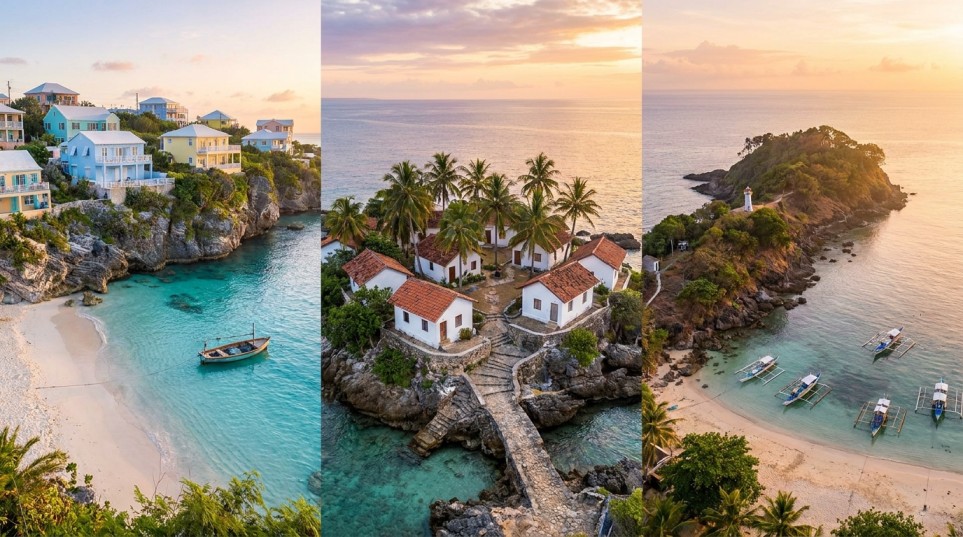
I remember the exact moment I stopped chasing famous beaches.
It was a Tuesday afternoon in August. I was standing on one of the “most beautiful beaches in the world” — the kind that appears on every travel magazine cover — and I couldn’t see the sand. Literally. Between the sunbeds bolted together like stadium seating, the vendors circling every five minutes, and the DJ booth that started thumping at noon, there was no beach left. Just a very expensive, very loud parking lot next to the sea.
That evening, I opened a map and started drawing circles around places nobody had mentioned to me — the next island over, the town behind the headland, the fishing village with no direct bus. What I found over the following years quietly changed how I travel forever.
This article is the distilled version of that search. These are 15 quiet beach towns around the world that don’t just look beautiful — they feel beautiful in a way that only happens when a place hasn’t been polished for consumption. Some are remote. Some are surprisingly easy to reach. All of them are the kind of places where you look around on your last morning and think: I need more time.
Why the World’s Best Beaches Are Hidden in Plain Sight

Here’s something the travel industry doesn’t broadcast loudly: the coastline of this planet is almost incomprehensibly long. The world has over 620,000 kilometers of it. Every major tourism campaign funnels millions of people toward maybe a few hundred of those locations.
Everything else? It’s just sitting there. Waiting. Often more beautiful than the famous version.
The best hidden beach towns share a few things. They have communities that existed before tourism arrived — fishing families, farmers, craftspeople — so the place has a soul that predates the Instagram era. They’re usually one inconvenient journey past somewhere famous. And they tend to ruin you for ordinary beach holidays in the best possible way.
1. Marettimo, Sicily — Italy’s Most Forgotten Island

Most first-time visitors to Sicily follow the well-worn path: Palermo for the street food, Taormina for the views, Cefalù for the cathedral. All worth it. But if you do any of that and miss Marettimo, I’d gently suggest you didn’t actually see Sicily.
Marettimo is the most westerly of the Egadi Islands, sitting about 40 kilometers off Trapani in the open Tyrrhenian Sea. The ferry ride is roughly 50 minutes, and the contrast between that boat dock and the rest of modern Italy is almost comedic. There are no cars on the island. The roads are too narrow even if there were. The population hovers around 700 people, most of whom are either fishing or related to someone who is.
The water around Marettimo belongs in a different category entirely. Translucent turquoise shading into deep cobalt, with visibility so clear you can watch the sea floor pass beneath you while snorkeling in 15 meters of water. There are sea caves along the coastline that you can only reach by renting a small boat, which costs almost nothing and is one of the most joyful ways to spend a morning I’ve ever found.
There’s no nightclub. There’s one small piazza with a handful of tables where people sit until midnight without needing entertainment beyond each other. The bars close when the barman feels like closing them.
Stay: One of the small family-run guesthouses in the village. Book early — there aren’t many rooms.
Go: May or September. Summer gets warmer and the boat is fuller.
2. Comporta, Portugal — Flamingos, Rice Paddies, and Miles of Empty Sand

Portugal has done an extraordinary job of keeping Comporta relatively quiet for as long as it has, given how close it sits to Lisbon. About 90 minutes south of the capital, the road in takes you through flat wetlands where rice paddies stretch to the horizon and flamingos stand in the shallows like they own the place — because they largely do.
The beaches here are a different species from the cliff-backed coves of the Algarve. They are vast. Wide and flat and open, backed by pine forests and dunes that absorb whatever crowds do arrive. Even in July, you can walk 20 minutes from the nearest car park and find a stretch of Atlantic coastline where you’ll be entirely alone.
The town itself has changed somewhat in the past decade — it’s attracted a quieter, wealthier European crowd, and there are now some genuinely excellent restaurants serving natural wines and fresh seafood at prices that reflect that demographic shift. But Comporta has managed, so far, to absorb this without losing its core character. The wooden shacks. The simplicity. The way the light bends gold over the dunes at 6pm.
3. Vieques, Puerto Rico — The Island That Lights Up at Night

Vieques spent decades as a U.S. Navy testing ground. When the military finally departed in 2003, what it left behind — inadvertently — was one of the most pristine and wildly beautiful island environments in the entire Caribbean.
The daytime case for Vieques is already strong. Beaches like Red Beach, Secret Beach, and Sun Bay are as photogenic as any in the Caribbean, with clear warm water and no cruise ships anchored offshore because the harbor simply doesn’t accommodate them. The wild horses that roam the island freely — descendants of horses left behind over the centuries — have become something of a symbol for the place, and stumbling across a herd while walking to the beach never stops being surreal.
But the night.
Mosquito Bay, on Vieques’s south coast, is scientifically documented as the world’s most bioluminescent body of water. The conditions here — a specific species of dinoflagellate called Pyrodinium bahamense, the sheltered bay, the surrounding mangroves that keep nutrients concentrated — create a phenomenon where any movement through the water produces a flash of cold blue-green light. Kayak through it on a moonless night and every paddle stroke leaves a glowing trail. Fish dart away in streaks of electric light. Put your hand in the water and watch it ignite.
I’ve done it twice and I’m still not entirely sure it’s real.
Book a tour: Nighttime kayak tours run most evenings. Go during a new moon for the strongest effect.
4. Koh Lanta, Thailand — The Island That Remembered Itself

When Koh Phi Phi became a casualty of its own fame — its famous bay so clogged with long-tail boats and day-trippers by the late 2010s that the Thai government periodically closed it just to let the coral recover — Koh Lanta sat nearby and watched, apparently unbothered.
Lanta is longer and flatter than most of the Andaman islands, with a west coast that runs in a nearly uninterrupted line of beaches for about 25 kilometers. The north is more developed; the south thins out to near wilderness. At the very tip is a national park where jungle trails lead to empty beaches that see almost no visitors on weekdays.
What makes Koh Lanta feel distinctly different from other Thai islands is its history. The island has a significant Muslim fishing community, particularly in the old town on the east coast, and this gives the place a grounded, working character that party-focused islands lack. The old town — wooden shophouses on stilts over the water — is genuinely beautiful and almost entirely tourist-free.
Come here for two weeks. Rent a scooter on day two. Explore slowly.
When: November through March is ideal. The island largely closes between May and October.
5. Alonissos, Greece — The Island the Marine Park Saved

The Greek island-hopping circuit has its greatest hits: Santorini, Mykonos, Rhodes, Corfu. These are all lovely. They are also, in midsummer, genuinely heaving.
Alonissos, in the Northern Sporades, is something else entirely. In 1992, the waters around it were designated Greece’s first National Marine Park — the largest protected marine area in Europe at the time. The restrictions put on fishing and development that followed essentially locked the island’s character in place. Today, the water around Alonissos is among the clearest in the Mediterranean.
The monk seal colony that the park was largely created to protect — the Mediterranean monk seal is critically endangered — means that the underwater life here is extraordinary. Divers come specifically for the diversity of what’s left when humans can’t take everything.
The village of Patitiri is compact and walkable. Old Alonissos, the hilltop settlement, was largely abandoned after an earthquake in 1965 and has been slowly, beautifully rebuilt by artists and people who wanted silence and a view. Cafes with terraces overlooking the Aegean, stone walls covered in bougainvillea, and almost no noise except wind.
Bonus: Dolphins are regularly spotted from the ferries between islands. Not occasionally. Regularly.
6. Maratea, Basilicata, Italy — The Coastline Italy Kept for Itself

Every Italian knows about Maratea. Almost no foreign tourists do. This imbalance feels increasingly unjust the longer you spend on its coastline.
Basilicata is Italy’s second-smallest region by population and shares only 32 kilometers of coast between its western edge and the Tyrrhenian Sea. Those 32 kilometers are among the most dramatically beautiful on the entire Italian peninsula — steep cliffs, hidden coves, water so clear it photographs blue-violet in direct noon light — and because the region has never been a major tourist circuit, the infrastructure has developed for people who actually live and eat here rather than for cameras.
Maratea town itself is a collection of several small settlements at different elevations. The upper town, San Biagio, is crowned by an enormous white statue of Christ visible from the sea and the surrounding mountains simultaneously. Below, the beaches — Fiumicello, Black Beach, Marina di Maratea — vary from pebble-and-crystal to sheltered sandy coves.
The food here deserves its own paragraph. Basilicata cuisine is rustic, honest, and deeply underknown — peperoni cruschi (dried sweet peppers), ‘nduja made to an older and less commercial recipe than its Calabrian cousin, fresh pasta with lamb ragù that tastes like it was made in a different century (complimentary). The restaurants along the Maratea coast reflect this directly.
7. Akyaka, Turkey — The Town Where the River Decides the Pace

Turkey’s Aegean and Mediterranean coastlines have developed rapidly over the past 30 years. Bodrum, Marmaris, Fethiye — all popular, all progressively more built up. Akyaka sits in Muğla province and, thanks in part to an architect named Nail Çakırhan who designed most of its buildings in a protected Ottoman style in the 1970s, looks almost exactly as it did half a century ago.
The river Azmak flows cold and clear through the town before emptying into Gökova Bay. People swim in the river in the shade of overhanging poplars. Flat-bottomed boats drift between the restaurants that line the banks. Children jump from the same wooden bridge their parents jumped from. It’s almost aggressively charming.
The bay itself is excellent for windsurfing — reliable thermal winds roll in from the mountains each afternoon — but the beach is calm in the morning, which splits the day naturally between swimmers and wind-sports people in a way that somehow never creates friction.
The architecture, the river, the mountains pressing close on three sides — Akyaka feels like it was designed by someone who genuinely loved the place first and thought about visitors second.
8. Pedasi, Panama — The Pacific Town That’s Still a Secret

Panama’s tourism story is almost entirely about Panama City and the canal. Which means the country’s extraordinary Pacific coastline — and Pedasi in particular — sits largely undiscovered.
Pedasi is a small town on the tip of the Azuero Peninsula, about four hours from Panama City by road. The drive alone — through savannah, colonial towns, and cattle country — is worth the journey. Arrive in Pedasi and you find a place that’s organized around its main square and church in the traditional Spanish colonial style, with a handful of seafood restaurants, a few excellent small hotels, and a general atmosphere of unhurried competence.
The beaches nearby — Playa Los Destiladeros, Playa Venao — are wide, powerful, and largely empty on weekdays. Offshore, Isla Iguana holds one of the only healthy coral reefs on Panama’s Pacific coast, accessible by a 20-minute boat trip. Humpback whales pass through between July and October. Fishing is exceptional year-round.
Pedasi is the kind of place travel writers describe as “undiscovered” and then immediately make slightly more discovered by writing about it. Go before this sentence ages badly.
9. Kaş, Turkey — Ancient Ruins at the Water’s Edge

Kaş (the pronunciation is somewhere between “cash” and “kash”) is a small port town on the Lycian Coast, and it has figured out something that eludes most coastal towns: how to be genuinely beautiful without becoming a caricature of itself.
Lycian rock tombs — 4th century BC — are carved directly into the cliff face above the town. You look up at them over breakfast. A Hellenistic theater sits near the water, mostly intact, with a view over the bay that the architects almost certainly knew was spectacular. Below the surface, a sunken city called Kekova can be explored by sea kayak, the outlines of Roman streets and staircases visible through the clear water beneath your boat.
The town has restaurants with tables literally hanging over the Aegean. The harbor fills with wooden gulets each evening. There are no high-rise hotels. Local ordinances have kept the scale human, and it shows in every street.
This is one of the most unique travel destinations in the world for anyone who finds history and natural beauty genuinely inseparable — because here, they literally are.
10. Tangalle, Sri Lanka — Where Turtles Outnumber Tourists Before Dawn

Sri Lanka’s southern coast runs from Mirissa (popular, deservedly) through Weligama (popular, becoming crowded) and then east toward Tangalle, where the tone shifts completely.
Tangalle has several distinct beaches separated by rocky headlands. Medaketiya is long and local-feeling. Marakolliya, behind a lagoon, is one of the most beautiful and isolated in the country. Rekawa, a short tuk-tuk ride away, is a major nesting site for five species of sea turtles — and the conservation project there runs night walks where you can watch females come ashore to nest, conducted with strict no-light, no-touch protocols that make the experience feel genuinely wild.
The town itself is working and real — a fishing harbor, a morning market, guesthouses run by families who’ve been doing so for two generations. Nothing is especially polished. The food is exceptional.
11. Rovinj, Croatia — The Peninsula That Earns Its Beauty

Croatia has a coastline problem in the sense that it’s so extraordinary that parts of it have become victims of their own reputation. Dubrovnik in August is functionally a different experience from Dubrovnik in a photograph.
Rovinj, up in Istria on the northern Adriatic, operates at a different frequency. The old town sits on a small peninsula — originally an island, connected to the mainland in the 18th century — and its characteristic tall Venetian-influenced buildings rise in tiers from the waterline to the church of St. Euphemia at the summit. The narrow lanes between them are too tight for cars and lined with the studios of painters and sculptors who’ve been drawn here for decades by the quality of the Adriatic light.
The water around the peninsula is clear and accessible from stone ledges below the old town walls. A short walk south brings you to Zlatni Rt (Golden Cape) — a forested park with rocky coves and pine-shaded paths leading to the sea.
Rovinj has good food, good wine (Istrian wines are criminally underknown internationally), and an old town that at any hour has someone sitting at a café table looking satisfied with their life choices.
12. Praia de Odeceixe, Portugal — Where Two Waters Meet

The southernmost point of the Alentejo coast — where it transitions into the Algarve — produces Odeceixe, a village perched on a hillside with a beach at the bottom of a valley that operates according to its own geography.
The beach is divided by the River Seixe, which flows cold from the hills alongside a narrow strip of warm ocean. You can stand with one foot in each. The valley walls on either side create a natural shelter that makes the beach feel protected and slightly private even when it has visitors.
The village — 15 minutes up the hill — has the whitewashed simplicity of the Alentejo region, a handful of restaurants, a small market on certain mornings, and accommodation that consists mostly of family-run guesthouses where the owners will tell you which days are best for swimming and which days the river is warm.
It’s the kind of discovery that makes you slightly reluctant to write about it.
13. Mancora, Peru — When Desert Decides to Meet the Ocean

Most people who visit Peru plan their trip around Machu Picchu, Lima’s food scene, and the Amazon. The northern Pacific coast remains almost entirely off the standard itinerary — which is a significant geographical gift to anyone who finds it.
Mancora sits where the Sechura Desert meets the Pacific, in the far north of Peru near the Ecuadorian border. The result is a landscape that shouldn’t logically produce a great beach town — dune-backed shoreline, strong surf, year-round warm water — but does. The air is dry. The light is extraordinary. The water temperature stays comfortable even in the southern hemisphere’s “winter.”
The town has a surf culture at its core — board rentals, early mornings, people who came for two weeks and stayed for two years — and a food scene built on the nearby ocean’s output. Ceviche made from fish caught the same morning is available at restaurants that look like nothing from the outside and taste like everything.
The sunsets at Mancora, with desert dunes silhouetted against orange Pacific sky, are in a category of their own.
14. Berlengas Islands, Portugal — A Fortress at the Edge of the Atlantic

Twelve kilometers off the coast of Peniche, Portugal, the Berlengas Archipelago sits in the Atlantic like something left behind by a civilization that decided the ocean was a better address than the mainland.
The main island, Berlenga Grande, is a UNESCO Biosphere Reserve. The resident population is effectively zero outside the summer season. A 17th-century fortress — Forte de São João Baptista — sits on a tiny islet connected to the main island by a narrow stone causeway, and remarkably, you can book one of its small rooms and sleep the night in it. The walls are thick. The sea surrounds you on every side. The nearest sound of traffic is 12 kilometers away.
During the day, the waters around Berlenga are genuinely exceptional for snorkeling and diving — marine protected area, cold Atlantic nutrient upwelling, visibility that extends well beyond what you expect. The boat from Peniche takes about 45 minutes and runs daily in summer. In rough weather it can be suspended entirely, which, if you’re already on the island, simply means you stay longer.
There are worse problems.
15. Ericeira, Portugal — The Village That Chose Its Identity

The fifth Portuguese destination on this list requires no apology. Portugal has done something that most coastal countries haven’t: it has distributed its beauty across a coastline long enough and varied enough that no single destination owns the whole story.
Ericeira, 50 kilometers north of Lisbon, was declared one of only two World Surfing Reserves in Europe — the other being in the Basque Country. The designation was recognition of what surfers had known for decades: the variety of breaks here, from gentle rollers to serious reef waves, concentrated along a few kilometers of cliff-backed coast, is extraordinary.
But Ericeira is not just a surf town. It is a fishing village that happens to have exceptional surf. The old town still functions as it has for centuries — the cobblestoned streets, the blue-tiled buildings, the harbor wall where old men sit in the same spot they sat yesterday and will sit tomorrow. The seafood restaurants don’t need atmosphere; they have fish, and the fish is the atmosphere.
On a clear morning, before the swell picks up, there’s a specific quality to the light over the Atlantic from Ericeira’s clifftops that’s been described in exactly the same terms by painters, writers, and surfers who’ve never met each other. Clarifying. Like being reminded of something important you’d briefly forgotten.
FAQ: What You Actually Need to Know
Q: What is the best time of year to visit quiet beach towns internationally?
The answer shifts by hemisphere and latitude, but the principle holds almost universally: shoulder season is best. In Mediterranean and European Atlantic destinations, May–June and September–October give you warm weather, functioning restaurants, and dramatically fewer visitors. Southeast Asian destinations like Koh Lanta operate on a dry season (November–April) / monsoon season (May–October) calendar that’s less negotiable. Central and South American destinations vary — research your specific country’s seasons before booking.
Q: Are hidden beach towns actually accessible for regular travelers?
More than you might expect. The perception that secret coastal towns require either extraordinary effort or extraordinary money is mostly inaccurate. Most of the places on this list are reachable by a combination of a main international flight and one short domestic journey — a ferry, a local bus, or a two-hour drive. The “inconvenience” is often measured in hours, not days, and the price is almost always lower than the famous alternative next door.
Q: How do I find undiscovered beach destinations before they go mainstream?
A few genuinely useful approaches: read travel writing from 5–10 years ago (places that were “emerging” then are often still relatively quiet now); look at the neighbors of destinations that recently became famous (the “Santorini overflow effect” sends people to the next island); search accommodation booking platforms filtered by review count rather than rating — a place with 40 reviews is more likely to be under-the-radar than one with 4,000; and talk to people who’ve been traveling a region for years rather than months.
Q: Is it irresponsible to write about — or visit — quiet places and risk making them crowded?
It’s a fair question and one that serious travelers think about more than they used to. The honest answer is that how you travel matters more than where. Staying in locally-owned accommodation, eating at family restaurants, respecting local customs, traveling in shoulder season, and spending money in ways that go directly to the community rather than international chains — these choices make a meaningful difference. A small beach town benefits from the right kind of visitors. The problem is volume and behavior, not presence.
Q: What should I actually pack for a trip to a small, remote beach town?
The essentials that are genuinely hard to source in small towns: reef-safe sunscreen (some popular brands aren’t sold in remote areas and standard sunscreens damage coral), a light packable layer for evenings (coastal temperatures drop more than expected), a physical backup of reservations and key addresses (signal is often poor), some local currency in small denominations (card machines are unreliable), and a good book you haven’t read yet. The unnecessary things most people pack for beach destinations: anything requiring an iron, more than two pairs of shoes, and itineraries timed to the hour.
Stop Looking Where Everyone Else Is Looking
The world’s coastline is vast enough that every single person reading this article could be standing on a different empty beach simultaneously — and there would still be more empty beaches left.
The quiet ones, the hidden ones, the places that feel unreal when you’re in them — they’re not rare. They’re just not advertised, because the entire architecture of modern travel advertising is built around the same limited set of locations that generate the most bookings. That’s a business model, not a map.
The map looks different.
It includes a Sicilian island with no cars and absurdly clear water. A Peruvian town where the desert meets the Pacific at golden hour. A Turkish port where you have lunch 20 meters from a 2,400-year-old tomb carved into a cliff.
All you have to do is look one step past the obvious answer.
Start with one place from this list. Open a tab. Look at the ferry schedule or the small airport nearby. See how far it actually is from somewhere you’ve already considered going.
The best beach escape you’ve ever had is probably somewhere you haven’t heard of yet. That’s not a problem. That’s the whole point.
Which of these quiet beach towns surprised you most? If you’ve been to any of them — or have a hidden coastal town of your own that deserves to be on a list like this — the most valuable travel knowledge still moves person to person. Pass it on.

