
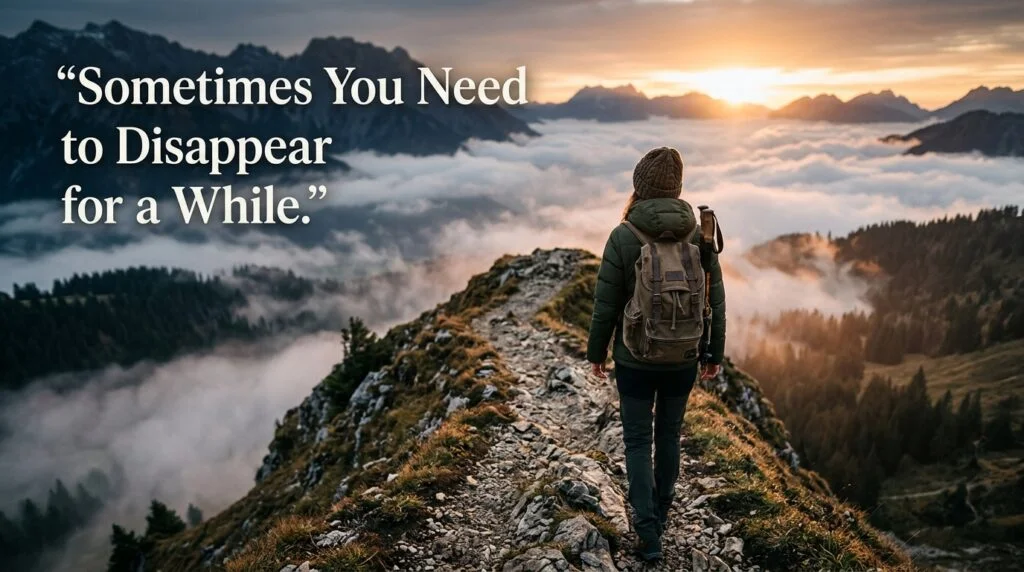
I Didn’t Go to “See Things.” I Went to Feel Nothing for a While.
Let me be upfront about something before we get into any destination list.
The first time I packed a bag and left alone — no itinerary, no travel buddy, no group chat updates — I wasn’t chasing adventure. I wasn’t trying to “find myself” in the cinematic sense that travel blogs love to romanticize. I was just exhausted. The kind of tired that sleep doesn’t touch. The kind that builds quietly in your chest over months of meetings, obligations, and noise.
What I needed wasn’t a beach with cocktails or a city with a packed sightseeing schedule. I needed somewhere that would simply let me exist without demanding anything from me.
That trip changed the way I understand travel entirely.
In 2026, more people than ever are traveling alone — not as a bold statement, but as a quiet necessity. Mental health is now openly part of the travel conversation. People are booking trips not just to see new things, but to feel like themselves again. And certain destinations, I’ve come to believe, are just better at that than others. Not because of their ratings or their Insta numbers — but because of something harder to quantify. A slowness. An atmosphere. The way the light falls, or the way nobody seems to be in a rush.
This is my honest guide to the best solo travel destinations for peace in 2026. Places I’ve been, places I’ve researched deeply, and places that real travelers consistently describe the same way: I left feeling lighter than I arrived.

Why Traveling Alone Is Actually the Most Honest Kind of Rest
Here’s something most people don’t say out loud: group travel, even with people you love, is social performance. You’re negotiating preferences, managing energy levels, accommodating different paces. It’s wonderful in its own way. But it isn’t rest — not the deep kind.
Solo travel for mental peace works because it removes that layer completely. When you travel alone, you eat when you’re hungry. You stay at a viewpoint until you’re ready to leave. You sit in a café with a journal and feel zero guilt about “wasting” an afternoon. There’s no one to manage. No one to entertain. The day is just yours — which turns out to be the rarest possible luxury.
A lot of people are afraid of the loneliness. And yes, it shows up. Usually around the second evening of the first trip, when dinner alone in an unfamiliar city feels strange. But most experienced solo travelers will tell you the same thing: push through that first wave, and what follows is something closer to freedom than loneliness. You become comfortable with your own company in a way that is genuinely good for you.
The places below are specifically chosen for travelers who want calm, not chaos. Quiet, not emptiness. Peace that’s active — where you’re present and aware — not just boredom in a different time zone.

1. Kyoto, Japan — The City That Teaches You to Slow Down Without Saying a Word
I want to describe exactly what Arashiyama feels like at 6:30 in the morning.
The sky is still pale and grey. The bamboo is taller than you expect — it makes you feel small in a way that’s oddly comforting. The wind moves through the stalks and produces this low, papery sound that isn’t quite music but isn’t quite noise either. The path is nearly empty. A monk in grey robes walks past you without looking up. And somewhere in the middle of all that, without planning it, your shoulders drop.
That is Kyoto. That is what makes it one of the most consistently peaceful solo travel destinations in the world, even with its tourist popularity, even with the crowds that descend during peak cherry blossom season.
What Makes Kyoto Work for Healing Solo Travel
Kyoto is a city where stillness has been intentionally cultivated for centuries. The Zen temple gardens — Ryoanji, Daitokuji, Tofukuji — were designed to provoke reflection, not stimulation. Sitting in front of a perfectly raked rock garden isn’t just a tourist activity. It’s a practice. And after twenty minutes of sitting quietly and looking at nothing but gravel and stone, something in your mind genuinely settles.
Beyond the temples, Kyoto’s social culture works in a solo traveler’s favor. Japanese public culture values personal space and quiet dignity. Nobody stares at a solo diner. Nobody makes you feel odd for wandering slowly and alone. In a world where so much attention is demanded of us, this city’s collective preference for discretion feels like a gift.
The honest caveat: Kyoto is not cheap. Accommodation can get expensive in central areas. Book a small ryokan (traditional guesthouse) in the Higashiyama district at least two months ahead — they fill fast, and the experience of sleeping in a tatami room with a paper screen door and a garden view is genuinely worth the extra cost.
Best time to visit: Late October into November — the autumn foliage is extraordinary, and it’s quieter than spring cherry blossom season.
One thing most guides won’t tell you: Download the offline Google Maps area before you arrive, then put your phone away. Navigate by feel. You will get pleasantly lost in the old alleys, and it will be one of the better parts of your trip.

2. The Azores, Portugal — An Atlantic Island Group That Feels Like a Secret
Most people, when you say “Portugal,” think Lisbon. Porto. The Algarve coast. They don’t think of nine volcanic islands sitting in the middle of the Atlantic, three and a half hours from Lisbon by plane, almost entirely free of the mass tourism that has reshaped so much of southern Europe.
That is precisely the point.
The Azores as a Quiet Place for Solo Travelers
The main island, São Miguel, is aggressively, almost unreasonably green. It rains frequently — which is why everything is so alive. Twin crater lakes called Sete Cidades sit inside an ancient volcanic caldera. They’re different colours depending on the light: sometimes slate blue, sometimes a deep olive green. Standing at the rim on a clear morning and looking down into that valley is one of those experiences that makes the effort of getting there feel completely justified.
What I love about the Azores for solo travel specifically is how unhurried everything is. Nobody is performing their enjoyment for social media. Locals run family restaurants where the fish was caught that morning and the wine comes from vines grown in volcanic soil that look like nothing you’ve seen in any vineyard. There are natural hot springs — some free, some €5 — where you can sit in geothermally heated water and listen to the Atlantic in the distance.
It’s a place that rewards the traveler who has deliberately lowered their expectations of stimulation. If you need constant activity to feel like your trip is “worth it,” the Azores might frustrate you. If you’ve decided to actually rest, it will be one of the best decisions you’ve made.
Best time to visit: May through September — the weather is warmest and whale watching (genuinely one of the world’s best spots) is at its peak.
Personal tip: Rent a cheap car on São Miguel and drive the interior roads without a destination. You’ll find unmarked hot springs, viewpoints with no tourist infrastructure, and small villages where the café has four tables and an espresso that costs 70 cents.

3. Chiang Mai, Thailand — Slow Life Isn’t Just a Hashtag Here
Here’s a thing that keeps happening with Chiang Mai: people plan to stay a week and end up extending to three. Not because it’s overwhelming or exciting. Because it’s the opposite. It pulls you into a pace that you didn’t know you were missing.
Why Chiang Mai Belongs on Any List of Calm Travel Destinations
The old city of Chiang Mai is encircled by a moat — a remnant of its fortified past — and inside those walls are over 300 Buddhist temples, dozens of independent coffee shops, and a general air of unhurriedness that is deeply out of step with how most of the world now operates. That contrast is the entire appeal.
In the mornings, monks in saffron robes do their alms rounds through the streets while locals kneel and offer food in brass bowls. This isn’t a performance staged for tourists. It’s daily life. You can sit on the steps of a temple at 7 a.m. with a coffee from the café next door and watch this happen, and it will recalibrate something in how you’re moving through your day.
The surrounding mountains of northern Thailand offer meditation retreats — some that last three days, some ten — where you wake before dawn, eat two vegetarian meals, and practice silence. I know that sounds demanding. It is, in a way. But the people who do these retreats consistently describe it as the most genuinely restorative thing they’ve ever done for themselves. If you’ve been considering it, Chiang Mai is one of the most accessible places in the world to try.
Budget reality: Northern Thailand is extremely affordable. A private room in a good guesthouse runs $15–25 USD per night. A full Thai meal costs $2–4. You can live well here on $40 a day without trying particularly hard.
Best time to visit: November through February — cool, dry, and genuinely pleasant. Avoid March to May (smoky from agricultural burning season).
Solo traveler note: The Nimman neighborhood has an excellent expat café scene if you want the gentle social option — good places to work, read, or fall into an easy conversation without it being forced.

4. Rishikesh, India — Where the River Is the Therapist
I’ll be honest: I was skeptical of Rishikesh before I went. It carries a certain amount of spiritual tourism cliché — the Beatles came here, every wellness blogger has done a yoga retreat, it can feel like a place that’s been packaged and resold too many times.
And then I sat by the Ganges for an hour on my second morning, and I stopped caring about the clichés entirely.
Rishikesh as a Genuine Healing Travel Destination
The Ganges moves fast through the Himalayas. It’s cold and green and loud — not loud in an aggressive way, but constant. A low roar that fills the whole valley. Sitting on the steps of one of the ghats (riverbanks used for ritual bathing and prayer) while the morning mist lifts off the water and the first light hits the opposite cliff is one of the most quietly moving things I’ve experienced anywhere in the world.
The early morning puja ceremony — where priests chant and ring bells and move fire across the river as an offering — happens every day at sunrise. Joining it as an observer costs nothing. You sit among local worshippers, the smell of incense drifts across the river, and for about forty minutes, your internal monologue simply stops. Not because anything dramatic happens, but because there isn’t space for it.
Rishikesh also has legitimate yoga and Ayurvedic medicine infrastructure — real teachers, not just drop-in classes aimed at tourists. If you’ve wanted to develop a practice rather than just attend a class, the teachers here are often extraordinary, and the cost is a fraction of what you’d pay in a Western city.
Important note for solo travelers: Stay in the Tapovan or Swarg Ashram area on the east bank of the river. It’s quieter, more local in character, and the guesthouses — many with river-facing balconies — are excellent value.
Best time to visit: February through April, or September through November. Avoid monsoon (July–August) when river levels make the ghats unsafe.

5. Reykjavik, Iceland — The Country That Doesn’t Ask Anything of You
Iceland feels like the edge of the world, which is exactly why it works so well for people who need to step back from it.
The landscape is geological and ancient — lava fields that stretch to the horizon, geysers that shoot steam sixty feet in the air, waterfalls that fall in such volume that you can feel them before you see them. And yet the dominant feeling in Iceland is not drama. It’s a profound, settled quiet.
Iceland as a Restorative Solo Travel Destination
Driving through Iceland alone is different from almost any other road trip experience. The roads are sometimes empty for an hour at a time. No billboards. No development. Just the land doing what it’s done for ten thousand years, unbothered by your presence or your opinion of it. There’s something almost medicinal about being in a landscape that has no interest in you.
Reykjavik itself — Iceland’s compact, walkable capital — is excellent for solo travelers. It’s small enough that you can understand it quickly, which removes the disorientation that can make new cities stressful. Good bookshops. Great coffee. An art and music scene far out of proportion to a city its size. On calm evenings, you can walk along the seafront and watch the mountains on the far side of the bay turn pink, and it doesn’t feel like a city at all.
In winter, the Northern Lights. This is one of those experiences where photographs genuinely don’t capture the reality. Seeing the aurora move — it shifts and pulses, sometimes slowly, sometimes fast — while standing in total silence in a field outside the city is one of the few things I’d call genuinely awe-inspiring without qualification.
Budget note: Iceland is expensive. Accommodation and food are the main costs. Self-catering (renting a small apartment or house) helps significantly. A medium-budget solo trip runs around $120–180 USD per day.
Personal tip: Don’t just do the Golden Circle tourist route. Drive north to the Westfjords or east toward Jökulsárlón glacier lagoon. The further you go from the obvious routes, the more Iceland shows you its actual self.

6. Sintra, Portugal — European Fairy Tale, Without the Fairy Tale Crowds (If You Time It Right)
Sintra is one of those places that risks sounding too good to be true. Palaces perched on forested hilltops. Medieval convents built inside rock faces. Gardens with grottos and spiral staircases descending into the earth. It all exists, and it’s all genuinely as atmospheric as it sounds.
Why Sintra Works as a Relaxing Solo Trip in Europe
The key with Sintra — and I cannot stress this enough — is timing. Visit on a Tuesday or Wednesday in October or November, and you’ll have places nearly to yourself. The mist hangs low in the forest. The old stone is damp and dark and the colors are extraordinary. You can walk from the town center up to Pena Palace through pine forest on a path that takes about forty minutes, and you might see three other people the entire way up.
The Quinta da Regaleira deserves its own paragraph. It’s a privately built estate from the early 1900s whose owner was obsessed with esoteric philosophy, Freemasonry, and the Knights Templar. The result is a garden full of symbolic structures — a chapel, underground grottos, a nine-level “initiation well” that spirals down into the earth like something from a dream. Wandering it alone, without a tour group, is one of the genuinely strange and wonderful experiences available to any solo traveler in Europe.
Where most guides go wrong: They tell you to do Sintra as a day trip from Lisbon. Spend the night instead. After 5 p.m., the day-trippers leave, the town goes quiet, the restaurants become actual local restaurants again, and the streets lit by lanterns at night feel like a completely different place.
Best time to visit: October through March for solitude; avoid July–August weekends entirely.

7. Faroe Islands — For the Solo Traveler Who Wants to Feel Genuinely Far Away
Everything about getting to the Faroe Islands is slightly inconvenient. The flights aren’t frequent. The accommodation is limited. The weather is completely unpredictable — you might get sunshine and then horizontal rain within the same hour.
This is the point.
Why the Faroes Are One of the Best Places to Travel Alone and Relax (On Your Own Terms)
The Faroe Islands are eighteen islands of dramatic cliffs, waterfalls, grass-roofed houses, and almost no mass tourism infrastructure. There are about 55,000 people living here, and in a strong year, around 100,000 tourists visit the whole archipelago — a fraction of what arrives in a single weekend to, say, Santorini.
The result is a kind of solitude that’s increasingly hard to find anywhere in Europe. You can hike for three hours along cliff edges above the North Atlantic and not see another person. Waterfall at Múlafossur drops directly into the sea from a village of grass-roofed houses — a scene so visually unlikely that it takes a moment to process as real. The capital, Tórshavn, has a tiny old town of timber and turf buildings and a café culture that moves at approximately the pace of cloud shadow on a hillside.
The weather unpredictability teaches you something useful: you cannot control everything. Sometimes the plan changes. You sit indoors with a book while the wind rattles the windows. And that’s fine. That’s actually more than fine. For people whose daily lives involve relentless control and scheduling, being gently forced to yield to weather is quietly therapeutic.
Practical note: Book six months ahead. Seriously. Accommodation fills well in advance and options are limited, particularly on the outer islands.
Best time to visit: June through August — the longest days give you 19+ hours of light, and the wildflowers are extraordinary.
Quick Guide-Matching the Right Destination to What You Actually Need
| What You Need | Go Here |
|---|---|
| Spiritual depth, guided practice | Rishikesh, India / Chiang Mai, Thailand |
| Complete nature immersion | Iceland / Faroe Islands |
| Cultural richness with built-in quiet | Kyoto, Japan / Sintra, Portugal |
| Hidden beauty without crowds | Azores, Portugal |
| Budget-friendly slow living | Chiang Mai, Thailand / Rishikesh, India |
| Wilderness that humbles you | Faroe Islands / Iceland |
| European peace without European crowds | Azores / Sintra (off-season) |
Things That Make Peaceful Solo Travel Actually Work
These aren’t tips you need a travel blogger to tell you. They’re just things that genuinely make a difference.
Give yourself the first day to do nothing. Arrive. Walk around without purpose. Eat something. Sleep. Don’t visit a single attraction on day one. Let the place settle around you before you engage with it.
Protect the mornings. Every single destination on this list is at its most beautiful and most empty in the first two hours after sunrise. Set the alarm. Go out before the cafés open. That time — just you and the early version of a place — is irreplaceable.
Don’t post in real time. I know this one’s hard. But there’s a meaningful difference between experiencing a place and curating your experience of a place for an audience. You can share everything when you get home. While you’re there, let it be just yours.
Carry a notebook. Not for productivity, not for lists. For whatever surfaces when you’re sitting quietly somewhere unfamiliar. Solo travel has a way of loosening thoughts that were stuck. Give them somewhere to go.
Give yourself permission to skip things. You don’t have to do everything. If you’re in Kyoto and you’ve already visited three temples and you feel complete — you don’t owe the fourth temple your presence. That’s not laziness. That’s listening to yourself. Which is the whole point.

FAQ — Questions Solo Travelers Actually Ask
Q. Is it weird to eat alone in restaurants while traveling solo?
In most places outside of large Western cities, solo dining is unremarkable. In Japan especially, solo dining culture is so normalized that many ramen restaurants have individual counter seats facing the wall precisely to give solo diners their own space. In the Azores, Thailand, Portugal — nobody will look twice. The discomfort is almost always internal, and it passes quickly after the first solo meal.
Q. How do I handle the loneliness that comes up during solo travel?
It’s real, and it’s worth saying honestly: loneliness will come. Usually in the evenings of the first couple of days. The move that works for most solo travelers is to lean into it rather than avoid it — sit with it in a café rather than scrolling your phone to escape it. It almost always passes and transforms into something quieter and more spacious. If you need a social option, guesthouses and hostels with common areas are excellent without requiring constant interaction.
Q. Which destination on this list is safest for solo female travelers?
All seven are generally safe, but Japan (Kyoto), Portugal (Azores and Sintra), and Iceland rank among the safest destinations in the world for solo female travelers by every available safety index. Rishikesh requires standard awareness in certain areas, particularly at night, but the main traveler zones along the river are well-established and comfortable.
Q. How long do I need for a genuinely restful solo trip?
Less than four days rarely provides enough time for the mental shift to happen — you spend too much of it on logistics. Seven to ten days is the sweet spot for most people. Anything beyond two weeks starts to feel like real life again, which isn’t bad, but isn’t the focused reset you came for.
Q. Do I need travel insurance for solo travel?
Yes. Always. This isn’t negotiable advice. Solo travelers have no backup if something goes wrong — no travel companion to manage logistics during a medical issue or a lost passport. Good travel insurance costs $30–80 for a week and covers far more than people realize. It’s the one travel expense nobody regrets.
The Real Reason You’re Reading This
You already know where you need to go. Or if not the specific place, you know the feeling you’re trying to get back to — that version of yourself who breathes more slowly and notices things and isn’t constantly bracing for the next thing.
These destinations don’t create that feeling. They just create the conditions for it. You do the rest.
So pick one. Not the most Instagram-worthy. Not the cheapest or the most logistically convenient. Pick the one that, when you read about it, made something in your chest open up a little. That’s your answer.
Book the first night. The rest figures itself out.
If this guide helped you decide, or if you’ve been to any of these places and want to share what the experience was actually like — I’d genuinely love to hear it. Leave a comment below or reach out directly. Real experiences from real solo travelers are always more valuable than any guide.

