
Why Busan Surprised Me More Than Seoul Ever Did
Honestly, I booked Busan almost as an afterthought. Seoul had been on my list forever — Busan was just that secondary city people mentioned when I told them I was heading to South Korea. “Oh, you should check out Busan too,” they’d say, then quickly move on. I almost didn’t go.
What a mistake that would have been.
From the moment the KTX train pulled into Busan Station and I stepped out into that salty, ocean-tinged air, I understood why people who’ve visited can’t stop talking about it. This is a city that has absolutely nothing to prove. It doesn’t chase trends or try to dazzle you with perfectly polished neighborhoods. It’s a port city, a beach city, a mountain city — all at once — and it carries every one of those identities with complete confidence.
I went planning to stay four days. I stayed eleven. Every single day I discovered something that made me push my return ticket back.
This guide is everything I actually did in Busan, in the order that matters — not ranked by tourist popularity, but by the kind of experiences that stay with you long after the trip is over. I’ve skipped the fluff and kept the honest bits, including the stuff that didn’t go quite the way I expected.

1. Haeundae Beach — Yes, It’s Crowded. No, You Shouldn’t Skip It.
The Beach That Earned Its Reputation
Every travel guide mentions Haeundae Beach first, and I was fully prepared to find it overrated. It’s the main tourist beach. It gets packed in summer. How good could it really be?
Pretty good, actually. And in ways I didn’t expect.
The beach itself is huge — around 1.5 kilometres of clean, well-maintained sand that stretches out wide enough that even on a moderately busy weekday morning, it doesn’t feel suffocating. What struck me wasn’t the beach in isolation though, it was the life happening around it. A group of older women doing water aerobics just offshore. A family setting up an elaborate picnic. Two university students doing yoga near the waterline, completely unbothered by everything around them.
I came back three times during my stay, and each visit felt different. Morning Haeundae is calm, almost meditative. Afternoon Haeundae is full-chaos energy — K-pop blasting, kids shrieking, vendors weaving through the crowds. But sunset Haeundae? That’s the version I’ll remember. The crowds thin, the light turns everything golden, and there’s this collective exhale that happens across the beach as people stop rushing and just… watch.
I had grilled mackerel and a cold beer from one of the boardwalk restaurants while the sun dropped into the water. That’s the kind of meal that costs almost nothing but feels expensive in all the right ways.
Practical note: Summer (July–August) is genuinely packed and brutally hot. Spring and autumn give you the same beach with a fraction of the crowds. If summer is your only option, go before 9 AM or after 6 PM — the beach transforms completely.
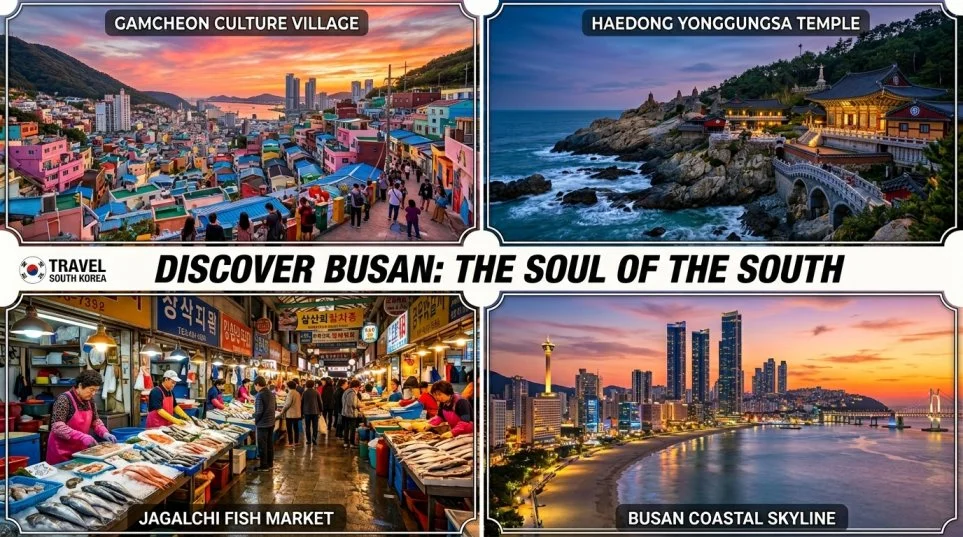
2. Gamcheon Culture Village — More Than an Instagram Backdrop
The Hillside Neighbourhood That Didn’t Disappoint
I almost talked myself out of going to Gamcheon. Every travel photo I’d seen looked staged — too perfect, too curated, the kind of place where people visit purely to recreate the same shot. I went anyway because a fellow hostel guest who’d lived in Busan for two years said it was her favourite spot in the city. That felt like a meaningful endorsement.
The thing about Gamcheon is that photos genuinely cannot capture what it’s like to be there. They show you the colours — the wild blues and yellows and greens covering entire building faces — but they can’t show you the texture of the place. The way the staircases climb steeply up the hillside and force you to stop, catch your breath, and notice that you’re suddenly somewhere completely new. The way murals appear unexpectedly around corners — some clearly professional, some obviously painted by locals, all somehow belonging.
Real people live here. That’s what the photos miss. During the day, yes, there are tourists — myself included — wandering with cameras. But the neighbourhood breathes around them. Laundry dries on lines between buildings. Cats sprawl in doorways. A grandmother sits outside on a plastic chair, watching everything with the expression of someone who has seen many seasons of visitors come and go and remains entirely unbothered.
I spent nearly four hours getting thoroughly, happily lost. I found a tiny gallery run by an artist in her seventies who was quietly painting the view from her window. I had excellent coffee at a café that had clearly been decorated with genuine obsession — every surface covered in something interesting. I climbed to a lookout point where the entire city and harbour spread out below me, and I just stood there for a while being grateful I hadn’t skipped this.
Go late afternoon. Morning brings tour groups that make the narrow lanes feel congested. Late afternoon is when the neighbourhood reclaims itself and actually feels like somewhere people live rather than a set.

3. Busan Tower — The View You Stay Until Sunset For
Yongdusan Park and 120 Metres of Perspective
I’ll be honest: I almost skipped Busan Tower because observation towers can feel like the most predictable tourist activity imaginable. You pay, you go up, you look at the city, you come back down. What’s actually memorable about that?
It turns out: the moment when you step off the elevator and the full view hits you all at once. I actually stepped backwards. Not dramatically — just the natural physical response to suddenly having the entire city spread out in every direction with the ocean on one side and mountains on the other and the harbour with all its ships somewhere in between.
Busan from above makes spatial sense in a way that Busan at street level doesn’t. You understand why the city feels the way it does — the way beach districts and working port and old residential neighbourhoods and sleek modern towers all coexist without quite blending. It’s a city of distinct layers, and you can see all of them from up here.
The park surrounding the tower is worth spending time in before you go up. There are walking paths shaded by old trees, locals jogging or doing evening exercises, a general atmosphere of unhurried city life that I found genuinely restorative after days of more intense exploring.
Arrive between 4 and 6 PM. You catch afternoon light, watch the sunset, and then see the city transition to night lights — effectively three different views for the price of one ticket. Bring a layer; it’s breezy up there regardless of season.
4. Jjangdeok Market — The Chaotic, Beautiful, Unforgettable Food Experience
Where Busan Actually Eats
Nobody goes to Jjangdeok Market because it’s comfortable. It’s loud, it’s crowded, the corridors are narrow, vendors are competing for space and attention, and the smells hit you immediately — grilling meat, fermented seafood, frying batter, all at once. If that sounds overwhelming, it is. It’s also the most alive I’ve felt sitting down to eat anywhere.
I ended up at a stall where an older man was grilling mackerel over charcoal in what I can only describe as a completely straightforward, no-theatrics way. Just fish. Just fire. Just decades of practice. I sat on a plastic stool about thirty centimetres off the ground, ate with my hands because that’s how you eat it, and shared the general atmosphere with a handful of locals who were there for exactly the same reason I was. The fish cost almost nothing. It was the best thing I ate in Busan.
The seafood section of the market sells things I hadn’t previously seen outside of documentary footage — sea cucumbers, live octopus, varieties of shellfish I still couldn’t name. Most vendors will cook whatever you point at. The language barrier is real but irrelevant: pointing and nodding has been a functional communication system for centuries and it works perfectly here.
Something I appreciated about markets like this is that there’s no performance happening. Nobody is eating slowly and elegantly for the gram. People are here to eat quickly and efficiently and get on with their day. That complete absence of self-consciousness is, paradoxically, one of the most freeing dining experiences you can have as a traveller.
Go hungry — genuinely hungry, not just peckish. Bring cash. Plan to smell like grilled fish for the rest of the afternoon and wear it proudly. Around 5–6 PM hits the sweet spot between the lunch rush thinning out and the evening crowd arriving.

5. Beomeosa Temple — Two Hours of Unexpected Peace
The Mountain Escape That Resets Everything
I’m not religious. I don’t meditate. I went to Beomeosa Temple because I needed a break from the energy of downtown Busan and someone mentioned it was quiet. That was enough.
The drive up takes about twenty minutes from the city centre, winding through roads where trees gradually close in overhead and the sounds of traffic fade out behind you. By the time you reach the temple complex, you’re somewhere else entirely. The air is cooler, the light is different, and the quiet is the kind you don’t realise you’ve been craving until you’re actually inside it.
The temple itself dates back to the 7th century, though most of what you’re seeing has been rebuilt over the centuries. The main halls feature intricately carved wooden beams painted in those deep greens and reds and blues that seem more vivid surrounded by mountain forest. There are statues of the Buddha in several halls, and people were actively there to practice and pray. I found myself moving through the space more slowly than I normally move anywhere, which I think was the whole point.
I sat on a wooden bench near one of the smaller pavilions for a long time, listening to water moving somewhere nearby and birds in the trees above. No plan. No next thing. Just sitting. I haven’t done that in a long time, and I needed it more than I knew.
They offer temple stay programmes — overnight experiences where you follow the monastery’s actual schedule, which includes waking up well before dawn for meditation and eating simple vegetarian meals in silence. I didn’t do it this time. I’m going back to do it.
Dress respectfully — covered shoulders and knees. Not strict, but considerate. Visit on a weekday if possible; weekend afternoons can get busy with day-trippers from the city.
6. Songdo Beach and the Glass Skywalk — For When You Want to Scare Yourself a Little
The Less-Crowded Beach With a Dramatic Extra
Songdo Beach is what Haeundae might feel like if you subtracted two-thirds of the people and added dramatic cliff faces on either side. The geography here is genuinely striking — the beach sits in a natural cove, framed by rocky headlands, and the water seems cleaner and clearer than at the main tourist beaches.
I went specifically because I wanted photos that didn’t look like everyone else’s Busan photos, and Songdo delivered. But the real reason to come here is the Skywalk — a glass-floored walkway cantilevered out from the cliff about forty metres above the water.
I am not great with heights. I know this about myself. I went out onto the Skywalk anyway because I had convinced myself it would be fine, and it was mostly fine except for the first thirty seconds when my brain was loudly and specifically informing me that I was standing on glass above open ocean and this was categorically a terrible idea. Then something shifted — some switch from terror to exhilaration — and I ended up standing out there much longer than I planned, watching the waves break against the cliff below me through the floor under my feet.
The beach itself is excellent for a slower afternoon. I found a spot at a seafood restaurant with a terrace facing the water, ordered grilled fish, and sat there watching the light change as the sun dropped. Songdo has a more intimate, local feel than the bigger beaches — fewer big hotels looming behind you, more of a neighbourhood.
Harder to reach than the main beaches, which is exactly why it’s less crowded. If heights genuinely aren’t your thing, skip the Skywalk — it’s not worth the anxiety. If you’re on the fence, go. You’ll be glad you did.

7. Nampodong — Busan’s Downtown Where Nothing Is Designed for Tourists
Just a Neighbourhood Being Itself
The best way I can describe Nampodong is that it’s where young Busan actually spends its time. Not where it performs for visitors — where it just lives. That distinction matters.
I spent an entire evening wandering here without any particular plan, which turned out to be exactly the right approach. I ducked into a vintage clothing shop where the selection was genuinely curated rather than deliberately retro-priced. I had coffee at four different cafés because each one looked interesting from outside and continued to be interesting once I was inside. I found a restaurant where the owner more or less decided what I was eating — the special of the day, which turned out to be a fish stew that cost around ₦6,000 and was extraordinary.
The real discoveries happen in the alleyways off the main streets. Turn down enough random corners and you start finding bars that occupy what appear to be repurposed closets, cafés lit entirely by candles, small restaurants with handwritten menus and four tables. These places aren’t hiding from tourists exactly — they’re just not particularly designed for them either, which makes being in them feel like a small privilege.
Busan Station nearby is worth a look for the architecture alone — a beautiful older building that anchors the surrounding area, which has more of an old-Busan energy than the newer developments spreading across the city.
Don’t plan Nampodong. Seriously — no itinerary, no list of specific restaurants. Just walk until something looks interesting, then go in. The neighbourhood rewards aimlessness more than strategy.
8. Taejongdae — Cliff Railways and Ocean Views That Actually Earn the Hype
The Southern Tip of Busan
Taejongdae sits at the very southern end of Busan, jutting out into the Korea Strait on a dramatic peninsula of forested cliffs. I went half-expecting it to be a pleasant but forgettable afternoon, and I left having completely reconsidered that prediction.
The small train that runs along the cliff edges is the kind of thing that sounds gimmicky — a little tourist railway winding around scenic viewpoints — until you’re actually on it. Then you’re watching cliffs drop away below you to the ocean and rock formations that look like something from a geography textbook on geological drama, and you understand why this exists. The views are legitimately spectacular.
Beyond the train, there are walking trails through the forest and along the cliff tops that you can follow at your own pace. The paths wind between twisted pines and enormous rock formations, occasionally opening up to sudden views across the water that feel like rewards for walking. I did a loop that took about ninety minutes and barely passed another person for long stretches of it — surprisingly peaceful for a popular attraction.
The lighthouse at the southern point is a worthwhile destination in itself. On a clear day you can see the coast of Japan on the horizon. I couldn’t quite see it when I was there, but several locals told me it’s visible in ideal conditions, which is a fact I find unreasonably compelling.
Taejongdae is genuinely beautiful and not particularly crowded compared to the city’s beaches. Combine it with Songdo Beach for a full day on the western side of Busan.

9. SEA LIFE Busan Aquarium — Better Than You’re Probably Expecting
An Afternoon That Didn’t Feel Like Tourism
I went to the aquarium because it was raining and I needed somewhere to be for a few hours. I left having spent nearly three and a half hours there and feeling a bit embarrassed that I’d almost not gone.
The design is smart in ways that matter. Instead of the standard approach of large tanks lined up against walls, they’ve built environments that try to recreate actual ocean habitats — coral reef sections, deep water zones, a section specifically dedicated to the sea life found in Korean waters. The underwater tunnel where sharks glide overhead is the obvious centrepiece, but I found the Korean waters section unexpectedly fascinating. I hadn’t realised how diverse the ocean immediately adjacent to Busan actually is. It reframed how I thought about all that water I’d been looking at from the beaches.
There were families, school groups, couples — the full spectrum of who aquariums attract — and despite the numbers, it never felt overwhelming. The layout distributes people well.
Weekday mornings are significantly quieter than weekend afternoons. If you’re travelling with children, this is an obvious choice. If you’re travelling alone and feel slightly self-conscious about visiting an aquarium as an adult, don’t — plenty of adults were there doing exactly the same thing, and nobody cares.
10. Kompisal-gil Coastal Path — The Walk Most Visitors Never Take
Three Kilometres of Real Busan
I found out about Kompisal-gil from a conversation with a Busan resident at a coffee shop — she mentioned it almost as an aside, the way locals mention things they assume everyone already knows. Nobody I’d spoken to before that had brought it up at all.
Kompisal-gil is a coastal walking path running roughly 3.5 kilometres along Busan’s western shoreline, connecting several beaches and passing through neighbourhoods that don’t see much tourist traffic. It’s completely unpolished — no information boards in English, no directional signs, no cafés positioned at scenic intervals. Just a path, the ocean, and whatever the neighbourhood currently looks like.
I did it on a weekday afternoon and passed fishing boats moored alongside residential buildings, elderly men sorting nets, small gardens planted in containers on concrete retaining walls, children on bikes. The path occasionally climbs to give wider views across the water toward the industrial port area — a reminder that Busan is fundamentally a working city, and that its identity is more complex than beaches and food markets.
The walk takes forty-five minutes to an hour at a relaxed pace. Starting from Songdo Beach and heading toward Dadaepo gives you the best of the scenery.
Grab kimbap from a convenience store before you start — there’s nowhere to buy food along the route, but there are several spots where you can sit and eat and watch the water. This is probably the most local thing I did in Busan.

11. BIFF Square and Busan Cinema Center — Where Busan’s Creative Identity Lives
Film Festival Town, Year-Round
Busan hosts one of Asia’s most significant international film festivals every October, and BIFF Square — named for it — is where that energy concentrates and then somehow manages to linger all year. The square features handprints and signatures of major directors and actors in the pavement, a bit like Hollywood’s Walk of Fame but more focused and more interesting to me personally.
The Busan Cinema Center nearby is architecturally extraordinary. The building’s roof extends outward in a cantilevered form that seems to float above the outdoor spaces below it — it’s the kind of structure that makes you want to understand how it actually stands up. There are cinemas, exhibition spaces, outdoor performance areas that get used for events throughout the year.
Even outside festival season, the area around BIFF Square has an energy that’s distinct from other parts of the city — more creative, more experimental, with street performers and small markets and the general sense that this is where Busan’s arts community hangs out. I spent a couple of hours wandering through the surrounding streets and didn’t run out of things to look at.
If you’re at all interested in cinema or architecture, the Cinema Center alone is worth the visit. If your trip overlaps with October, check whether festival screenings are open to the public — some are accessible without advance tickets.
12. Jagalchi Fish Market — The Real Thing
Where Busan’s Seafood Begins
Jagalchi is the largest seafood market in South Korea and one of the oldest continuously operating markets in Busan. It is also, very notably, not designed for tourists. It is a working market. The distinction matters.
I went early on a weekday morning, around 7 AM, which turned out to be the right call. The market was at full activity — vendors arranging impossibly fresh catches, buyers negotiating loudly, delivery people navigating around each other with complete practiced efficiency. The smell is intense and unmistakably oceanic. Within about five minutes I stopped noticing it.
The range of seafood on display is genuinely astonishing. I saw varieties of fish I couldn’t identify, live octopus in tanks, sea cucumbers in sizes that seemed improbable, shellfish I had no names for. The vendors know everything about what they’re selling in the way that only comes from a lifetime of selling it.
Upstairs, several small restaurants will prepare whatever you purchase from the market vendors below. You bring them the fish, they cook it. The sashimi platters up here are extraordinary — not because they’re fancy, but because the fish is so fresh that there’s nowhere for the quality to hide. A full meal costs a fraction of what you’d pay at any restaurant targeting tourists.
Go before 9 AM for the most activity and the best selection. This is not a place for people who are squeamish about where their food comes from — which is exactly why it’s valuable.

13. Taejongdae Amusement Park — The Ride You Didn’t Know You Needed
Small Park, Unexpected Delight
Taejongdae Amusement Park is not Everland. It’s small, it doesn’t have extreme rides, and it wouldn’t be worth travelling to on its own. But sitting directly on the clifftops at Taejongdae, it has something that no other amusement park I’ve visited can claim: the Luge ride winds down the cliffside with the Korea Strait visible far below.
That geographical context makes the whole experience strange and wonderful. You’re doing something inherently silly — going wheee on a track — while the ocean crashes against rocks several dozen metres below you. The combination of ridiculous and spectacular doesn’t resolve into either one. It just coexists.
The park is compact and never gets overwhelmingly crowded except on public holidays. Go in with the correct expectations — this is a fun addition to a Taejongdae visit, not a destination in itself — and you’ll enjoy it.
14. Dongbaek Seom Island — Quiet, Beautiful, Fifteen Minutes from Haeundae
The Nature Escape Nobody Tells You About
I stumbled onto Dongbaek Seom Island almost by accident, having turned the wrong way while walking along the Haeundae waterfront. What I found was a small island — connected to the mainland by a short bridge — with forested walking paths, rocky coastal formations, and views back across the bay toward Busan’s skyline.
The walk around the island takes about thirty minutes at a slow pace, less if you’re moving with purpose. The paths wind through trees close enough to the water that you can hear waves below you without always being able to see them. There are benches positioned at strategic viewpoints. The whole place feels like it was designed by someone who wanted people to have a quiet moment rather than a busy attraction.
I sat at one of the viewpoints for a long time watching the light on the water and listening to the trees and the sea. After days of active exploring, it was exactly what I needed without knowing I needed it.
Best at dawn or during golden hour before sunset. Photographers come specifically for the views back toward the city skyline — the silhouette of Busan’s buildings against the sky with the sea in the foreground is genuinely beautiful.
15. Busan’s Coffee Culture — The Unexpected Deep Rabbit Hole
A City That Takes Its Coffee Seriously
I didn’t come to Busan expecting to spend meaningful time thinking about coffee. I left with a new framework for what a café can be.
Busan has developed a coffee culture that feels genuinely distinct from Seoul’s — less about massive commercial chains and more about individual identity. The independent cafés here are intensely personal spaces. Each one has been designed with a level of care that borders on obsessive, and the result is that almost every café I walked into felt like a distinct world. One was floor-to-ceiling vintage records. One had entire walls of handwritten notes left by previous visitors. One served coffee from a small roastery the owner ran out of the back room.
The Seomyeon area has the highest concentration of what locals call coffee street, but honestly, wandering any residential neighbourhood will surface excellent independent cafés. Part of what I enjoyed about Busan’s café culture is that the baristas are genuinely interested in their craft in a non-performative way. They’ll explain what you’re drinking if you ask, and they seem to mean it when they do.
I spent more afternoons café-hopping in Busan than I had any plan to. It kept being a good idea.
No single definitive destination here — the experience is in the wandering. Pick a residential neighbourhood you haven’t explored yet and walk until a café looks right. That’s usually the correct approach.
Questions People Actually Ask Before Going to Busan
Q. How long do I actually need in Busan?
Two to three days gets you through the major highlights. Four to five days lets you actually settle in, explore at a pace that doesn’t feel rushed, and start discovering things that aren’t on any list. A full week is, in retrospect, the right amount. I stayed eleven days and didn’t feel like I’d run out of things to be interested in.
Q. When’s the best time to visit?
Spring (April–May) and autumn (September–October) are the obvious answers — mild temperatures, low humidity, the beaches accessible without fighting summer crowds. Summer is hot and crowded but gives you the full beach experience. Winter is cold but beautiful in a different way, and visitor numbers drop significantly. I went in late spring and found it close to ideal.
Q. Is Busan expensive?
Street food and market meals are remarkably affordable. Mid-range restaurants are reasonable. High-end dining exists if you want it. Accommodation is meaningfully cheaper than Seoul across all categories. Transport is inexpensive. On a sensible budget, Busan is genuinely easy to manage.
Q. How do you get around?
The subway covers most of the major areas and is easy to use even with no Korean at all — everything is sign-posted in English and the system logic is straightforward. Reloadable cards (available at convenience stores) save you the hassle of buying individual tickets. Taxis are affordable for the distances where the subway doesn’t quite reach. I used the subway for probably 80% of my trips and taxis for the rest.
Q.What are the three things you genuinely cannot skip?
Haeundae at sunset, Gamcheon in the late afternoon, and a meal at a proper street market. Those three things together give you the emotional geography of Busan better than anything else I can recommend. Everything else is bonus.
Busan Is the Kind of City You Have to Experience Twice to Understand
The first time in Busan, you’re getting your bearings — learning that it’s not one city but several, understanding how the beach districts and mountain temples and working port and creative neighbourhoods all fit together. The second time, you actually know what you’re looking at.
What surprised me most wasn’t any individual attraction. It was the accumulation. Each neighbourhood I explored seemed to add something to my understanding of the previous one. Each meal was context for the last. By the end of eleven days, Busan had started to feel like somewhere I knew rather than somewhere I was visiting.
That’s the thing about Busan that nobody quite manages to put in a travel guide, including this one: it rewards the kind of attention that’s too slow and too aimless for a typical trip itinerary. The best things I found there — the hidden cafés, the coastal path, the market meals, the quiet hour at Beomeosa — weren’t on any list. They happened because I had enough time to wander and enough sense to follow whatever looked interesting.
Give Busan that time if you can. It will earn it.
Have you been to Busan? What captured you most? Leave a comment below — I’d genuinely love to know.

