
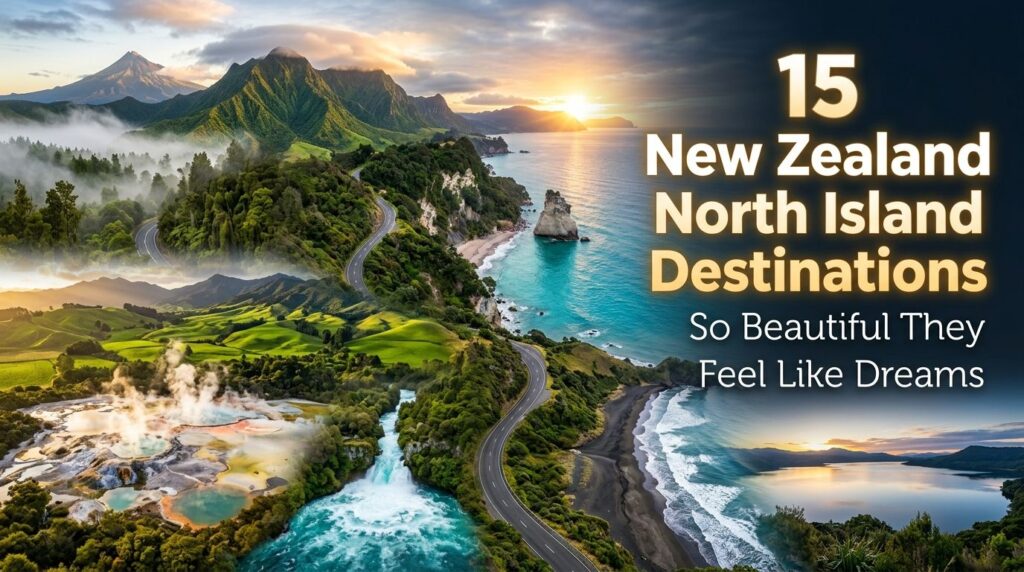
Some places whisper. New Zealand’s North Island shouts — in geysers, in ancient forests, in oceans colliding at the edge of the world.
Let me tell you about the exact moment I knew the North Island had me.
It wasn’t at the famous spots. It wasn’t when I first saw the Emerald Lakes from the ridge of the Tongariro Crossing, though that was jaw-dropping. It was on a Tuesday afternoon, on a side road near Raglan that wasn’t on any itinerary. I’d pulled over because the light through the pohutukawa trees hit the black sand beach at an angle I couldn’t explain. I sat on the bonnet of my rental car for twenty minutes. Just sat there.
That’s what the North Island does. It ambushes you with beauty in places you didn’t see coming.
Most travellers to New Zealand make a beeline for the South Island — the glaciers, Queenstown, Milford Sound. And honestly? They’re missing half the story. The North Island is geothermal, ancient, Māori-hearted, and endlessly varied. In a single road trip, you can move from volcanic craters to coastal wine country to underground starfields made of living light.
This guide covers 15 of the most breathtaking New Zealand North Island destinations — the iconic ones, the underrated ones, and a few that barely appear in any guidebook at all. Whether you’re deep in trip planning or just daydreaming, read on. And then go.
The Iconic North — Where the Island Begins to Reveal Itself
1. Bay of Islands-144 Islands and Not Enough Days

Three hours north of Auckland, the world shifts.
The Bay of Islands is one of those places that earns its name completely. There really are 144 islands — small, forested, ringed with the kind of turquoise water you associate with the Maldives, not New Zealand. On a clear day, the whole bay sparkles like someone spilled jewels across a map.
I took a day cruise out here and watched two dolphins race the bow of the boat for nearly twenty minutes. Nobody spoke. Everyone just leaned over the railing and grinned like idiots.
Beyond the scenery, this region holds enormous historical weight. The Treaty of Waitangi — the founding document of modern New Zealand — was signed here in 1840. Visiting Waitangi Treaty Grounds isn’t just a box to tick; the cultural performances and the guided explanations of what that treaty meant (and still means) give you a framework for understanding New Zealand that nothing else really provides.
Don’t miss: The Hole in the Rock — a sea cave large enough for a boat to pass through — on Piercy Island. It sounds gimmicky. It’s absolutely not.
Hidden local move: Take the ferry to Russell rather than just staying in Paihia. Russell is New Zealand’s first European settlement, and it has this lovely, time-slowed quality — wooden buildings, a working church from 1836, a pub that’s been serving people since the 1860s.
2. Cape Reinga-The Edge of Everything

Fair warning: getting to Cape Reinga takes most of a day from Auckland. The road narrows, the farms thin out, the sky gets bigger. And then you arrive at the northernmost tip of the North Island, where the Tasman Sea and the Pacific Ocean meet in a very visible, very dramatic line of colliding water.
This place is sacred to Māori people. According to tradition, it’s here that the spirits of the dead leap from a lone pohutukawa tree clinging to the cliff face and begin their journey to Hawaiki, the ancestral homeland. That tree is said to be over 800 years old. It looks it — gnarled and wind-bent and completely unbothered by the centuries.
You can feel the weight of that story standing there. The wind is constant. The lighthouse is white against a sky that can’t seem to decide what colour to be. And somewhere below, two oceans argue quietly.
Road trip note: Many visitors drive Ninety Mile Beach (technically 88 kilometres, which New Zealand apparently rounds up) on the approach to Cape Reinga. You need a tour operator or a vehicle specifically cleared for beach driving — the tide is no joke. But the experience of driving along a hard-packed beach with the Tasman on one side and towering sand dunes on the other is genuinely one of the wildest things you can do on four wheels.
3. Waipoua Forest — Standing Next to 2,000 Years of Silence

I was not prepared for Tāne Mahuta.
I knew it was a big tree. I’d read the dimensions. I thought I understood what “largest kauri tree in New Zealand” would look like.
I did not.
Tāne Mahuta — whose name means Lord of the Forest — rises from the floor of Waipoua Forest in Northland and simply dominates everything around it. Its trunk is wider than most people’s living rooms. Its canopy blocks out the sky. It is estimated to be somewhere between 1,250 and 2,500 years old, which means it may have been a substantial tree when the Mongol Empire was at its peak.
The evening guided tours run by local Māori operators are the way to do this properly. You walk through the forest with lanterns. Someone tells you the stories behind these trees — not as folklore, but as living tradition. You stop at Te Matua Ngahere (Father of the Forest) as well as Tāne Mahuta. By the time you leave, you feel quietly rearranged.
Practical note: Kauri trees are threatened by a soil pathogen called kauri dieback. Every entrance point has boot-cleaning stations. Please use them. It takes thirty seconds and it matters enormously.
Auckland and the City Coast — More Than a Stopover
4. Auckland-The City on 53 Volcanoes

Most travellers treat Auckland as a transit lounge. That’s their loss.
Auckland sits on the Tāmaki Makaurau volcanic field — 53 volcanic cones, most of them now grassed-over hills and parks, scattered throughout the city. You can climb several of them. From Maungawhau (Mount Eden), you can see the entire city, the harbour in two directions, and on clear days, the Coromandel Peninsula on the eastern horizon.
The city itself moves at a different pace to what international visitors often expect. The coffee is exceptional — New Zealand invented the flat white, and Auckland has built a café culture around that fact. Ponsonby Road on a Saturday morning, with its old villas converted into restaurants and independent shops, is one of the most pleasant urban streets in the Southern Hemisphere.
For food: Don’t eat in the Sky Tower restaurant. Instead, head to Otara or Papatoetoe for the night markets, where the Pacific Islander and Asian communities have created a food scene that is genuinely world-class and costs almost nothing. Hangi-cooked meats, Tongan Lu pulu, Samoan chop suey — this is what Auckland actually eats.
5. Coromandel Peninsula — The Drive That Changes Your Plans

You plan to spend one night. You end up spending three.
The Coromandel Peninsula, about two hours east of Auckland, has this quality of slowing people down against their will. The road that winds around its coastline is narrow and spectacular — bush on one side, Pacific views on the other, tiny towns appearing and disappearing every half hour.
Cathedral Cove is the centrepiece and deservedly so. A 45-minute coastal walk brings you down to a white sand beach framed by a natural archway through which you can walk at low tide. The light inside the cave is gold and diffused. It’s been used in films (including the Chronicles of Narnia) and you absolutely understand why.
Hot Water Beach is where the Coromandel gets playful. At low tide, thermal water seeps up through the sand close to the shore. You hire a spade from the café, dig a pool, and sit in your own naturally heated spa while the Pacific rolls in twenty metres away. It’s completely ridiculous. It is also completely wonderful.
The hidden one: Coromandel Town, on the western coast, gets skipped by most visitors who come for the beaches. It has a working gold mine you can tour, a café in an old pub that serves the best green-lipped mussels I’ve had anywhere, and a harbour sunset that will make you cancel your plans for the following day.
The Geothermal Heart — Fire, Steam, and Colour
6. Rotorua-Where the Ground Breathes

There’s a smell when you arrive in Rotorua. Sulphur — faintly, pervasively, like a struck match that never quite goes out. Within twenty minutes, you don’t notice it anymore. That’s the first thing Rotorua teaches you: that extraordinary things become normal faster than you think.
The second thing it teaches you is that the earth is alive in ways most places don’t show you.
Wai-O-Tapu Thermal Wonderland deserves a full morning, minimum. The Champagne Pool steams at 73°C and is rimmed with deposits of arsenic and gold in shades of orange and yellow. The Artist’s Palette spreads across the hillside in soft mineral greens and creams. The Devil’s Bath — an aggressive, almost radioactive-looking acid green — stops people mid-sentence. None of it is filtered or enhanced. That’s just what chemistry and heat and time produce when left alone for long enough.
The Lady Knox Geyser erupts each morning at 10:15 AM, assisted by a daily soap injection. Yes, soap. The geyser’s timing is not natural — but watching 20 metres of superheated water thunder skyward is spectacular regardless of the soap situation.
The Te Puia cultural complex is where you engage with Rotorua’s Māori heritage properly. The evening concert and hāngī dinner is one of the best ways to begin understanding Māori culture — the kapa haka performance isn’t a tourist show, it’s a living tradition, and the performers bring genuine pride to it. Stay for the meal afterward; hāngī-cooked food (slow-cooked in the earth using geothermal heat) has a smokiness and depth that’s difficult to replicate.
7. Waiotapu-A Painter’s Fever Dream in Mineral Form

Worth its own entry, honestly.
If you’ve seen photographs of the Champagne Pool and thought they looked digitally altered, let me tell you plainly: they haven’t been. Those colours — the deep orange mineral ring around a steaming turquoise pool — are exactly what you see with your own eyes. The whole reserve is like this. Colour everywhere. Colour that has no business being that colour.
Arrive by 8:30 AM. The morning light is softer, the crowds are thinner, and the steam sits differently on the water in the early hours. By 11 AM on a summer day, you’re fighting for a view at the Champagne Pool railing.
The photographer’s tip: The Primrose Terrace, further into the reserve and often hurried past, photographs beautifully in flat morning light. Most visitors skip it entirely to get back to the main pools. Don’t be most visitors.
8. Lake Taupo and Huka Falls-Where Calm and Power Coexist

Lake Taupo is the size of Singapore. That’s not a metaphor — the surface area is literally about the same as the island city-state. It fills the caldera of a supervolcano that last detonated roughly 1,800 years ago with enough force to change the colour of the sky above Rome and China.
Today it is extraordinarily serene. Blue, vast, ringed by mountains, with the perfect cone of Ruapehu visible on clear days to the south. Kayaking on the lake at dawn, when the water is mirror-flat, is the sort of experience you plan for twenty minutes and remember for twenty years.
Huka Falls, just upstream from Taupo town, takes the wide Waikato River and squeezes it through a narrow gorge 15 metres wide before hurling it 11 metres down into a pool of impossible aquamarine. The volume of water moving through that gap — 220,000 litres per second — is almost incomprehensible when you’re standing right next to it. It’s not the tallest waterfall in New Zealand. It’s nowhere near. But it’s one of the most viscerally powerful natural features on the entire island.
Adventure and the Volcanic Plateau
9. Tongariro Alpine Crossing-The Greatest One-Day Walk on Earth

I’m going to keep this simple because the statistics do most of the talking.
19.4 kilometres. Crosses three active volcanoes. Passes through the site used for Mordor in the Lord of the Rings films. Contains the Emerald Lakes — three crater lakes in vivid turquoise and green that look digitally composited into the landscape. Ranked repeatedly as the finest single-day walk in New Zealand and among the top day hikes on the planet.
The walk takes 6–8 hours depending on pace and conditions. The high point sits at 1,886 metres. Red Crater, near the summit, exhales sulphurous steam. The descent takes you past lava fields, ancient craters, and enormous views of the Central Plateau.
Honest talk about it: This hike is not a stroll. The ascent from Mangatepopo Valley to the South Crater is genuinely steep and can be icy in poor conditions. Check the weather forecast carefully — the crossing is only safe in stable weather, and it changes fast. Proper footwear (trail shoes or light hiking boots), layers, and enough water matter here.
Best kept secret: Start before 6:30 AM. The Emerald Lakes get crowded mid-morning, and the light on the crater lakes is most spectacular in the early hours before cloud builds up.
10. Waitomo Glowworm Caves-A Sky That Lives Underground

In 1887, a local Māori chief named Tane Tinorau explored a subterranean river in the Waikato region with a European surveyor. They lit candles, built a raft of flax stems, and floated into the dark. What they found on the cave ceiling above them was something neither had any name for.
The Arachnocampa luminosa — the New Zealand glowworm — is a small, bioluminescent larva found only in New Zealand. Millions of them cling to the limestone ceilings of the Waitomo cave system and emit a soft, cold blue light to attract prey.
Floating beneath them in a small boat, in complete silence and total darkness, with that living ceiling above you — it’s one of those experiences that removes language temporarily. You want to say something and there’s nothing adequate to say, so you just look.
The standard Glowworm Grotto tour runs about 45 minutes and is beautiful. The Black Water Rafting experience — floating on inner tubes through underground rivers and waterfall passages, guided by glowworm-lit tunnels overhead — is genuinely one of the most original adventure activities in New Zealand. Plan two to three hours for it. Come out dripping and slightly dazed and absolutely glad you did it.
Logistics: Waitomo is 2.5 hours south of Auckland and makes a natural stop on any North Island road trip heading toward Rotorua or Taupo.
Coast, Culture, and the East
11. Napier-Art Deco at the End of the World

On the third of February 1931, an earthquake measuring 7.8 on the Richter scale levelled the city of Napier in about two and a half minutes. 256 people died. Almost every building was destroyed.
What the city did next was remarkable: it rebuilt itself entirely in the architectural style of the moment. Art Deco — with its clean geometric lines, ornate facades, and distinctive fonts — was at the height of its fashion in 1931, and Napier embraced it completely. Whole blocks were rebuilt in coordinated style. The result, almost a century later, is one of the most intact Art Deco city centres anywhere in the world.
Walking Napier’s main streets feels like being inside a particular kind of dream — one set in the 1930s, on the coast of the South Pacific, with excellent wine nearby.
And the wine really is excellent. Hawke’s Bay — the region surrounding Napier — is one of New Zealand’s premier wine regions, particularly for Syrah and Bordeaux-style reds. The Cape Kidnappers Gannet Colony, at the end of dramatic coastal cliffs about an hour from town, hosts thousands of Australasian gannets between October and April. Standing among them — the noise, the movement, the complete indifference the birds show to human visitors — is unexpectedly affecting.
12. Raglan-Where Time Learns to Surf

Raglan doesn’t try to impress you. That’s part of its charm.
This small west-coast town, two hours from Auckland, has one of the longest left-hand surfbreaks in the world — drawing surfers from Australia, California, and everywhere in between. But even if you’ve never stood on a surfboard in your life, Raglan earns its place on any North Island vacation itinerary.
The black volcanic sand beaches are dramatic and usually uncrowded on weekdays. The harbour is warm and calm enough for kayaking. The main street — and it really is just one main street — has coffee shops that would hold their own in any city, and a fish and chip shop that regularly features in “best in New Zealand” conversations.
Watch the sunset over the Tasman Sea from the headland above the main beach. Bring something warm — the west coast wind arrives reliably at dusk. Stay for the afterglow, which turns the whole sky colours that feel slightly too good to be real.
13. Whanganui River-The Journey That Slows Everything Down

In 2017, New Zealand gave the Whanganui River the legal status of a person.
Not a symbolic gesture — actual legal personhood, the same rights and protections as a human being, with two legal guardians appointed to speak on its behalf. This happened because for the Whanganui iwi (tribe), the river has never been a resource or a backdrop. It is an ancestor. Ko au te awa, ko te awa ko au — I am the river, the river is me.
The Whanganui River Journey is one of New Zealand’s nine Great Walks — the only one completed by canoe or kayak rather than on foot. Over three to five days, paddlers travel 145 kilometres downriver through native bush, past limestone bluffs, and through a landscape that has changed very little in centuries. There are DOC huts along the way. You sleep to the sound of the current.
This is the most off-the-beaten-path destination in this entire guide. Most international tourists don’t know it exists. The people who do it tend to describe it as one of the best decisions they’ve ever made while travelling.
14. Hawke’s Bay Wine Country-Slow Afternoons in Vine Country

There’s a particular quality to a Hawke’s Bay afternoon in summer.
The light is warm and slightly gold. The Syrah vines are heavy with fruit. Someone has opened something good at the cellar door table, and the winemaker has sat down to talk about the vintage — not as a sales exercise, but because they genuinely want to.
Hawke’s Bay is New Zealand’s second-largest wine region, but it has a personality entirely its own. The wineries here are less formal than Marlborough, more agricultural in feel, more likely to pour you something unusual from a single barrel with a handwritten label.
The full picture: Combine a morning at the wineries with an afternoon drive to Cape Kidnappers for the gannets (see #11), and an evening back in Napier at one of the waterfront restaurants. That is a nearly perfect North Island day.
15. Coromandel Pinnacles-The View That Earns Itself

Last on the list and perhaps the hardest to reach — which is exactly why it feels the most like your own discovery.
Inside the Coromandel Forest Park, inland from the beach towns, the Pinnacles are ancient volcanic rock formations rising to 759 metres above sea level. Getting there involves a 7-kilometre walk each way through native bush — kānuka, tree ferns, ancient rimu — that is beautiful enough to justify the trip even if you turned around before the summit.
From the top, the Coromandel Peninsula spreads out in both directions. Pacific to the east. Hauraki Gulf to the west. The bush canopy below. The sky above. Nothing between you and any of it.
The Pinnacles Hut, available for overnight stays through DOC bookings, lets you watch that view at sunset and again at sunrise, which most people who have done it will tell you is a non-negotiable part of the experience.
Book the hut early. People who have been once try to come back every year. The hut fills up.
Your North Island Road Trip Blueprint
Two weeks is the sweet spot. Here’s how to connect these destinations into a coherent journey:
| Days | Where | Highlights |
|---|---|---|
| 1–2 | Auckland | Volcanic cones, Ponsonby, harbour ferry |
| 3–4 | Northland | Waipoua Forest, Bay of Islands, Cape Reinga |
| 5–6 | Coromandel | Cathedral Cove, Hot Water Beach, Pinnacles |
| 7–8 | Rotorua | Wai-O-Tapu, Te Puia, Māori culture |
| 9 | Waitomo | Glowworm caves, Black Water Rafting |
| 10–11 | Taupo | Lake Taupo, Huka Falls, Tongariro Crossing |
| 12–13 | Napier/Hawke’s Bay | Art Deco, Cape Kidnappers, wine |
| 14 | Raglan (on return) | Black sand, sunset, slow decompression |
A rental car or campervan is essential for most of this route. Some New Zealand roads in these regions are narrow, winding, and genuinely thrilling — give yourself more time between destinations than the map suggests.
Frequently Asked Questions
Q: What’s the absolute best time of year to visit the New Zealand North Island?
November through March is the prime window — warm, dry, long days. November and March have the added advantage of smaller crowds compared to peak January. If you’re doing the Tongariro Crossing, late November to April gives you the best chance of safe, clear conditions. Winter (June–August) is mild compared to many countries and significantly cheaper, though some adventure activities reduce their schedules.
Q: How do North Island and South Island compare for first-time visitors?
The South Island has more dramatic mountain scenery; the North Island has more thermal activity, more Māori cultural experiences, and a greater variety of landscapes within shorter driving distances. Most travellers who do both islands say the North surprised them more — it tends to be underestimated.
Q: Can I visit North Island destinations on a tight budget?
More than people realise. The Tongariro Crossing, beach walking on the Coromandel, watching the gannets at Cape Kidnappers, exploring Napier’s Art Deco streets — these cost little or nothing. The main expenses are flights into Auckland, car rental, and accommodation. DOC campsites and freedom camping (where permitted) dramatically reduce costs, and many of the best experiences on the island are completely free.
Q: Is it safe to drive in New Zealand as a visitor?
Generally yes, with a few adjustments. New Zealand drives on the left. Rural roads on the North Island can be narrow with steep drop-offs and no guard rails — take them slowly. The roads between Opotiki and Gisborne on the East Coast, and much of Northland, require patience and attention. Fill your tank whenever you see a petrol station in rural areas; the next one may be 80 kilometres away.
Q: How do I respect Māori culture while visiting these sites?
The best approach is honest curiosity and willingness to follow guidance. At wahi tapu (sacred sites), follow any posted protocols without questioning them. Remove shoes when entering a marae (meeting ground) if asked. Ask before photographing people. Book Māori-led tours when available — the experience is better, and the benefit goes directly to the community. Māori culture in New Zealand is living and contemporary, not a historical exhibit, and engaging with it as such is the difference between a good trip and an extraordinary one.
One Last Thing Before You Go
I’ve given you 15 destinations, a two-week route, a FAQ, and more practical information than most travel guides put in a single article. But here’s what I can’t give you, and what the North Island will give you if you let it:
The unplanned afternoon. The road you turned down because something felt right. The conversation with someone at a campsite who tells you about a track that isn’t on any map but goes to a view that will ruin every other view for a while.
New Zealand’s North Island is generous with those moments. It produces them almost daily for anyone paying attention.
So build your itinerary. Book the Tongariro shuttle and the Waitomo cave tour and the glowworm boat. Do all of that. And then, wherever you are on whatever day, leave one afternoon completely empty.
You’ll know what to do with it when you get there.
Ready to start planning your North Island road trip? Pin this guide, share it with whoever you’re travelling with, and start with the question that makes every great trip possible: which one do we do first?

