
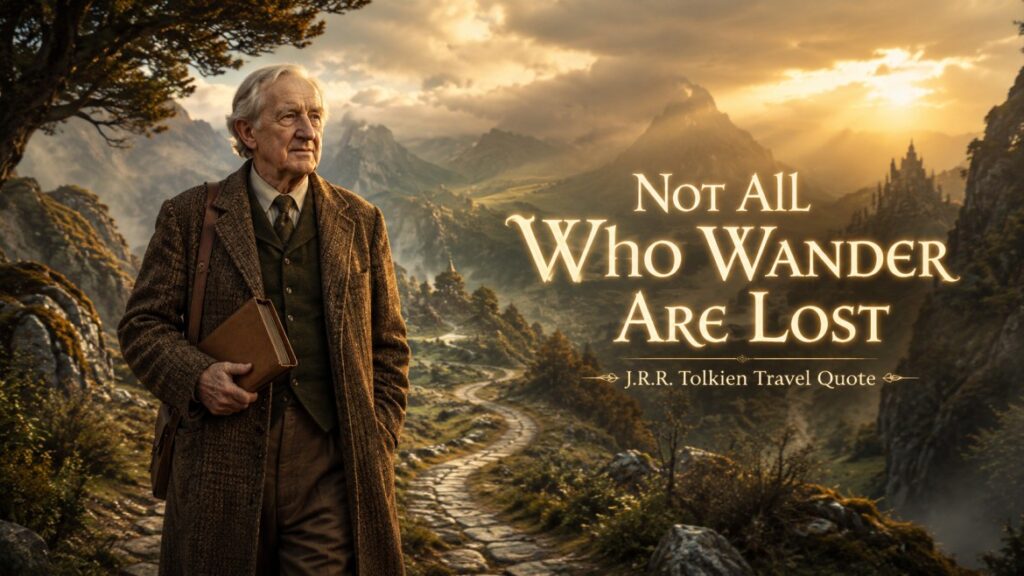
A Single Line That Changed How Millions Think About Travel
There is a moment most travelers know well. You are standing somewhere unfamiliar — a narrow alley in a foreign city, a trail winding into foggy hills, a train station where you barely speak the language — and something inside you quietly asks: Should I really be here?
That question, that small flicker of doubt, is exactly what J.R.R. Tolkien answered more than seventy years ago with a single, now-legendary line.
“Not all those who wander are lost.”
Four words that hit differently depending on where you are in life. When I first read those words at nineteen, sitting in a departure lounge with a one-way ticket and no real plan, they felt like permission. Like someone had handed me a traveler’s license that said: Go. It is okay not to know where this leads.
This article is a deep dive into the travel quotes of the day by J.R.R. Tolkien — not just a list of lines slapped together, but a real conversation about what they mean, where they come from, and why they still strike a nerve with every wanderer, backpacker, road-tripper, and restless soul today.
Who Was J.R.R. Tolkien, and Why Should Travelers Care?

John Ronald Reuel Tolkien was a British author, poet, and professor of English language and literature at Oxford University. He is best known for The Hobbit (1937) and The Lord of the Rings (1954–55) — two works that together built one of the most detailed fictional universes ever imagined.
But here is what most people miss: Tolkien was not just a fantasy writer. He was a deeply thoughtful philosopher of the road. His entire mythology is built around movement — journeys, quests, wandering, going there and back again. The characters he loved most were not kings sitting in towers. They were travelers. Hobbits walking out their front doors into the unknown. Wizards who never seemed to stay in one place. Rangers who knew every path but owned no home.
That is why his words resonate so deeply with the traveling community. He was writing about travel, even when he was writing about dragons.
The Most Famous Travel Quote by Tolkien — And Its True Origin
Where “Not All Who Wander Are Lost” Actually Comes From
Let us clear something up, because this matters. The full verse is far more powerful than the single line most people tattoo on their arms or print on their passport holders. It appears in The Fellowship of the Ring, written as a riddle-poem about Aragorn — a man who seems like a rough, directionless wanderer but is in fact a king in waiting:
All that is gold does not glitter, Not all those who wander are lost; The old that is strong does not wither, Deep roots are not reached by the frost.
Read that in its complete form and something expands. Tolkien is not simply saying that wandering is acceptable. He is saying that appearances mislead us — that the person who looks lost may be the one with the deepest roots, the greatest strength, the clearest purpose.
For travelers, that hits on multiple levels. You have probably met someone at a hostel or on a night train — sun-worn, carrying a battered pack, going somewhere that raised eyebrows back home — who radiated more clarity and direction than anyone you had ever met in a corporate office. That is Aragorn. That is the real meaning of this quote.
Ten Tolkien Travel Quotes That Every Wanderer Needs to Read

These are not just inspirational travel quotes to paste on a vision board. Each one deserves a moment of quiet attention.
1. “Not All Those Who Wander Are Lost”
(The Fellowship of the Ring)
Already discussed above — but worth returning to whenever self-doubt creeps in mid-journey. Keep this one close.
2. “It’s a Dangerous Business, Frodo, Going Out Your Door.”
This is from Bilbo Baggins, and it is perhaps the most honest travel quote ever written. It does not promise you that travel will be comfortable or safe. It simply says: once you step outside, the road takes over. You do not fully control where it leads.
Every traveler who has ever missed a connection, gotten lost after dark, or found themselves in a situation they could not have predicted knows exactly what Bilbo meant.
3. “The Road Goes Ever On and On”
This appears multiple times throughout Tolkien’s work, and it carries a meditative quality that grows with you. The road does not end. The journey is not a chapter in your life — it is your life. There is always another turn, another horizon, another reason to keep moving.
4. “I Am Looking for Someone to Share in an Adventure.”
Said by Gandalf to Bilbo at the very start of The Hobbit — and honestly, what better travel quote could there be? This is what every solo traveler secretly hopes to find in a new destination. That one person at the right moment who says: Come with me. I know something worth seeing.
5. “There Is Nothing Like Looking, If You Want to Find Something.”
A quiet reminder that travel is not passive. You do not find the interesting things by keeping your head down or sticking to the tourist trail. You look. You pay attention. You take the street your map did not mark.

6. “Home Is Behind, the World Ahead”
From The Fellowship of the Ring, sung by the hobbits as they first leave the Shire. This is the feeling of departure — that bittersweet mix of leaving behind what is known and walking toward everything that is not. No journey quote captures the first morning of a long trip better than this one.
7. “Adventures Are Not All Pony Rides in May Sunshine.”
Tolkien never romanticized the hard parts of travel. Mud, cold, exhaustion, fear — he put all of it on the page without apology. This quote is a grounding reminder that the difficult moments on a journey are part of the journey. They are not signs that something went wrong.
8. “I Will Not Say: Do Not Weep; for Not All Tears Are an Evil.”
Not a quote most people associate with travel. But anyone who has had to leave a place — or a person — they loved while traveling knows the particular grief of departure. Tolkien gives that feeling full dignity here. It is okay to feel the weight of goodbye.
9. “Short Cuts Make Long Delays.”
Pippin says this, and any experienced traveler has learned it the hard way. The faster route, the cheaper shortcut, the “just this once” decision to skip the scenic road — they have a habit of costing more than they save.
10. “Wherever I Am, I Am What Is Missing.”
Wait — this one is actually Mark Strand, a poet, not Tolkien. I am mentioning it here on purpose, because the internet frequently misattributes quotes. When you are collecting travel quotes of the day, always trace them to the source. Real wisdom is worth getting right.
Why Tolkien’s Words Work So Well as Journey Quotes
There is a structural reason Tolkien’s quotes travel so well across centuries and contexts. He was not writing personal diary entries or motivational speeches. He was building a mythology — and mythology speaks in archetypes.
When Tolkien writes about roads, he is writing about all roads. When he writes about wandering, he is writing about every kind of wandering: physical, spiritual, professional, emotional. That breadth is why a quote written about a fictional hobbit leaving a fictional village in a fictional world lands with full force in the heart of a real person standing at a real crossroads.
His language also has a particular unhurried quality. It does not push you anywhere. It opens a door and waits.
Using Tolkien’s Travel Wisdom in Your Own Journeys

Here is something practical: these are not just quotes to post on Instagram before your flight. They are tools you can actually use on the road.
Before you leave: Read “Home is behind, the world ahead” — let yourself feel the bigness of what you are stepping into.
When doubt creeps in mid-trip: Return to “Not all those who wander are lost” — it is a permission slip and a compass at once.
When things go sideways: Hold onto “Adventures are not all pony rides in May sunshine” — difficulty is not failure. It is the story.
When you have to leave somewhere you love: Sit with “Not all tears are an evil” — let yourself feel the goodbye properly.
When you are tempted by shortcuts: Remember Pippin. Take the long road. It usually earns it.
A Personal Note-What These Quotes Actually Mean on the Road
I want to be direct about something. I have read plenty of travel quote articles that feel like someone typed “Tolkien” into a database and copied the output. This is not that.
The quote “Not all those who wander are lost” changed something real for me. Not because it is pretty — though it is — but because it gave language to a feeling I had never been able to explain. The feeling that movement itself is meaningful, even when it is not heading somewhere obvious. That choosing the slower, stranger, less-approved path is not recklessness. It is a different kind of knowing.
If you are reading this and you are in that place — somewhere between where you were and where you are going, unsure if the detour was a mistake — Tolkien would tell you to keep walking. The roots are deeper than they look.
FAQ-J.R.R. Tolkien Travel Quotes
Q1: Did Tolkien actually travel much himself?
Tolkien spent most of his life in England, particularly Oxford. He was not a globe-trotting adventurer in the physical sense. However, he was deeply influenced by Norse mythology, Welsh language, and ancient European landscapes — all of which he explored through reading and academic study. His inner journeys were vast, even if his external ones were modest.
Q2: What book is “Not All Those Who Wander Are Lost” from?
It comes from The Fellowship of the Ring (1954), the first volume of The Lord of the Rings. It appears in a letter written by Gandalf, containing a poem about Aragorn.
Q3: Are there Tolkien quotes about travel that are frequently misattributed?
Yes, several quotes circulating online under Tolkien’s name are not actually his. Always cross-reference with the original texts. If a quote sounds oddly modern or cannot be traced to a specific book and character, it is likely misattributed.
Q4: How can I use Tolkien quotes in travel writing or blogging?
Use them as thematic anchors rather than decorations. Open a section with a quote, then unpack what it means in real travel terms. That creates genuine resonance rather than surface-level inspiration.
Q5: What is the best Tolkien quote for someone who is nervous about their first solo trip?
“It’s a dangerous business, Frodo, going out your door. You step onto the road, and if you don’t keep your feet, there’s no knowing where you might be swept off to.” — It is honest about the uncertainty and thrilling about the possibility, all at once.
Let the Road Teach You What It Knows
J.R.R. Tolkien wrote his books in an age before budget airlines and Instagram travel culture. He wrote them during a World War, amid personal loss, while building a mythology largely from imagination and ancient texts.
And yet somehow, across all that distance, his words land perfectly in the middle of the modern traveler’s experience.
Because the road has always been the road. The fear of stepping out your door has always been the fear of stepping out your door. And the quiet, unshakeable feeling that wandering — real, unhurried, unplanned wandering — is one of the most purposeful things a person can do?
Tolkien understood that better than almost anyone who ever wrote it down.
So today’s travel quote, as always: Not all those who wander are lost.
Now go somewhere that proves it.

