
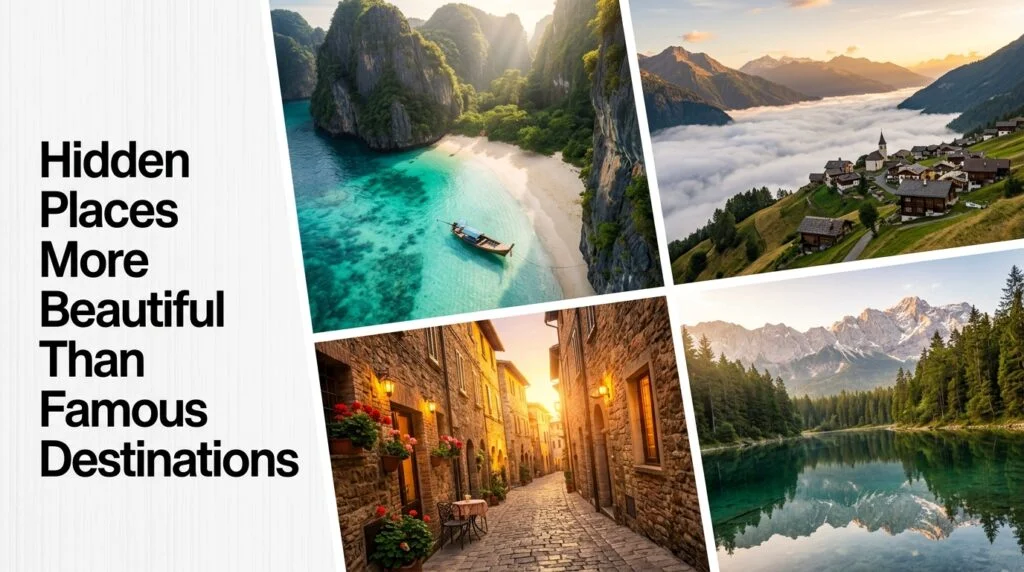
“The real voyage of discovery consists not in seeking new landscapes, but in having new eyes.”
— Marcel Proust
I Almost Missed the Best Place I’ve Ever Been
It was a mistake, technically.
My connecting flight was delayed by six hours in Tirana, Albania. I had no plan, no guidebook entry for the city, and exactly enough euros for a taxi and a meal. The driver, without being asked, took a longer route through the old bazaar quarter. I ended up eating grilled peppers and white cheese at a plastic table next to a man feeding bread to a stray cat. The afternoon light came through the awning in long, amber strips.
It was, somehow, one of the finest hours of travel I’ve ever had.
That accident taught me something I’ve been testing ever since: the most beautiful places in the world are rarely the ones you planned for. They’re the ones that appear in the gaps — in the slow mornings, the wrong turns, the cities nobody told you to visit.
This article is a collection of those places. Not all discovered by accident — but all discovered by stepping sideways from the obvious path.
Each one is genuinely, strikingly beautiful. Each one is undervisited in a way that still protects what makes it special. And each one rewards the traveler who shows up not to photograph a postcard, but to actually be somewhere.
Let’s begin.

1. Nagaland, India — The Northeast Nobody Talks About
The Unexplored Tourist Place That Will Rearrange Your Sense of India
Most international visitors to India cover a predictable triangle: Delhi, Agra, Jaipur. Some extend south to Kerala or east to Varanasi. Almost none go northeast to Nagaland — which is precisely why Nagaland remains one of the most extraordinary, under-the-radar travel experiences available anywhere in Asia.
Nagaland is a small mountainous state bordering Myanmar, home to sixteen major Naga tribes, each with distinct traditions, languages, textile patterns, and oral histories stretching back centuries. The landscape is a continuous fold of green ridgelines and river valleys, with villages perched on hilltops that have been inhabited for generations. The air at altitude is clean in a way that cities never are — sharp and cool even in October.
The Hornbill Festival, held every year in the first week of December near the state capital Kohima, brings all sixteen tribes together for ten days of traditional dance, music, craftsmanship, and food. It is the single most culturally concentrated event I have ever attended — and it draws a fraction of the international crowd that similar events in Southeast Asia command. You can stand three feet from performers in full ceremonial dress, in a venue where you actually have room to turn around.
Outside the festival, Nagaland rewards slower travel. The villages of Khonoma and Dzükou Valley offer trekking through landscapes that most Indian travelers have never seen. The Dzükou Valley in particular — a high-altitude grassland bowl with seasonal wildflowers so dense they look artificial — is accessible by a three-hour hike and offers camping under skies with almost no light pollution.
Important logistics note: Foreign nationals require an Inner Line Permit (ILP) to visit Nagaland, obtainable online or at the border. The process is straightforward but must be planned in advance. This small administrative step keeps the visitor numbers lower than they would otherwise be — which is a feature, not a barrier.
What nobody tells you: The food. Naga cuisine is unlike anything else in India — smoked pork with fermented bamboo shoots, ghost pepper chutneys, sticky rice cooked in banana leaves. If you have any serious interest in food culture, Nagaland alone is worth the detour.

2. Gjirokastër, Albania — The Stone City That Europe Forgot
Offbeat Travel Destination With Ottoman Roots and Mountain Drama
Albania spent forty years under one of the most isolated communist regimes in history. When the borders finally opened in the early 1990s, the rest of Europe had largely moved on without it — which meant that the country’s medieval architecture, Ottoman-era bazaars, and extraordinary mountain landscapes had been sealed in something close to amber for half a century.
Gjirokastër is the most dramatic expression of this preserved world.
The city climbs a steep hillside in the Drino Valley, its old quarter built almost entirely from the same grey-blue stone that comes out of the surrounding mountains. The rooftops — slate, steeply pitched, stacked against each other up the slope — create an almost unified surface across the hillside, as if the city grew from the rock rather than being built on top of it. UNESCO designated it a World Heritage Site in 2005. Most Western tourists still haven’t found it.
A massive Ottoman-era fortress crowns the hill above the city, accessible by a steep road winding through the old bazaar. Inside, there’s a captured American spy plane from 1957 — a Cold War artifact sitting in the courtyard of a medieval citadel in the mountains of southern Albania — that perfectly encapsulates how Gjirokastër exists slightly outside normal historical logic.
The writer Ismail Kadare, one of the great novelists of the 20th century, was born here and set his most celebrated work in these streets. Reading Chronicle in Stone before you visit layers the whole place with an additional dimension that makes the grey rooftops feel inhabited by stories.
Travel reality in 2025: Albania has been growing in popularity for several years, and Gjirokastër has started to appear on Balkans itineraries. But it still receives a small fraction of the visitors that Dubrovnik or Kotor handle. Go now, while the ratio of beauty to tourist infrastructure still tips toward the authentic.
Where to sleep: The traditional kulla tower houses have been converted into guesthouses throughout the old quarter. Staying in one — thick stone walls, heavy wooden beams, windows looking out over the valley — is the right way to experience the city.

3. Flores, Indonesia — The Island That Isn’t Bali
Hidden Beautiful Place Just East of the Tourist Trail
Bali is, objectively, a beautiful island. It is also operating at a level of visitor volume that makes genuine solitude nearly impossible in popular areas. Lombok is beginning to follow the same trajectory.
Flores, the long, mountainous island that stretches east from Lombok across the Lesser Sunda chain, is where Indonesia’s landscape performs its most dramatic work — and where the crowds have not yet arrived.
The name means “flowers” in Portuguese, a linguistic artifact of the colonial era. The reality lives up to it. The interior of the island is a series of volcanic peaks draped in forest, dropping steeply to coastlines of black sand and electric-blue water. The road across the island — the Trans-Flores Highway — is a journey through a series of landscapes that feel completely distinct from one another: rice terraces, savannah, dense jungle, volcanic highland.
Kelimutu is the reason many travelers first hear about Flores. Three crater lakes sit at the summit of this active volcano, and they are — astonishingly, genuinely — three different colors. Turquoise, brown, and black or white, depending on the mineral composition of the water and oxidation state at any given time. The colors shift over years and sometimes over seasons. Arriving at the summit before dawn and watching the colors emerge from the dark as the light builds is the kind of experience that’s genuinely difficult to describe without resorting to cliché — so I’ll just tell you that I sat there for two hours and didn’t look at my phone once.
Komodo National Park is technically accessible from Flores and draws visitors for the dragons — but beyond the famous islands, the park contains dive sites that serious underwater photographers rank among the best in the world, with manta rays, whale sharks, and coral density that the Indo-Pacific is famous for globally.
Lesser-known Flores detail: The weekly traditional market at Ende operates on a rotating schedule between villages — each week, a different village hosts, and the surrounding communities walk or motorcycle hours to attend. Finding the schedule and arriving at one of these markets is one of the most authentic cultural experiences available in Indonesia and almost completely off the standard tourist itinerary.

4. Plovdiv, Bulgaria — Europe’s Oldest Continuously Inhabited City
Underrated Vacation Spot With Six Thousand Years of History
Rome gets the headlines. Athens gets the mythology. Plovdiv, Bulgaria — which has been continuously inhabited since roughly 4000 BC, making it older than both — quietly holds its own council.
I’ll be direct: Plovdiv is one of the most pleasant cities I’ve spent time in. That’s not a dramatic claim, but it’s a meaningful one. The old town, built across three of the city’s six central hills, is a preserved showcase of Bulgarian National Revival architecture — brightly painted merchant houses with oriel windows projecting over cobbled lanes, each one built to display its owner’s prosperity through asymmetry and ornamentation.
The Roman amphitheater, which seats 6,000 and dates from the 2nd century AD, still hosts concerts and theater performances in summer. Sitting in the ancient stone seats watching a live performance with the illuminated old town visible behind the stage is an experience that, in any Italian or Greek city, would have three-month advance ticketing requirements. In Plovdiv, you can often buy a ticket the day of the show.
The Kapana district — a former craftsmen’s quarter now occupied by independent cafés, galleries, bookshops, and studios — has the atmosphere of a creative neighborhood still in the process of becoming itself. Not yet performative, not yet gentrified to the point of sterility. It’s the kind of place where you sit down for coffee and stay for three hours because the conversation and the light are both too good to interrupt.
Plovdiv was European Capital of Culture in 2019, alongside Matera. This raised its profile without fundamentally transforming it. The city absorbed the attention and returned to being itself, which is the best thing a city can do.
Cost reality: Bulgaria uses the lev, not the euro. A full dinner with wine at a good restaurant in Plovdiv’s old town costs roughly what a coffee costs in Western European capitals. The city is extraordinary value for what it offers.

5. Oaxaca, Mexico — The Cultural Capital That International Travelers Keep Undervaluing
Unique Travel Destination Where Every Sense Gets an Education
Mexico City gets the international press. Tulum gets the lifestyle content. Cancun gets the spring breaks.
Oaxaca — pronounced wah-HAH-kah, a source of endless gentle correction from locals — gets the travelers who care about food, indigenous culture, mezcal, textile art, and colonial architecture in roughly equal measure. And even then, it remains surprisingly underrepresented on international itineraries relative to its quality.
The city of Oaxaca sits at 1,500 meters elevation in a mountain valley in southern Mexico, which gives it a climate that is essentially perfect — warm days, cool nights, clear skies for most of the year. The historic center, built in warm green volcanic stone that turns gold in afternoon light, is walkable in its entirety and organized around a central zócalo that functions as the city’s living room: café tables extend onto the square, musicians play, families promenade, and the 16th-century church of Santo Domingo glows at the far end of the pedestrian street like an architectural promise.
Oaxacan food is recognized by serious culinary institutions as one of Mexico’s most complex and distinctive regional cuisines. The seven mole sauces. The tlayudas. The memelas. The chocolate drinks. The grasshopper tacos that you are, statistically, going to feel conflicted about and then eat anyway. The mezcal distilleries in the surrounding villages, where the agave is still crushed by stone wheel and roasted in earthen pits, produce spirits that bear almost no resemblance to what’s bottled under the same name for export markets.
The indigenous Zapotec and Mixtec communities in the surrounding Sierra Norte mountains maintain weaving, pottery, and woodcarving traditions that are genuinely thousands of years old. Visiting the village workshops — Teotitlán del Valle for rugs, San Bartolo Coyotepec for black clay ceramics, Arrazola for alebrijes — is not a tourist activity so much as an education in how art lives inside a community rather than hanging on its walls.
What genuinely surprises people: How green and mountainous the surroundings are. Most visitors imagine Mexico as coastal or desert; Oaxaca’s cloud forests and mountain trails are a constant revelation.

6. Vipava Valley, Slovenia — Wine Country Without the Waiting List
Peaceful Travel Place That Challenges Tuscany on Its Own Terms
Slovenia is one of Europe’s smallest and most consistently beautiful countries, and even among its admirers, the Vipava Valley is often overlooked in favor of Lake Bled’s famous island church or the Soča River’s impossible turquoise.
This is a mistake worth correcting.
The Vipava Valley runs west from Ljubljana toward the Italian border through a landscape of limestone karst hills, medieval hilltop villages, and vineyards that produce wines almost unknown outside the country and, increasingly, sought by serious wine professionals across Europe. The indigenous Zelen and Pinela grape varieties exist almost exclusively in this valley. Drinking a glass of Zelen — pale, aromatic, subtly mineral — in the courtyard of a 16th-century manor house while a bora wind moves through the vines is the kind of specific, unrepeatable experience that travel exists to provide.
The village of Štanjel, perched on a basalt plateau above the valley, has a population of fewer than 200 people and a set of renovated terraced gardens, a Venetian-era fountain, and a hilltop fortress that offers views across the valley to the Julian Alps on clear days. The village is maintained with a level of quiet, unfussy care that reflects a Slovenian relationship with heritage that doesn’t require tourism to justify itself.
The Vipava River rises from karst springs and runs cold and clear along the valley floor. In summer, locals swim in it. The water temperature is bracing in the way that mountain water always is, which is to say it is perfect after walking uphill in the heat.
Why it’s underrated: Slovenia as a whole is still building its international tourism profile. Within Slovenia, Lake Bled absorbs most of the visitor attention. The Vipava Valley benefits from being excellent and slightly inland — easy to reach, easy to miss if you don’t know to look.

7. Murchison Falls, Uganda — Africa’s Most Dramatic Hidden Beautiful Place
Where the Entire Nile Squeezes Through a Seven-Metre Gap
Most travelers planning an African safari default to Kenya or Tanzania. This is understandable — the Maasai Mara and the Serengeti are genuine natural wonders and deserve their reputation.
But Uganda offers something those destinations don’t: the combination of world-class wildlife with almost no queues.
Murchison Falls National Park is Uganda’s largest and oldest protected area, and it contains a natural phenomenon that I’ve never heard described adequately: the entire volume of the Nile River — the longest river on Earth — is forced through a rock gap seven metres wide before dropping 43 metres into the gorge below. The compression creates a roar you can hear from a kilometer away and a mist that rises constantly above the falls like a permanent weather system.
The boat ride to the base of the falls, taken in the golden light of late afternoon, passes hippos wallowing in the shallows, Nile crocodiles draped on sandbanks like beached logs, African fish eagles calling from acacia trees, and — if you’re patient and quiet — the occasional elephant drinking at the water’s edge. The entire experience costs a fraction of comparable wildlife experiences in East Africa’s more famous parks.
Beyond the falls, the park’s savannah supports lions, giraffes, elephants, buffaloes, and a bird diversity that has made it a serious destination for ornithologists. The chimpanzee tracking in the Budongo Forest within the park is less commercial and, many visitors report, more intimate than similar experiences in Bwindi.
The honest picture: Uganda requires some additional planning — a yellow fever vaccination is mandatory, and the roads in some sections of the park are rough. The infrastructure is functional but not polished. For travelers who find this acceptable, the reward is wildlife encounters with a quality-to-crowd ratio that East Africa’s famous parks can no longer offer.
A personal note: I have stood at the edge of Murchison Falls in the morning, with the spray on my face and the sound filling the air completely, and understood immediately why the explorers who first documented it in the 19th century ran out of adequate words. Some things resist description not because language is inadequate but because the experience is too physical to translate. You have to be there.
FAQ: Underrated Places — Your Real Questions Answered
Q1: How do I visit underrated destinations without accidentally ruining them?
Travel slowly and spend locally. One traveler staying a week in a guesthouse owned by a local family contributes more to a destination’s long-term health than ten travelers staying one night in a chain hotel. Be thoughtful about what you photograph and where you post it — geotagging fragile natural sites contributes to crowding. Bring your curiosity, your patience, and your genuine interest. Leave the place better than you found it, even if only marginally.
Q2: What’s the best time of year to visit offbeat travel destinations?
The honest answer: shoulder season almost always wins. The weeks just before or just after peak season give you the best light (photographers know this instinctively), lower prices, more local interaction, and significantly fewer crowds. For most European destinations, this means April–May or September–October. For tropical destinations, the transition between dry and rainy seasons often produces dramatic skies and lush landscapes with reduced visitor numbers.
Q3: Is it more expensive to travel to less crowded destinations?
Not necessarily, and often the opposite is true. Underrated destinations typically have less tourism infrastructure markup. Local guesthouses, markets, and restaurants in places like Plovdiv, Nagaland, or Vipava Valley cost significantly less than equivalent quality in heavily touristed destinations. The main costs of offbeat travel are time (longer transit routes) and research investment — both of which pay dividends in the experience itself.
Q4: How do I handle language barriers in truly unexplored tourist places?
Download Google Translate’s offline language packs before you go. Learn five to ten words in the local language — greetings, thank you, please, delicious, beautiful. People in off-the-beaten-path destinations respond to effort even more warmly than those in well-touristed areas, simply because it’s less expected. A badly pronounced but genuine attempt at the local greeting opens more doors than fluent English delivered with entitlement.
Q5: What if I go somewhere underrated and it doesn’t live up to the hype?
This is the most honest question on this list. The answer is: sometimes it won’t. Travel is not a guaranteed return on investment, and the places that exist in your imagination before you visit are always slightly different from the real thing — sometimes richer, sometimes different in unexpected ways, occasionally disappointing. The travelers who consistently have the best experiences are those who arrive with genuine curiosity rather than a checklist of expected reactions. The place doesn’t owe you transcendence. Go open. Be surprised.
The Quiet Side of the World Is Still There
Here is something worth sitting with:
The world has not run out of beauty. It has not been entirely photographed, catalogued, overrun, or ruined. The impression that every worthwhile place is already overcrowded is itself a product of the media ecosystem we consume — which naturally amplifies the places that generate the most content, creating the illusion that those are the only places worth visiting.
They are not.
Nagaland is still quiet at dawn. The stone rooftops of Gjirokastër still catch the morning light without a tour group visible in the frame. The Nile still forces itself through seven metres of rock at Murchison and nobody is selling you a souvenir at the viewpoint.
The secret — to the extent that there is one — is simply to care enough to look further than the first page of results. To be willing to take a connecting flight instead of a direct one, a local bus instead of a transfer, a guesthouse meal instead of a restaurant with English menus and a TripAdvisor sticker on the door.
That willingness is not a sacrifice. It is, in every meaningful sense, the whole point.
Your next step is simple: Choose one place from this list — the one that stirred something in you, not the most practical or the most famous. Open a new browser tab. Start reading about it. Not to plan a trip, necessarily, but to let yourself want something specific and beautiful and slightly out of reach.
That wanting is where every journey actually begins.
Which of these places called to you? And where have you been that still felt genuinely undiscovered? Share below — the travel community grows richer every time someone gives away a real find.

